Admin_Adham
Every year, thousands of people lose an eye to trauma, to disease, or to a painful condition that cannot be corrected without losing the organ. Others are born without one. For most of them, the path back to a sense of normalcy runs through an ocular prosthesis: a custom-painted artificial eye that sits in the socket over an orbital implant — the mechanism that produces prosthetic motility — and is, ideally, nearly indistinguishable from the patient’s remaining eye.
How a prosthesis looks shapes far more than appearance. Studies have linked it to self-esteem, body image, and social confidence, although research shows patients vary widely in how well they adjust.
Crafting the orbs has historically been painstaking artisanal work. A small profession of specialized clinicians called ocularists takes an impression of each patient’s socket, carves a wax model to fit, and hand-paints the iris on a flat disc to match the fellow eye. The flat disc is part of why traditional prostheses can look slightly off, according to David Carpenter, ocularist who helped develop a new digital three-dimensional (3D)-printed ocular prosthesis alternative at Moorfields Eye Hospital in London, England.
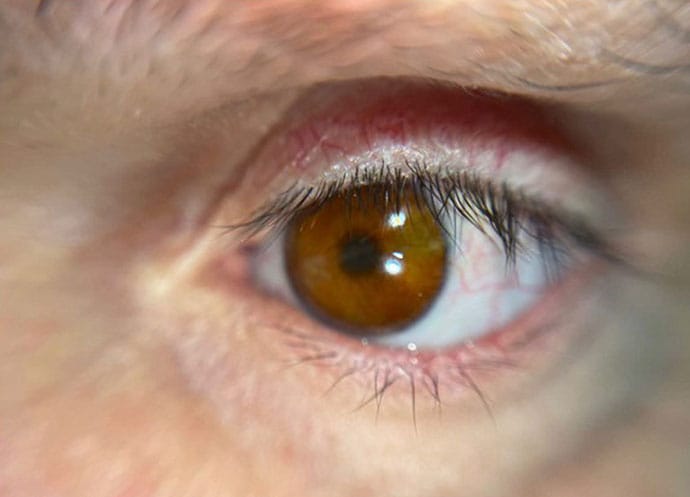
A real iris is “like a very shallow volcano,” he said. “It’s got sides coming up to a hole in the middle, which is the pupil, and the sides of that, they’re all furrows and fell, so there’s lots of peaks and troughs around the iris.” Painting that texture onto a flat surface only approximates the way light moves through a living eye.
The artisanal process is also slow. A handmade prosthesis can take days of skilled labor, and waiting lists at major centers stretch for months. In the US, fewer than 60% of patients who undergo eye removal surgery ultimately obtain a prosthesis, according to a 2025 review, with cost cited as the most common barrier.
A new study from Carpenter and colleagues at Moorfields now suggests fully 3D-printed prostheses produced through a digital workflow performed comparably to traditional handmade prostheses across motility, cosmesis, and patient-reported outcomes. Researchers say the advance supports broader adoption of digital manufacturing in a field that has changed little in more than a century.
The phase 1/2 randomized crossover trial enrolled 28 participants between January 2022 and July 2023, each of whom wore a digital and a handmade prosthesis for 4 months in randomized order. The digital workflow scans the empty socket and the patient’s other eye, uses software to design the prosthesis automatically, and prints it on a color 3D printer.
Like a natural eye, a prosthesis needs to move, and motility was the trial’s primary outcome measure. Patients with handmade prostheses typically get a few millimeters of movement in each direction with an orbital implant, enough that the artificial eye tracks roughly with the real one when they look around. On that measure, the two prostheses came out essentially tied. Cosmetic ratings from both patients and ocularists were also about even.
On a patient questionnaire, the digital version scored better in one area: Patients said its color looked more natural. Because the digital workflow scans the topography of the patient’s own iris and reproduces it 3D in the print, “the way then that the light goes in and reflects back out mimics the natural eye much better,” said Carpenter, whose group presented their findings at the recent Association for Research in Vision and Ophthalmology (ARVO) 2026 Annual Meeting.
Side effects were uncommon and mild, with one small difference between groups: The 3D-printed prostheses were somewhat more prone to rotating in the socket than the handmade forms. Greater rotation of the 3D-printed prosthesis suggests the friction fit between prosthesis and orbital implant may be less stable with the algorithmically designed shape than with a wax model an ocularist has iteratively fitted to a specific socket.
An Access Problem the Technology Could Address
“Prior research has shown that an ocular prosthesis, which can allow the patient to have a normal cosmetic appearance despite having had the eye removed for medical reasons, is an important step in rehabilitation and adds to patient’s self-esteem and psychosocial well-being,” said Mark Krakauer, MD, of Lewis Katz School of Medicine at Temple University in Philadelphia.
Krakauer was a co-author of a recent review looking at the use of ocular prostheses over 11 years at two urban academic trauma centers serving underserved populations. The finding: Only 59% of those patients had obtained a device.
Employment status and longer follow-up duration with the eye doctor were significantly associated with obtaining a prosthesis. In telephone interviews with patients who had not obtained one, cost was the most cited barrier. “They are generally covered by insurance, but there may be copays or deductibles,” said Krakauer. People who do not get them either use an eye patch or leave the eye socket uncovered.
Carpenter said the digital workflow is “probably comparable cost-wise” to traditional fabrication. “What it does is it cuts down on the amount of time needed for each prosthetic, which means you can then see more patients in that timeframe,” he said. The fitting appointment is shorter because impressions and hand-painting are not necessary, and the finished prostheses arrive ready to fit, eliminating time ocularists normally spend building each one by hand.
The labor-intensive nature of the traditional process of making ocular prostheses creates real bottlenecks, Carpenter said. At Moorfields, “We were a team of seven ocularists there that are working 5 days a week, and we have a waiting list of patients waiting to come and see us. We just can’t keep up with the demand.”
The digital workflow does not eliminate the ocularist but reorganizes their role. Rather than taking an alginate impression and hand-painting an iris, the ocularist fits a generic conformer shape with a window into the socket and scans through it with an AS-OCT imager. An algorithm predicts the optimal prosthesis shape, and a photograph of the patient’s fellow iris is mapped onto that shape before printing.
The 3D process removes the painting step, Carpenter noted, although many ocularists already buy prepainted irises rather than painting their own.
The digital workflow does not yet accommodate all patients. Those with unusually shaped sockets, nystagmus that prevents holding still at the digital scanner, or eyes that require a cosmetic shell over a damaged native globe are not currently candidates. Minors cannot yet be fitted through the digital process because the scanner does not generally fit in their eye socket, although Carpenter said expanding the workflow to children is an area of active development.
Reception among ocularists has been mixed, said Carpenter, who is working to commercialize the prosthesis in the UK, Europe, and the US. Some are enthusiastic; others view the technology as a threat. But, he noted, “it’s a tool to aid an ocularist, and I’m an ocularist; that’s what I’ve done for 30 years, and I’m not going to be promoting a product that undermines an ocularist.”
Christina Szalinski is a freelance science writer with a PhD in cell biology based in upstate New York.