

 Admin_Adham
Emergencies happen anywhere, anytime, and sometimes medical professionals find themselves in situations where they are the only ones who can help. Is There a Doctor in the House? is a Medscape Medical News series telling these stories.

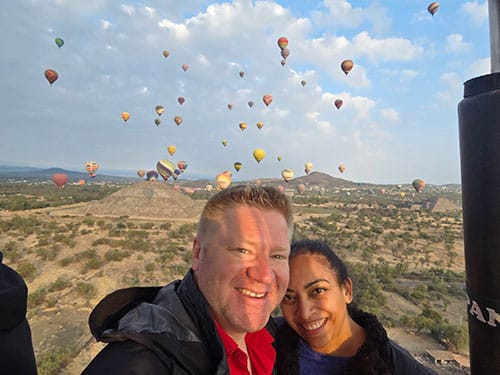
Jyothi Lagisetty, MD: We were vacationing in Mexico City and began the day with an early-morning hot air balloon ride over Teotihuacan, which is this amazing complex of temples and ruins. We saw the temples from above at sunrise, and it was absolutely gorgeous. After landing, we had the opportunity to explore the complex. The Pyramid of the Moon was the last part of our excursion, which involved a steep climb up very tall stone steps. My knee was hurting that day from a recent injury, so I decided to stay at the bottom, while my husband Andy climbed to the top. He had been up there maybe 10 minutes and had just started to come back down when we heard gunshots.
Captain Andrew Roseborrough, Houston Fire Department: I enjoyed the view at the top for a few minutes. In the middle of the stairs to the mezzanine, there’s a cable to assist people climbing up and down. There was a long line of people waiting to use it, and I’m kind of a tall guy, so I figured I could get down the big stone steps by myself. Just after I had started down, I heard gunshots behind me, followed by screaming.
Lagisetty: From below, I could see it was a lone shooter. It didn’t seem like this was part of something bigger, so I sta yed and waited for Andy at the bottom of the stairs. He rushed down with a huge crowd of people behind him running and screaming. The man with the gun took a few shots at the people fleeing but thankfully missed them. There were quite a few people still stuck at the top, blocked from the stairs by the shooter.
Roseborrough: She was so brave, waiting for me at the bottom of the steps. I had a little bit of a head start on most of the crowd, but they caught up quickly. I kept hearing gunshots, and the sound of ricochets off the stone ruins. We ran for cover as soon as I caught up to Jyothi.
Lagisetty: We got down behind a stone wall and waited. It felt like hours, but the National Guard came probably within 10 or 15 minutes. They were obviously trying to figure out the situation because the shooter had high ground.
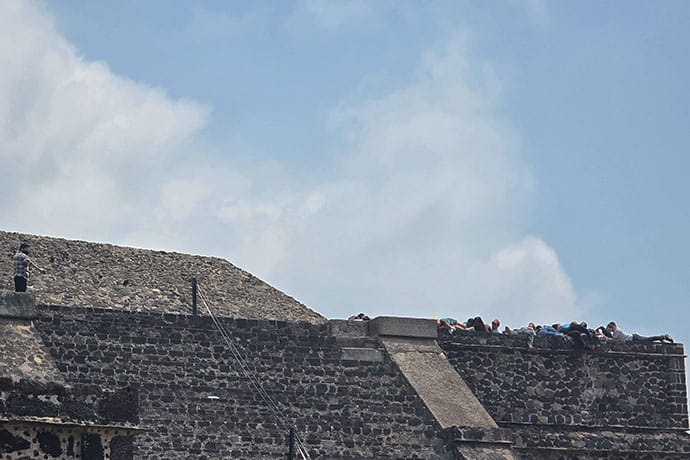
There were 50 or 60 people still on top of the pyramid with the gunman. We could see them lying on the ground and hanging over the edges. We had no clue if any of them were hurt or worse. So we were watching from below just terrified for them, hoping it would end soon.
Roseborrough: At that point, the gunman was firing over the top of the hostages and yelling. We heard later from one of the people up there that he had some sort of agenda. He was ranting about the temple being sacred and how tourists shouldn’t be there taking pictures.
The National Guard started ascending the pyramid as soon as they were organized. I think they had a sniper because suddenly we saw the gunman get shot and fall. He immediately got up and ran toward the back side of the pyramid. That’s where he ended up killing himself.
As soon as it was apparent that he was gone, all the hostages jumped up from where they were lying and started running down the steps.
Lagisetty: We found out later that those people just immediately dropped and played dead. And then once they could get to the stairs, they carried all the injured people down. They were amazing. One person was deceased at the top, and I think five more were shot.
We had just started jogging toward the escaping hostages when we heard a man yell, “Doctor! Doctor!” He led us to a father who was carrying a child and screaming for help. The boy was 6 or 7 years old. He had multiple bullet wounds in one leg and was in a lot of pain, screaming and obviously scared.
Roseborrough: We both speak a little Spanish, but luckily, the father spoke English. As soon as he heard that Jyothi was a doctor and that she works with children, he immediately marshaled everybody around us, saying, “She’s in charge. Do whatever she says.” He seemed so relieved that somebody was tending to his son.
We were able to work together to quickly do a head-to-toe. We didn’t see anything more life-threatening, just the shots to the leg. We had a brief discussion about whether we should tourniquet or not. In Houston, our strategy is to tourniquet basically all extremity wounds because there are multiple trauma centers across the city. But Jyothi pointed out that we didn’t know how long it would take to get the boy to a trauma center, and because it didn’t look like the bleeding was arterial, we decided to skip the tourniquet.
So we fashioned some pressure dressings. People brought us cloth and some gauze and water, so we did the best we could.
Lagisetty: Everyone pitched in. People were ripping off their clothes and tearing them into strips. The winner was a lady who said, “I have maxi pads.”
Perfect. I said, “I’ll take those!”
Shortly after that, people brought us a woman who we believe was the boy’s mother. She had a gunshot wound to her knee and one in her hip, and we found a palpable bullet right under the surface of her abdomen with bruising around it. The victim was impressively calm. We were very concerned about internal bleeding but knew that we couldn’t do much more than apply pressure to the wounds and try to keep her and her son calm, let them know that we were there to help, and that more help was on the way.
Roseborrough: I rem ember a woman ran up to us and identified herself as a doctor, but after seeing that we had these two patients covered, she ran off to help other shooting victims; we weren’t the only ones trying to help in that carnage. I’m not sure if any of our interventions really changed their outcomes, but I know we made that terrible moment just a little better for that family. We did what we could until the paramedics arrived and took over.
Lagisetty: We didn’t have a moment to think. We were thrown into the situation and did exactly what our training has taught us to do. It was only afterward that it hit us how crazy the whole thing had been. We had blood all over our hands, so we stopped at a bathroom on the way out. We were washing the blood off and looked at each other like, “Wow. That just happened.”
Roseborrough: That moment standing next to each other, washing blood off our hands was surreal. The danger was over; there was nothing else we could do to help. We just stood there for a moment hugging each other, thinking, “Holy cow. What was that?”
Lagisetty: We made it to our tour bus, and two people there, also incidentally from Houston, had been up on the pyramid with the shooter as hostages. One girl told us that the gunman had been rambling and trying to show them videos on an iPad. “He talked about some girl named Columbine,” she said.
“Columbine? The Columbine high school shooting?” I asked. She was so young, she didn’t know what that was. Apparently, the killer had a fascination with the Columbine shooters. We looked it up later and realized it was the 27th anniversary.
Roseborrough: The scary part really came afterward, thinking about how differently things might have gone. There’s a video from that day — someone with a selfie stick in line to use the cable accidentally recorded the shooter. You can see the guy in the background putting down his backpack, taking out the gun, and then I walk right through the frame on my way to the stairs. It was a matter of seconds between me being right there and when he started firing. What would have happened if Jyothi had decided to tough it out and climb the pyramid? Or if I decided to stay a minute longer taking pictures?
Lagisetty: As a firefighter, he’s out in the field all the time, but this was a first for me. It’s humbling because you realize how much you have at your disposal in the hospital. And then when you’re on the dusty ground by an old rock wall, what do you do?
Roseborrough: Jyothi was extremely composed. I am so impressed and proud of her. Whenever we have rookies at the firehouse, I tell them that going into the first two or three burning buildings, you won’t be able to think. That’s why we train so much; you will be so full of adrenaline, you’re going to have tunnel vision. But if you rely on your training, you’ll be okay.
I remember when I was finally able to have an active mind within a fire situation, how much more control you have when you can analyze and respond to what’s in front of you, and I think it translated here. When we were presented with this child screaming and bleeding, we were both able to not only rely on our training but also maintain active thought processes and communicate with each other and with the people around us so we could help.
Lagisetty: We didn’t find out what happened to the boy and his mother, although news reports over the next few days said that said the victims who had been sent to the hospital were all stable, so we hope they had good outcomes.
Everyone around us kept apologizing on behalf of Mexico. Our tour guides kept saying, “This is not us. This is not what we stand for.” They were afraid this crazy event would taint our view of Mexico and all the people who live there.
Roseborrough: I think we need to go back to Teotihuacan so we can overwrite that memory. Everything else about that place was so beautiful and awesome; there’s so much history and culture there. It’s not fair to associate that amazing site with one moment of violence.
Jyothi Lagisetty, MD, is an emergency medicine physician at Memorial Hermann Southwest Hospital in Houston.
Captain Andrew Roseborrough is a firefighter and paramedic with the Houston Fire Department in Houston.
Are you a medical professional with a dramatic story outside the clinic? Medscape Medical News would love to consider your story for Is There a Doctor in the House? Please email your contact information and a short summary to access@webmd.net.
Read more in the series:
Nightmare In-Flight Crisis Forces Desperate Treatment Choice


