

 Admin_Adham
EMILY.AI has developed the first AI-based medical device that uses data and predictive capabilities to adjust oxygen flow to each patient’s needs, enabling real-time control and customized oxygen therapy, according to a press release from the Jiménez Díaz Foundation University Hospital in Madrid, Spain. The technology was developed using real-world observations from the hospital’s intermediate respiratory care unit.
The Significance of the Advancement
Oxygen therapy is one of the most widely used treatments in modern medicine. From patients with acute respiratory failure to those with chronic conditions or individuals admitted to ICUs, supplemental oxygen administration is essential for maintaining homeostasis and preventing cell damage associated with hypoxia.
Although oxygen therapy is widely used and essential, many of the systems currently in use still rely on manual adjustments made by healthcare staff. These devices are based on models described over a century ago and pose risks to patients while placing a heavy burden on healthcare staff.
Paradigm Shift
From a physiologic standpoint, oxygen therapy aims to maintain adequate levels of blood oxygen saturation within specific therapeutic ranges for each patient. To achieve this, biomedical sensors such as the pulse oximeter are used, capable of estimating hemoglobin saturation through optical principles based on the differential absorption of red and infrared light.
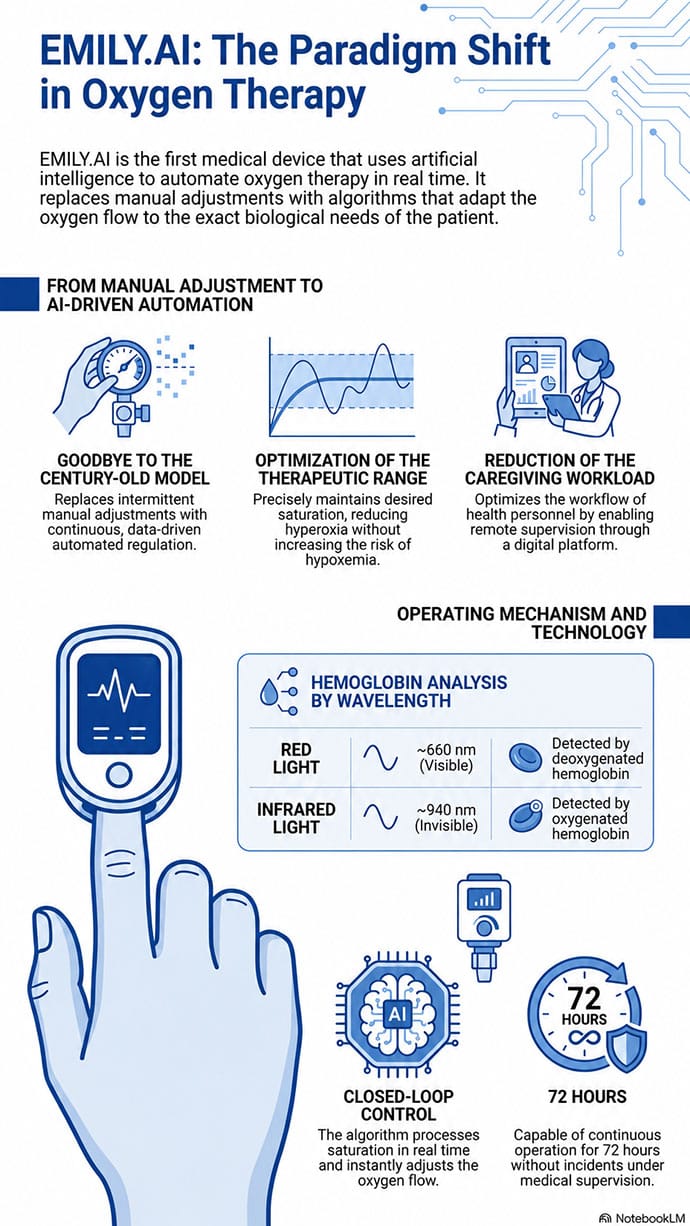
In conventional oxygen therapy, healthcare staff monitor these levels using the pulse oximeter and act accordingly. However, with EMILY.AI, algorithms process the information in real time, and the device automatically adjusts the oxygen supply to maintain optimal, personalized levels.
The Key Lies in the Wavelength
The key difference between red and infrared light is wavelength. Red light is around 660 nm and falls within the visible spectrum, while infrared light is around 940 nm and cannot be seen by the human eye.
Observing red light is very simple; just turn on a red laser. If we want to see infrared light, it is possible, but we need to use an intermediary device capable of detecting it and converting it into visible light that can be seen by the human eye. Finding this type of technology isn’t that difficult because it’s probably right in your pocket. It’s your phone’s camera.
To see it, simply pick up a device that uses infrared technology, such as a TV remote control, and observe this phenomenon by pressing a button. You’ll notice that nothing is visible to the naked eye, but if you use your phone’s camera and focus on the part of the remote that sends the signal to the TV, you’ll see a light turn on when you press a button on the remote.
How Does a Pulse Oximeter Work?
The difference in wavelength is crucial in these sensors because oxygenated hemoglobin absorbs infrared light better, while deoxygenated hemoglobin absorbs red light more readily. A pulse oximeter has light-emitting diodes that emit the light; this light reaches the blood and then returns to the pulse oximeter, where it is received by a photodiode. Finally, the device analyzes the difference between the emitted and received light to indicate blood oxygen saturation.
This same principle is also used by other everyday devices, such as smartwatches, fitness trackers, and sleep monitors. If we look closely at them — specifically at the part that touches the skin — in the dark, we might notice they have a red light (visible to the eye) and an infrared light (invisible). Some of these devices also have a green light, but this is intended for heart rate monitoring, not for measuring oxygen saturation.
Challenges
EMILY.AI more accurately maintains the patient’s oxygen saturation within the desired therapeutic range and significantly reduces episodes of hyperoxia without increasing the risk for hypoxemia. Additionally, it reduces the need for frequent adjustments by healthcare staff, thereby reducing the care burden and allowing treatment to be monitored remotely via a digital platform.
Currently, the device does not replace healthcare staff because it does not operate completely autonomously, although it does function continuously for at least 72 hours without incidents. This broadens the scope of use, from episodic sessions lasting a few hours to continuous supervised oxygen therapy. Furthermore, the device is in the process of implementing International Organization for Standardization standards to obtain CE marking and could be ready for commercialization in approximately 2 years.
Despite these limitations, we are undoubtedly looking at a device that could redefine the standard of oxygen therapy worldwide. As Sarah Heili-Frades, MD, PhD, stated, “Today, EMILY.AI responds to what’s going on; tomorrow it will anticipate what is going to happen.”
The authors of the article declared having no conflicts of interest.
This story was translated from Univadis Spanish, part of the Medscape Professional Network.


