Admin_Adham
Tina Merritt, MD, is an allergist and immunologist at Allergy & Asthma Clinic of Northwest Arkansas in Bentonville, and one of the pioneers in the study of alpha-gal syndrome.
Medscape spoke with her about the initial discovery of the tick-triggered allergy, the evolving understanding of its biological mechanism, and how to manage patients with the condition.
Walk us through the early history of the discovery of this condition. When and how did researchers begin to realize that ticks might be playing an important role in the syndrome?

When I was in fellowship at the University of Virginia, people were having systemic reactions to the cancer drug, cetuximab. The oncologist who was part of the study lived next door to Dr. [Thomas] Platts Mills [credited with the discovery of the alpha-gal allergy]. He asked Dr. Platts-Mills to figure out why people were having reactions to this medicine. We developed a test that looked at IGE reactivity to this cetuximab and four of the samples came back positive. I called the company and left messages and said, “Hey, send me the rest of your samples.” Well, it was around that time that they didn’t get their FDA approval so I went on to my next job, in Arkansas.
And then when I was in Arkansas, the medication did get approved and a patient in Bentonville died from their first infusion. I called Dr. Platts-Mills and I said, “Somebody died from this cancer drug. We need to get this test going again.” I got the human investigation approval and we developed the test. He figured out it was related to tick bites because he was looking at the distribution of people that had this allergy, and it corresponded with the lone star tick, Rocky Mountain spotted fever, and rickettsia. The same pattern.
You and he share a personal connection to this discovery, too, right?
Dr. Platts-Mills also had an allergy to alpha-gal. He had been bitten by a bunch of seed ticks and his alpha-gal test went up and he developed delayed urticaria. And I also had a beef and pork allergy from childhood. And he called me and said, “Don’t you have a beef and pork allergy?” I said, “Yes, I couldn’t eat it at your house!” And then he said, “Well, it’s from tick bites.” At first I didn’t believe him.
You’ve been tracking this condition for roughly 20 years. How has your understanding about the clinical presentation of this allergy changed?
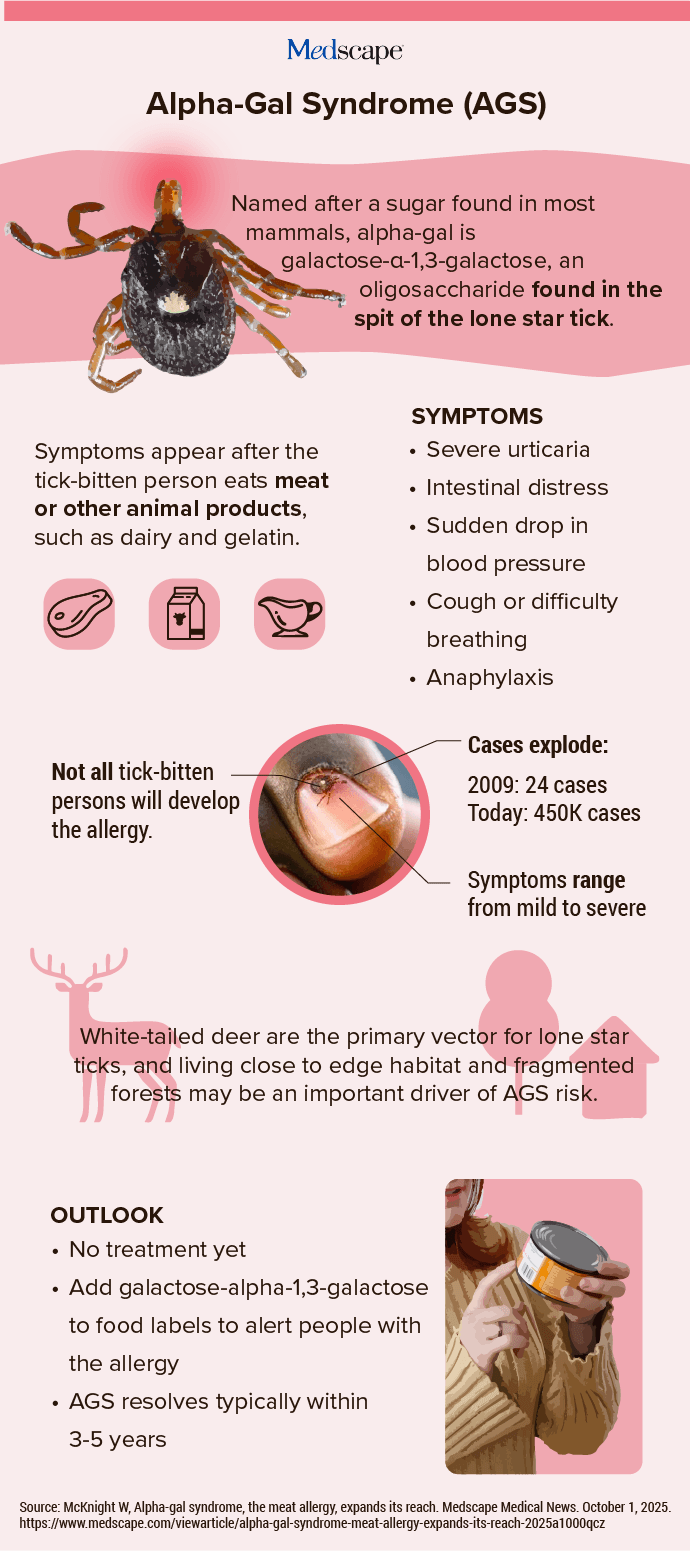
It’s not very clear-cut. It causes hives, it causes stomach problems, and some people have different symptoms over time. And then the usual thing about alpha-gal is the reaction is delayed. But some people may report having symptoms 4 hours after eating, and those symptoms can range from mild stomach aches to full blown anaphylaxis. We’ve also found that people who have low positive tests can have severe reactions — and the reverse is true. I’ve had some people with high positive tests who have no symptoms and keep eating it. It’s a very unusual food allergy.
We used to think of food allergies as being related to protein. And this one’s a carbohydrate. And then the fact that it’s delayed, that makes it very difficult to diagnose at first. People may have a delay in their diagnosis because they may not associate the hamburger they had at 6:00 clock with the hives they developed at 12 at night.
What have you learned about other allergies and how to manage and diagnose them through the last decade and a half or so of your work in this particular area?
Milk allergy is something that’s reported sometimes with people that have alpha-gal allergy. So I think it’s very important to pay attention to symptoms. It may not be full-blown anaphylaxis, but if it’s angioedema or abdominal pain, diarrhea and vomiting, those types of things need to be recognized as possible signs of alpha-gal allergy, as well.
You’ve had this allergy for many years. But some evidence says, at least in some people it can be transient. Is that something you have observed in your practice?
Some people may go into remission, but remission means that if you get bitten again, it’s going to come back possibly. So I tell people they might go into remission if they don’t get bitten again, if this is their first time having this allergy. In my case, I’ve had it off and on since the third grade and so I’m probably not going into remission. My immune system has a good memory and it’s going to keep recognizing alpha-gal.
A lot of people have been bitten by ticks. Not everybody gets alpha-gal syndrome. Why some and not others?
We think it has something to do with the immune response, and that also includes genetics and blood type. There were a couple of studies that suggest type B blood is protective because it’s a similar structure to alpha-gal. And we know of other conditions that make it worse, such as an autoimmune disease or a vitamin D deficiency.
It seems the public is much more aware of the foods they eat that can trigger allergic reactions associated with alpha-gal than some of the medical and health-related products that are linked to the allergy, such as carrageenan. Are physicians becoming more aware of these compounds and products, and what advice do you have for them for how they can talk to their patients about cross-reactivity?
There needs to be much more awareness. I think some physicians may not think medication ingredients can trigger alpha-gal reactions. For example, they may not think of a vaccine [Flucelvax] that’s produced in a dog kidney cell line as being a concern for alpha-gal allergy. The FDA doesn’t require labeling for mammal ingredients, so we may not know if this flu vaccine is safe and this one isn’t. Or we may not know that this capsule is vegetable based and this one isn’t.
Right now we don’t have a good way of knowing about these risks, other than different providers such as Pill Clarity, where you can go to check if a particular form of medication is safe.
But it’s important to look at the ingredients in medicines. I know with myself I was dizzy for six months before I realized that a tablet could have pre-gelatinized starch. And when I cut that out, my dizziness went away. I’ve had patients with full-blown anaphylaxis to just one capsule. And I had a patient that had to be intubated because she took a medicine that was over-the-counter that had a gelatin capsule.
Any progress on treatments?
Well, there’s going to be a monoclonal antibody that’s going to bind up IgE specific for certain foods. But if your mechanism isn’t just IgE-mediated — but also IgG-mediated — then that may not be the best treatment. But that’s probably several years down the line.
Tina Merritt, MD, is co-holder of a patent for the test to identify IgE reactivity to alpha-gal.