

 Admin_Adham
 Jump to Key Points
New research has revealed characteristics that make bacteriophages (which are viruses that infect and kill bacteria) more efficient predators.
In general, a bacteriophage, or phage, targets just one bacterial strain, but some phages can attack several strains.
In the new study, researchers discovered that broader-spectrum phages shared a similar characteristic: particular forms of structural diversity in the fibers on their tails. The discovery could enable the creation of bacteriophage therapies that work against broader ranges of bacteria.
The study was published online on September 22 in Proceedings of the National Academy of Sciences.
- Broader-spectrum phages linked to structural diversity in tail fibers.
- P aeruginosa pili variants concentrated at phage-binding region.
- Some phages tolerate minor pili changes; others lose infectivity.
- Tail-fiber shape may predict phage host range and activity.
- Phage matching could speed therapy for drug-resistant infections.
Broadening Clinical Utility
“This work is related to the problem of antibiotic resistance,” senior author Lori L. Burrows, PhD, professor emeritus of biochemistry and biomedical sciences at McMaster University in Hamilton, Ontario, told Medscape News Canada.
“We are starting to encounter bacterial pathogens that are not killed by any of our current antibiotics, and one of the ways we can treat those essentially untreatable infections is by using phages, which are natural predators of bacteria. They use their tails to attach to the bacteria they infect,” Burrows said.
Phages were identified over 100 years ago and used before antibiotics were discovered. Scientists have been studying them for decades as a possible solution to antibiotic-resistant infections, she added.
The problem is that phages are selective. A phage that can eradicate one bacterial strain may not be able to kill another, even if the bacteria are closely related. A phage that works for one patient may not be useful for another patient, Burrows explained.
“Antibiotics are much more general, in terms of what they can kill, so they kill lots of different kinds of bacteria. Phages are more lock-and-key-style predators, so they need to identify the right host for them to replicate in. Understanding what makes some phages able to target a wider range of bacteria could help us focus on the types of phages that may have broader clinical utility,” she said.
Burrows described a phage that was used to treat a woman with a highly resistant urinary tract infection. “She had been on very strong antibiotics for multiple years. She couldn’t take other antibiotics because of the side effects. Eventually, she lost one of her kidneys because this infection would not go away.”
Health Canada decided that the woman was debilitated enough to warrant experimental treatment. “We worked with a clinician at St. Joseph’s Health Centre in Toronto to find predators for her particular Escherichia coli strain that was causing her urinary tract infection,” said Burrows, “and then treated her with those and successfully got rid of the infection after years of trying.”
Tail Fiber Variations
In the current study, the researchers explored how phages interact with Pseudomonas aeruginosa, a common cause of hospital-acquired infections.
“P aeruginosa is becoming resistant to almost every antibiotic that we have. It makes long, hairy fibers called pili and shoots these out so that they attach to whatever they want to hang on to, like catheters, contact lenses, etc. The phages have evolved to exploit this, so when these bacteria shoot out their fibers, the phages stick to them. When the bacteria retract the fibers, the phages get a free ride down to the surface of the bacteria, and then they can infect and kill the bacteria,” Burrows explained.
These pili are made of molecular fragments that stack up in a way that looks like lollipops, she explained. “These lollipops vary in flavor across the Pseudomonas strains. We realized that some phages are picky and only like cherry lollipops, whereas other phages don’t seem to care about the flavor and can infect lots of different flavors.”
After analyzing genetic data from more than 1300 unique P aeruginosa strains, the researchers found 53 distinct pili variants. “These variations were concentrated almost entirely on the part of the pili that phages interact with, which suggests that the bacteria have, over time, evolved different pili flavors to avoid their local phage populations,” Burrows said.
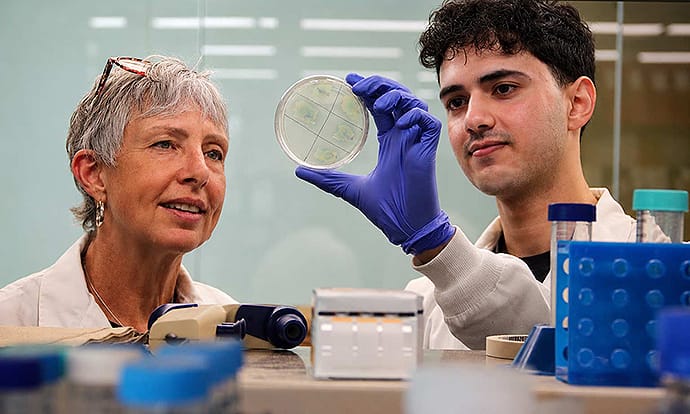
When her team tested a panel of phages against these different strains of P aeruginosa, they observed two distinct behaviors. Some phages were highly sensitive to even minor changes in pili, losing the ability to infect the bacteria. Other phages could tolerate large differences in pili and retain their ability to infect.
To understand why some phages could tolerate variation in the bacterial structures they attach to while others were much more sensitive, the team compared AI-generated models of the tail fibers that the phages use to latch on to bacteria. They found a consistent difference between narrow-acting and broader-spectrum phages.
The phages that were highly selective about which strains they could infect had tail fibers that were similar, whereas the broader-acting phages had tail fibers that varied more at the point of contact with the pili, despite having an otherwise similar overall structure. “This suggests that the physical shape of a phage’s tail fibers may be a useful predictor of its activity,” said Burrows.
“What I hope comes from this research is ultimately a faster and more informed approach to phage therapy,” first author Ikram Qaderi, a PhD candidate at McMaster University, told Medscape News Canada. “If we can understand what determines which bacteria a phage can recognize, we may eventually be able to predict which phages are most likely to work against a particular infection and reduce the time it takes to identify an effective treatment.
“I also hope it gives us a better way to develop phages with broader activity,” Qaderi continued. “Understanding why some phages can recognize a wider range of bacterial strains could help guide the development of new phages rather than leaving us to rely entirely on finding them by chance.”
Qaderi added that he would like to see phage therapy become more accessible and successful in Canada, particularly for patients with drug-resistant infections who have few other options. “Improving our ability to match phages to bacterial infections is an important step toward getting there.”
Alternatives to Antibiotics
Commenting on the research for Medscape News Canada, Isaac Bogoch, MD, an infectious diseases specialist at the Toronto General Hospital, University of Toronto, said that broader-acting phages can make treatment faster and more accessible for drug-resistant pathogens, and this finding might make it easier to find broader-acting phages. Bogoch did not participate in the research.

“We know how difficult it is to find a specific bacteriophage, and when we do find those phages, there are issues with specificity; they only target a single pathogen. This study shows that it might be easier and faster to identify phages that have slightly broader targets, which might be helpful in combating several different infections,” Bogoch said.
“We know we’re in an era of significant emerging drug-resistant organisms, and it’s just getting harder and harder to treat antibiotic-resistant infections. This is a growing problem all over the world that is sadly killing millions of people per year. We need alternatives to conventional antibiotics. Phage therapy is a very old but impressive and reliable way to treat some drug-resistant infections,” he said.
The study was funded by Canadian Institutes of Health Research Project grants. Burrows, Qaderi, and Bogoch reported no relevant financial relationships.



