Admin_Adham
A 44-year-old woman in Copenhagen was caught in a revolving pattern of crisis. When she drank heavily, she self-harmed — sometimes cutting herself with knives in her apartment and calling 112 for help. Police would respond; she would be admitted to a psychiatric ward, stabilized, and discharged.
Then it would happen again.
The pattern was familiar to emergency services: acute episode, hospital admission, release, and repeat. What was missing was not just continuity but also an effort to address the underlying cause of the crisis.
That changed when the Sociolance became involved.
“We asked why she was drinking and if she’d like a contact person she can call, talk with, and make a plan,” said René Pedersen, social worker and functional manager for the Emergency Medical Services (EMS) Copenhagen, Capital Region of Denmark.
Pedersen and his paramedic partner, Søren Lund, eventually helped her enter 24-hour rehabilitation, where she received a dual diagnosis of alcoholism and psychiatric illness. They continued to follow her after discharge.
“Today, it’s been 4 years, and she’s stopped drinking and has returned to her prior place of employment,” Pedersen said.
The intervention was not a hospital admission or a police action. It was a visit from a mobile, nonemergency clinic known as the Sociolance — a “social ambulance” that is redefining what it means to meet people where they are.
Manned by a paramedic and a municipality social worker, the Sociolance acts as an adjunct unit when a situation requires social assistance as much as, or more than, medical services. It was designed to bridge a long-standing gap: people with overlapping social, physical, and mental health challenges — often homeless or socially vulnerable — who repeatedly interact with emergency systems but struggle to find sustained support. In doing so, the unit not only serves vulnerable residents but also helps free up traditional emergency medical resources.
Lund, a 30-year EMS paramedic veteran and functional manager for the EMS Copenhagen, Capital Region of Denmark, said a typical service call might involve someone on the street experiencing substance withdrawal. In the past, the only option was to take that person to a hospital, where they would be stabilized and then released — often back to the same circumstances.
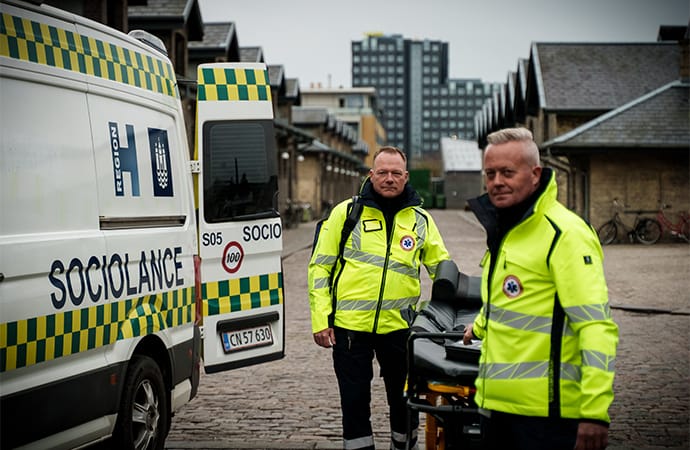
“Sociolance combines social and healthcare professionals so we can do both evaluations at the same time and find the right solutions, for example, a need to contact the municipality who would then take over,” he said. “Before, I would drive out in the ambulance to try to help these people, but I didn’t have any solutions for them; their problems were a social problem.”
A Pilot Project
The Sociolance first launched as a pilot in December 2015 as a collaboration between the Capital Region of Denmark’s Emergency Response Team, the Social Services Department of the Municipality of Copenhagen, and the Copenhagen Fire Brigade. Service requests ran through the Emergency Medical Dispatch Center. The pilot ran through August 2017 and was subsequently extended based on its positive reception.
During this period, the Sociolance was involved in more than 2000 calls, mainly assisting people on the street affected by alcohol or drugs. At least one third of those offered social or healthcare services — related to substance abuse, mental illness, or somatic disease, often in combination — accepted them. Approximately 1 in 5 received housing services.
Training developed organically.

“They learned from each other during the pilot project, but the social worker did get some training around the ambulance and how to help the paramedic in dealing with, for example, the onset of cardiac arrest or some other acute somatic illness,” Thomas Reimann, MBA, director and chief executive officer for the EMS Copenhagen, Capital Region of Denmark, told Medscape News Europe. “Otherwise, the paramedic is responsible for the communication with the dispatch center, and the social worker for the connection into municipality resources like shelters and so on.”
The orchestration is tight, involving the primary emergency dispatcher, the ambulance, and the Sociolance.
“Normally, they start with the social worker going into the system to see if there have been any reports or concerns or if some socially vulnerable person needs follow-up. If an emergency call comes in over 112, the nurse or paramedic entering the call can decide if it’s more a Sociolance or ambulance assignment,” said Reimann.
Ambulances also have a direct number for the Sociolance.
“If they are with someone in the Copenhagen municipality and decide that they shouldn’t transport that person to the hospital — that’s not the right care — they can get guidance, and if they agree, the ambulance might transport that person to a shelter or whatever fits instead,” he said.
The police can also file reports if they are concerned about a citizen who may need follow-up.
A Day in the Sociolance
The Sociolance operates daily in the Copenhagen municipality from 11 AM to 11 PM. An additional vehicle was added last summer and now runs 2 days a week in the adjacent Frederiksberg Municipality. Another municipality south of Copenhagen has secured funding to launch its own unit.
One of the keys to the Sociolance’s success is relationship-building after a first encounter.
“We go out a lot of times,” Lund said, noting that trust is often fragile.
“We talk to them so they see we are not the bad guys, then we come again tomorrow and the next day and the next day, and suddenly they choose to go with us and see what we can do for them. When they are stable, we hand over the assignment to the municipality, and they take it from there.”
Pedersen said his most important tool is direct access to municipal systems during every shift.
“When we get called out to a person, I can contact the municipality and see if they have a case in the system so that the person can get help, or if I need to start a case,” he said.
Not all encounters happen on the street. The team also visits people in apartments, sometimes discovering homes without electricity or other essential services — opportunities to reconnect residents with municipal support.
“It’s a good way of catching a person that might be under the radar of the system because he hasn’t been sick or a nuisance,” said Reimann.
The Sociolance Model
For both Lund and Pedersen, the work is personally meaningful.
“Together, we can do so much for vulnerable citizens. We see how big a difference it’s made for these people,” Pedersen said.
Reimann agreed.
“We do a lot of things to ensure the emergency side of the system is not seeing unnecessary pressure and also ensuring that citizens have found the right pathway through the system,” he said.
He has ridden along with the unit himself.
“They meet them over and over again. Sometimes, the community of socially vulnerable people just needs some care, some conversation, and then the unit moves on. And others obviously need a shelter or maybe a long-term solution within the municipality.”
The program has not been without challenges. Coordination between the unit, shelters, authorities, and hospitals requires constant attention. The region has also established a Flex Clinic to address issues common in this population, including co-occurring substance abuse, violence, frustration, and somatic illness. Officials are exploring placing a social worker in the dispatch center to help direct calls more effectively.
Most funding for the Sociolance has come from the Dutch Ministry of Finance, with additional support from the municipality. Expansion, however, remains limited by available resources.
Reimann would like to see more units on the streets, particularly in the summer when Copenhagen sees an influx of visitors and call volumes increase.
“It’s a current discussion with the Copenhagen municipality to see if we can find funding for a second unit or maybe half of a unit for the summertime,” he said — something that might be more straightforward if there were a federal mandate on the number of units required per municipality.
“We’re not finished evolving this,” Reimann said.
Reimann, Lund, and Pedersen are employed by the EMS Copenhagen, Capital Region of Denmark.
Liz Scherer is an independent health and medical journalist who frequently reports on European health news. She has written extensively about health equity and the social determinants of health.