Admin_Adham

This story is part of Blood, Sweat, and Tears, a special Medscape package exploring the future of diagnostics and health monitoring via body fluids. Read about Sweat and Tears and find out how medicine is on the verge of a biomarker data renaissance.
The first big discovery happened as so many do — by accident.
Kenneth Dawson, PhD, director of the Centre for BioNano Interactions at University College Dublin, Dublin, ran a lab that routinely pooled blood for nanoparticle experiments — standard practice in academic labs studying blood-particle interactions. During one meeting, a postgrad put results on a screen. The nanoparticles had captured human chorionic gonadotropin, a pregnancy hormone.
A small sound escaped from the back of the room as one of the lab members recognized the signal as her own. The postgrad had unwittingly given away a colleague’s pregnancy to the group.
It’s not that the pregnancy was otherwise undetectable — a standard over-the-counter test would have found it. But this was one hormone from one person’s blood, diluted across roughly 25 samples. The nanoparticles had pulled it above the instrument’s detection threshold, and that capacity mattered.
That moment opened the diagnostic arm of Dawson’s research, formalized in a landmark 2007 paper first describing the protein corona — the spontaneous layer of proteins that coats any nanoparticle entering body fluid. It also heralded the rise of an exciting line of research exploding the limits of blood’s diagnostic potential.
Besides engineering nanoparticles to uncover rare proteins, scientists are interrogating bloodwork in other ways. Consider a routine blood panel, which returns roughly 30 values. Researchers from Memorial Sloan Kettering and Mount Sinai trained an AI model on those values and found it could predict a cancer patient’s response to immunotherapy — and do so more accurately than either immunohistochemistry (a lab test that looks for proteins in biopsy tissue) or whole-exome sequencing (an expensive DNA test).
They validated the model on a massive scale: across nearly 10,000 patients, 21 cancer types, and 10 global phase 3 trials. An April study confirmed the mechanism: The AI reads signs of systemic inflammation, revealing the patient’s “immune profile” that determines whether their T cells can respond to a checkpoint inhibitor. From there, it connects the dots, linking inflammatory signatures in the blood to how much the immune system is suppressing the tumor.
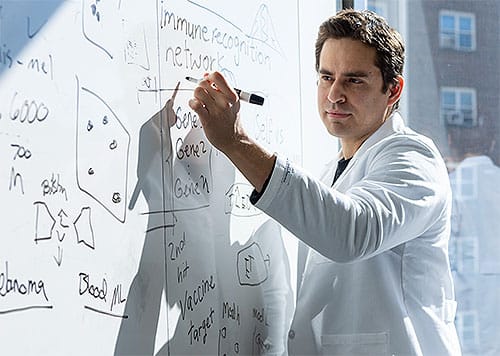
“All this data has been in front of our eyes for many, many years,” said co-creator Diego Chowell, PhD, an assistant professor of AI and human health and of immunology and immunotherapy, at Icahn School of Medicine at Mount Sinai, New York.
Other scientists are developing “negative-selection” platforms to isolate living tumor cells that DNA tests cannot see. Still others have created a multimodal sequencing approach that can pull six layers of cancer data from a single strand of DNA. And last month, neurologists reported an at-home finger-prick test that can detect Alzheimer’s pathology in people with no symptoms and no clinical diagnosis — bypassing the PET scans, lumbar punctures, and specialist referrals that have gatekept Alzheimer’s detection for decades.
Together, these achievements suggest the clinical potential of blood has been profoundly underestimated — until now.
Reaching More Proteins Than Ever Before
Twenty-two proteins account for 99% of all the protein in a human body. Thousands more make up the remaining 1%, and these carry disease-relevant information. “The real story about that disease and the stage of the disease is all buried,” Dawson said. “But if you could pull it together again, the story is revealed.”
Engineered nanoparticles can reveal that story, pulling those rare proteins above the detection threshold. Clinicians already measure some of these “low-abundance” proteins individually — prostate-specific antigen for prostate cancer, cancer antigen 125 for ovarian cancer, alpha-fetoprotein for liver cancer — using immunoassays designed to detect a single known target. But those tests need to know what to look for. Mass spectrometry can measure thousands of proteins simultaneously without prior assumptions, which is what makes it so powerful for discovering new biomarkers. Abundant proteins have long drowned out the rare ones, but now nanoparticles are giving mass spectrometry access for the first time.

Omid Farokhzad, MD, PhD, a former Harvard Medical School professor and current CEO and chairman of the California-based biotech company Seer, took a different path to the same finding. At Harvard, he found that proteins were coating his drug-delivery nanoparticles, masking their targets.
In 2017, his group published the first study of the protein corona in living systems, showing that different nanoparticle surfaces produce biologically distinct coronas. In a test tube, nanoparticles don’t have to be safe — making the number of possible chemistries scientists could use to design them “infinitely large,” Farokhzad said.
His company’s Proteograph platform uses five such nanoparticles and is being deployed in a 10,000-person population cohort in Singapore alongside Olink’s competing antibody-based platform.
“The absolute answer is in the hands of the proteins,” Farokhzad said. “Genes are surrogates. You’ve got to get to the protein” to catch the disease.

One of Farokhzad’s collaborators on that 2017 study was Morteza Mahmoudi, PhD, now at Michigan State University’s precision health program, East Lansing, and founder of biotech startup XProteome. In 2014, Mahmoudi and colleagues showed that corona composition varies from one person to the next, and he has since pursued diagnostic applications.
With XProteome, Mahmoudi has developed small-molecule techniques that block albumin (a common blood protein) from hogging nanoparticle surfaces. The result: His nanoparticles can now detect 6600 proteins — roughly two-thirds of all the proteins in the human body — from a single sample.
Of course, numbers mean nothing if the proteins can’t tell you anything useful. So Mahmoudi’s group set out to profile blood samples to see which proteins stood out. In a March 2025 study analyzing protein coronas from 35 prostate cancer patients, his team identified an enzyme called TBXAS1 as a causal factor linking metastatic cancer and cardiovascular disease.
The enzyme had not appeared in a plasma proteome atlas of more than 53,000 adults and nearly 3000 proteins. Meaning: It was invisible to every conventional method.
Four days later, a study by a Cambridge group appeared in Nature, reporting that aspirin prevents metastasis by suppressing the downstream product of that same enzyme. Mahmoudi hadn’t known about the other research (a surprisingly common phenomenon known as multiple discovery), but here was independent confirmation that he’d found a real target.
The bigger picture: The catalog of actionable targets in blood for cancer, cardiovascular disease, and potentially neurodegeneration is far larger than anyone has mapped.
The Hunt for One Perfect Tumor Cell
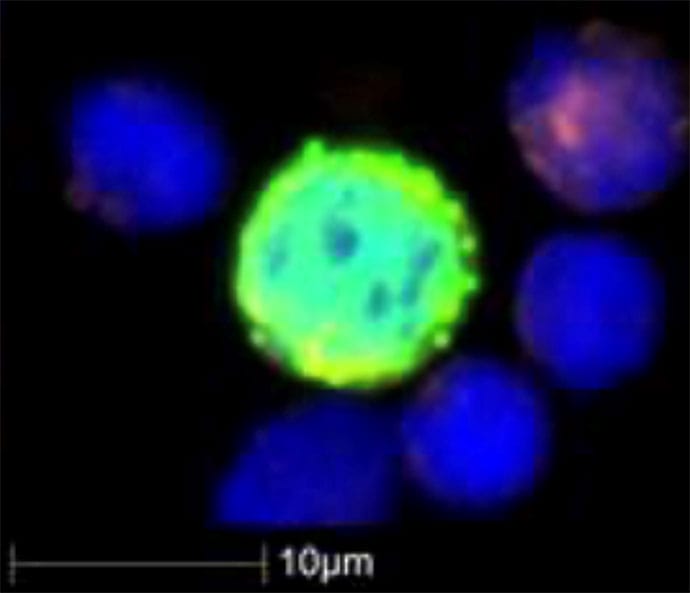
A different resolution gap exists for circulating tumor cells (CTCs), rare cancer cells that detach from a tumor and drift among billions of ordinary blood cells. Unlike cell-free DNA (cfDNA), which is mixed with fragments from dying tissues, a CTC is fully intact. It can reveal whether a drug’s target is present, how the cell is resisting treatment, and how much diversity exists within its population — all information that fragmented DNA can’t provide.

“If you can purify a tumor cell to absolute purity, you have one perfect tumor cell,” said Daniel Haber, MD, PhD, director of the Mass General Hospital Cancer Center, Boston.
His group uses a platform called CTC-iChip, developed with bioengineering pioneer Mehmet Toner, PhD, at Mass General, which works by negative selection. Instead of targeting the cancer, it targets the blood. It uses magnets to pull out normal blood cells and examines what remains (the cancer). By making no assumptions about what the tumor looks like, the tech can catch unusual cancer cells that traditional tests would have missed.
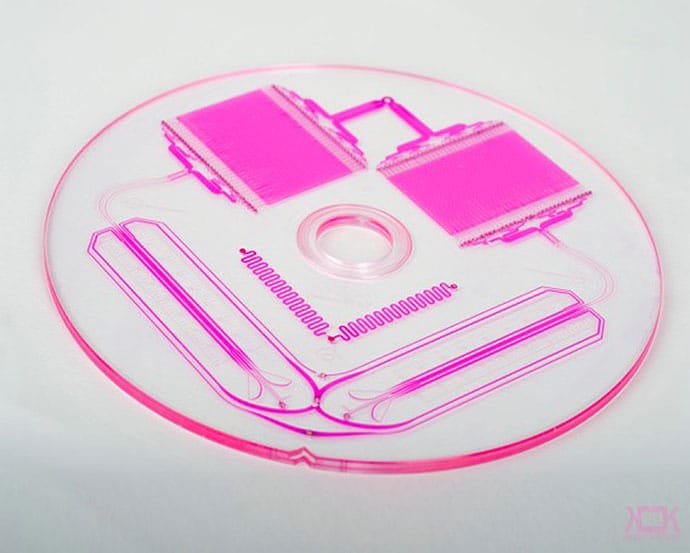
In a May study, his group used the platform to analyze cells from 20 small cell lung cancer patients receiving tarlatamab, a drug targeting a surface protein — delta-like ligand (DLL3) — common in neuroendocrine cancers but rare in normal tissue.
Years of immunohistochemistry studies on tissue biopsies had indicated that virtually all small cell tumors express DLL3. But the new tech showed something different: Roughly half the patients carried DLL3-negative cells, and those patients failed treatment.
“Is the gold standard what the pathologist sees in the tumor?” Haber said. “Or is the gold standard whether the patient responds to the drug?”
He posed the question rhetorically to emphasize that, of course, the patient outcome is what matters. And a tool that captures every CTC when treatment begins may guide outcomes better than a biopsy of a single lesion weeks earlier.
Speaking of cfDNA…
Multi-cancer early detection (MCED) blood tests examine cfDNA methylation patterns, scanning for multiple cancers simultaneously. While GRAIL’s Galleri test is the closest to regulatory approval (recent setbacks notwithstanding), other similar tests are in the wings and could be more powerful.

Anna Schuh, MD, PhD, is a professor of molecular diagnostics at the University of Oxford in Oxford, England, and co-founder of the social enterprise SerenOx. She is developing an MCED, called TriOx, which uses TET-assisted pyridine borane sequencing — a chemistry that preserves DNA while reading its methylation state. Usually, DNA analysis destroys roughly 80% of the DNA, but TriOx can extract multiple layers of cancer biology (methylation patterns, mutations, fragment lengths) from the same scarce material in a single pass. In early-stage cancer, where tumor-derived DNA may account for less than 0.1% of the total circulating fragments, that could mean the difference between catching the signal and losing it.
“When you’re only looking at one modality, you might be capturing 60%-70% of the signal,” Schuh said. “You need to stack them.”
In a study published last year, TriOx detected six cancer types at 94.9% sensitivity and 88.8% specificity. An unpublished extension called ONT-TriOx, which uses long-read nanopore sequencing, can catch 12 cancer types (such as renal, pancreatic, and colorectal) with greater than 99% specificity, according to preliminary data. That’s a high enough threshold to justify population-level screening.
Getting Faster Results
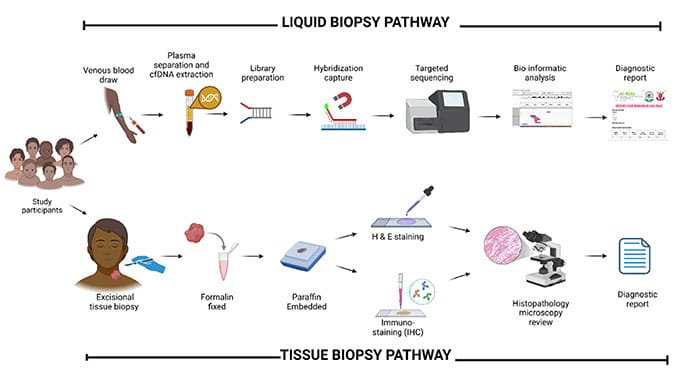
Schuh’s work extends beyond multi-cancer screening. In March, her group published a Nature Medicine study that deployed a separate, targeted cfDNA liquid biopsy (not TriOx) for childhood Burkitt lymphoma across four hospitals in Tanzania and Uganda. The study enrolled 313 children and young adults with clinically suspected lymphoma over 2 years. Eight children died before a tissue sample could be taken, and 20 more gave samples too degraded to assess. Even among samples that reached the lab, nearly a quarter could not achieve a gold-standard diagnosis.
The liquid biopsy used a combination of clinical features and DNA markers in the blood specific to Burkitt lymphoma and correctly identified the disease with 86% sensitivity and 95% specificity. In a head-to-head comparison, the blood test delivered a diagnosis in a median of 6.5 vs 46.8 days for tissue pathology. For 42% of patients, it was the only diagnostic result available when clinicians had to make treatment decisions, because tissue results hadn’t arrived yet.
Blood could shorten diagnostic times for neurology too. A May 2026 study in Nature Communications showed that an at-home finger-prick test can flag early warning signs of cognitive decline. The test measured two critical biomarkers: phosphorylated tau 217, which correlated with declines in episodic memory and executive function; and glial fibrillary acidic protein, a marker linked to working memory. By combining these results with memory scores, researchers were able to identify high-risk participants. While the test is still a few years away from clinical use, experts say it could shorten screening time from months to days.
The field certainly has come a long way since Dawson’s postgrad accidentally revealed a colleague’s pregnancy.
“We are at the very beginning of a massive molecular revolution,” said Farokhzad.
Chowell reported holding a provisional patent for predicting immunotherapy response using routine blood tests and is co-inventor on patents licensed to Personal Genome Diagnostics and Tempus. Farokhzad is CEO and Chairman of Seer, Inc., which commercializes the Proteograph platform discussed in this article. Mahmoudi is founder of XProteome and holds a patent licensed to Seer, with royalties paid by Brigham and Women’s Hospital. Schuh is co-founder and chief medical officer of SerenOx; TriOx is licensed to SerenOx. Dawson and Haber reported no relevant financial relationships.