

 Admin_Adham
At 15, Ava McCarron is an enthusiastic and self-confident high school freshman in Tampa, Florida, who plays goalie and defense on her two soccer teams, loves reading, and babysits her younger siblings.
But she still remembers some hurtful comments from cruel middle school classmates.
“One person called me a cow, and others would call me a half breed,” said McCarron, who was diagnosed with vitiligo at age 10. Not merely a cosmetic problem, vitiligo affects the immune system, in turn affecting the skin and leading to white patches.
About 70 million people globally have the condition that can affect all races and ethnicities, as well as either gender. About 1% of the population, including children and adults, is affected.
While McCarron can call up the cruel comment when asked if she’s ever been teased or bullied, she’s moved on, obviously secure and poised. How? A supportive family and a unique experience known as Camp Victory.
Camp Victory: A Dream Come True
The groundbreaking initiative is the dream — and for the past 3 years, reality — of Los Angeles dermatologist Pearl Grimes, MD, director of the Vitiligo and Pigmentation Institute of Southern California. She is also a founding member of the Global Vitiligo Foundation and a clinical professor of dermatology at the University of California, Los Angeles.

Now, she’s gearing up for the third year of Camp Victory, scheduled for June 28 to July 1 at the Great Wolf Lodge in Concord, North Carolina, for children aged 6 years or older.
Campers are required to have an official vitiligo diagnosis. Each camper is accompanied by one parent; both receive transportation expenses, a three-night stay with meals, excursions to nearby attractions, social and fun activities, and group sessions led by psychologists.
Funding is provided by companies and other sources. Volunteers help out, and therapists get an honorarium.
While there is no cure for vitiligo, effective treatments exist and have improved in recent years. The focus of Camp Victory, however, is on mental and emotional support. The goal, Grimes said, is to bring joy, support, and empowerment into the lives of children with vitiligo and their families.
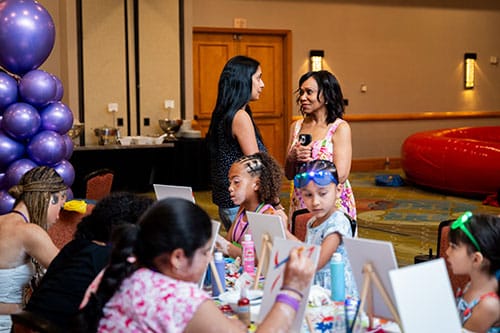
This year, “we have 45 campers and 45 parents,” she said in an interview. About half of the group will be repeats; the rest, first-timers.
She talks excitedly about the plans for this year. The camp will open Sunday evening with a welcoming ceremony and a fireside chat, dinner, music, and a talent show inviting any who wish to perform to do so, Grimes said.
“There’s an enormous need to understand childhood vitiligo,” Grimes told Medscape Medical News. Those with vitiligo and their families need not only information about vitiligo but also suggestions on how to address the challenges of living with the disease that both children and their parents encounter, such as the comments, the stares, the snubbing.

The aim, Grimes said, is to create a space where campers and parents can find “not just understanding, but true victory over vitiligo.”
Most of her campers have never met another person with vitiligo, Grimes said, so that experience is invaluable.
First Timers’ Jitters
Before her first time at Camp Victory, Ava confessed: “I was kind of wary. Meeting new people can be tough, but my mom talked me into it.” Her mother, Carissa, is a special education teacher, warm and supportive. She used to say to middle school Ava: “That person [who name called] is probably hurting and wants to hurt you.”

At her first Camp Victory, Ava met some girls her age. “I met two my age who I really clicked with. My fears went away fast.” It was, she recalled, “a very loving environment, and everyone is so welcoming.”
First Time Hopeful
Maurice Browne of McDonough, Georgia, is the father of Khamora Browne, who has vitiligo, and they are going to Camp Victory for the first time. When he heard about it, he talked to his daughter about it, calling it a way for her to understand “why she is beautifully different.” His daughter agreed.
Khamora’s mother was on board with the idea too, so they applied and were accepted.
Addressing Mental and Emotional Challenges
One therapist who is returning this year is Andre Joachim, MSED, LDC, NCC, who practices in the Chicago area. “I have a little bit more in-depth understanding of what individuals diagnosed with vitiligo may experience,” Joachim said. That’s because he was diagnosed about 33 years ago, at age 19.
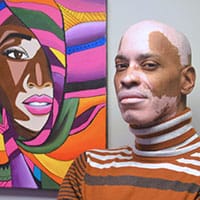
His focus is on mental health as a priority, stressing the importance of connection and community.
He freely shares his experience, telling participants he has been bullied, excluded, and discriminated against. He was rejected for a job in a fast-food restaurant because of it. A friend had recommended him to the manager, but the manager told the friend, who told Joachim, he couldn’t hire him because he feared he would lose customers.
Joachim relayed the experience to one of his professors, who advised him to keep focusing on his education. It paid off. Besides a thriving practice, Joachim has modeled, showing the world in that way, too, that vitiligo does not mean withdrawing.
At camp, Joachim primarily works with parents, and they can have substantial challenges, he has found. “They are so focused on their child’s well-being, they don’t realize how much they are stressing. They have anxiety, depression and worry about the kids.” It can be overwhelming.
He counsels them, gently, to allow their children to figure out some things on their own and trust them to seek parental help when needed. He also suggests ongoing counseling with individual therapists for the child and parent, with family counseling when needed.
Helping Youth
Another veteran, returning for the third session of Camp Victory, is Stacy E. Kratz, PhD, LCSW, CAP, a visiting professor at the School of Social Work at the University of Nevada, Reno.

During her 17 years as a social worker, she has counseled patients with vitiligo about the issues they face. “The most common is social anxiety because children with vitiligo have a tendency to become more self-conscious about their appearance,” Kratz said. There is also “anticipatory anxiety” due to the unpredictable nature of vitiligo and its progression, she said.
The unique part of Camp Victory, she said, is to include parents and children. She calls that feature one of the most unique aspects of the event.
In counseling sessions, Kratz reminds participants that those with vitiligo have an increased risk for mental health symptoms such as anxiety, as do their parents. She focuses on the symptoms and on educating people about the conditions.
For younger people, play therapy can help, she said. For older ones, cognitive-behavioral therapy can be helpful.
Ongoing support is valuable, she said. She suggests turning to the Global Vitiligo Foundation for information, and don’t neglect home life, she said. “A positive and well-informed atmosphere and culture at home helps kids the most,” Kratz said.
Maintaining the Connections
Campers and parents don’t want to give up the connections as the time at camp concludes, so Grimes has developed ways for them to stay in touch.
Besides trading contact information for online emailing, chat rooms, and screen time, there’s a book club for anyone interested.
The Payoff
“The camp becomes a major source of empowerment,” Grimes said, allowing the campers to put vitiligo in its place — a part of them, but just one part. And not their identity.
When the campers meet others with vitiligo, she added, they leave with a new sense of self and self-worth “and are not defined by vitiligo.”
She has many memories of the past two camps, and many of the parting comments stick with her. One camper, about 8, told her as he said goodbye: “I’ve found my tribe.”
Funding for the camp is provided by companies and other sources. Grimes reported doing clinical research and/or serving as consultant for CLINUVEL, BOD CLINUVEL, L’Oréal, Johnson & Johnson, Merck, Versicolor Technologies, Incyte, Pfizer, AbbVie/Allergan, and skinbetter science. Joachim and Kratz reported having no disclosures.


