Admin_Adham
AMSTERDAM — A noninvasive EEG-based test may help predict the risk of sexual dysfunction for patients considering treatment with antidepressants, a new study showed.
The Loudness Dependence of Auditory Evoked Potentials (LDAEP) test indirectly measures central serotonergic activity, which research suggests may be involved with sexual disturbances reported in up to 70% of patients who take selective serotonin reuptake inhibitors (SSRIs).
Researchers found that individuals with major depressive disorder (MDD) who had low pretreatment LDAEP scores were more likely to report sexual side effects after treatment with an SSRI.
“Currently, patients only discover sexual side effects after they’ve already started antidepressant medication,” said senior author Kristian Jensen, MD, PhD, of the Neurobiology Research Unit, Rigshospitalet, Denmark, and associate professor at the University of Copenhagen, in a press release.
“If confirmed, our findings could enable a more precise approach to depression treatment, helping doctors select medications to minimize sexual side effects in those patients most likely to develop SSRI-related problems. This could help treatment adherence and overall quality of life and generally give better treatment options for depression,” he added.
The findings were presented October 14 at the 38th European College of Neuropsychopharmacology Congress (ECNP) 2025.
A Common Problem
As many as 60% of individuals with MDD report sexual disturbance. While SSRIs can improve mood and sexual functioning, they can also contribute to sexual dysfunction by decreasing sexual desire and arousal and making it harder to achieve an orgasm, the researchers noted.
An increase in central serotonin levels caused by SSRIs could be the mechanism behind SSRI-related sexual dysfunction, they added.
The LDAEP test indirectly measures serotonin activity in the brain by analyzing how sounds played at different volumes affect auditory evoked potentials in the primary auditory cortex.
Previous research had suggested that the test may flag individuals at risk for sexual side effects during SSRI treatment.
To investigate further, researchers enrolled 90 unmedicated adults (median age, 27.5 years; 73% female) who had been diagnosed with MDD for a duration of less than 2 years.
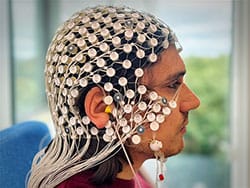
Participants underwent LDAEP testing at baseline, wearing a headset equipped with 256 electrodes. Sound tones are played through earphones at volumes ranging from 60dB (which is as loud as a conversation) to 100dB (as loud as a loud hairdryer). The test takes about 30 minutes, researchers said.
After testing, participants received escitalopram at 5-20 mg for 8 weeks.
Eight patients whose depression did not improve by week 4 (defined as less than 25% reduction in the Hamilton Depression Rating 6-item subscale) were switched to the serotonin-norepinephrine reuptake inhibitor duloxetine.
Sexual function was measured before and after treatment, using the validated Danish version of the Changes in Sexual Functioning Questionnaire (CSFQ), and SSRI-related sexual side effects were assessed at the end of treatment with the Udvalg for Kliniske Undersøgelser standardized clinician-rated evaluation of SSRI side effects.
Measuring Serotonin Activity
After 8 weeks of treatment, 30% of men and 74% of women had sexual dysfunction as assessed by the CSFQ.
Pretreatment LDAEP was associated with SSRI-related orgasmic dysfunction at week 8 (P = .039) and predicted orgasmic dysfunction with 87% accuracy (P = .017), but it was only marginally associated with SSRI-related decreased libido (P = .050).
Participants with lower pretreatment LDAEP were more likely to report sexual side effects after treatment (P = .031).
A lower LDAEP response indicates higher serotonin activity, and “high serotonergic activity is an indication of more susceptibility to sexual dysfunction,” first author Gudrun Dilja Ketilsdottir, a medical student at the University of Copenhagen, Denmark, told Medscape Medical News.
While 70% of women and 58% of men had reported pre-treatment sexual disturbances, LDAEP was not associated with pretreatment sexual function (P = .11).
“Our findings seem only to apply to medication-induced sexual problems, so it’s not a general test for sexual difficulties,” said Jensen.
Researchers noted that a larger sample of male participants is needed to get a more accurate understanding of SSRI-related erectile dysfunction.
Study findings are currently under peer review, researchers said, adding that they hope to replicate their findings in a new 600-patient study.
Although LDAEP is not available in the clinic, “that may change if this test lives up to expectations,” Jensen said.
More Study Needed
Commenting on the study for Medscape Medical News, Eric Ruhe, MD, PhD, professor in difficult-to-treat depression at Radboud University, Nijmegen, Netherlands, said the appeal of LDAEP is the idea of an objective, noninvasive measure of serotonergic activity.
However, Ruhe — who was not involved in the research — noted a potential problem with how patients might interpret test results.
“If the test is positive, we then have the problem of people not complying with first-line treatment. So, would they want to be treated with the optimal drug for depression, or would they want to be treated to avoid sexual adversity? That remains the devil’s dilemma. But, I guess it’s a choice for the patient,” he said.
Also weighing in, Sameer Jauhar, MBChB, PhD, clinical associate professor in affective disorders and psychosis, at Imperial College London, UK, noted that using LDAEP to measure serotonergic function is a bit unusual.
“It is not measuring it in the way we generally measure neurotransmitters in the brain, i.e. through molecular imaging, such as PET,” he said in a statement from the UK nonprofit Science Media Centre.
“The hypothesis is scientifically sound — higher central serotonin pre-treatment is associated with more sexual dysfunction when someone takes an SSRI, which will increase central serotonin further [and] further cause sexual dysfunction,” he added.
“The associations observed are certainly in the right direction,” he added. “The predictive accuracy of the measure — over 80% — is very high and will require clarification in a peer-reviewed publication, as sometimes smaller sample sizes can inflate this,” Jauhar noted.
The work was supported by the Lundbeck Foundation and Research Fund of the Mental Health Services — Capital Region of Denmark. The researchers and Ruhe reported no conflicts. Jauhar reported personal fees from Recordati, LB Pharmaceuticals, Boehringer Ingelheim, Wellcome Trust, Lundbeck, Janssen, and Sunovion, and nonfinancial support from the National Institute for Health and Care Excellence, British Association for Psychopharmacology, and Royal College of Psychiatrists.