Admin_Adham
This is the third article in a 3-part series. Click here for part 1 and part 2.

The decision to become a general cardiologist came easily to Akash Goyal, MD. He liked the depth and breadth of the field and the prospect of helping patients in real time. But during his first few years of practice, he realized the supply of cardiologists was not keeping pace with the growing number of aging patients.
“So we have to do the same amount of work, with fewer cardiologists,” Goyal said. “There is definitely a squeeze.”
Goyal, an assistant professor of cardiovascular disease at The Ohio State University Wexner Medical Center in Columbus, said the number of patients he’s expected to manage has steadily increased. Physician assistants and nurse practitioners have helped meet the rising demand for cardiac care, Goyal said, but he’s concerned about how his department will adapt in the future as the patient population gets older.
Many cardiologists are grappling with similar anxieties as they face growing pressure to do more with less. Their workforce is constricting while the population of older patients rapidly expands. Burnout and cuts to training funds are also contributing to what the American College of Cardiology (ACC) has called a “ workforce crisis” for the specialty.

“We’ve got an increasing population in age, but also in prevalence of cardiometabolic disease and non-direct cardiac conditions, so more people have orthopedic issues, or cerebral vascular issues, or kidney issues, and they all make it more complex for cardiac disease and elevate the risk,” said Thomas M. Maddox, MD, MSc, a professor of medicine at Washington University School of Medicine in St Louis. “On the supply side, we’ve got an aging cardiology workforce, there’s uneven geographic distribution, and people are retiring.”
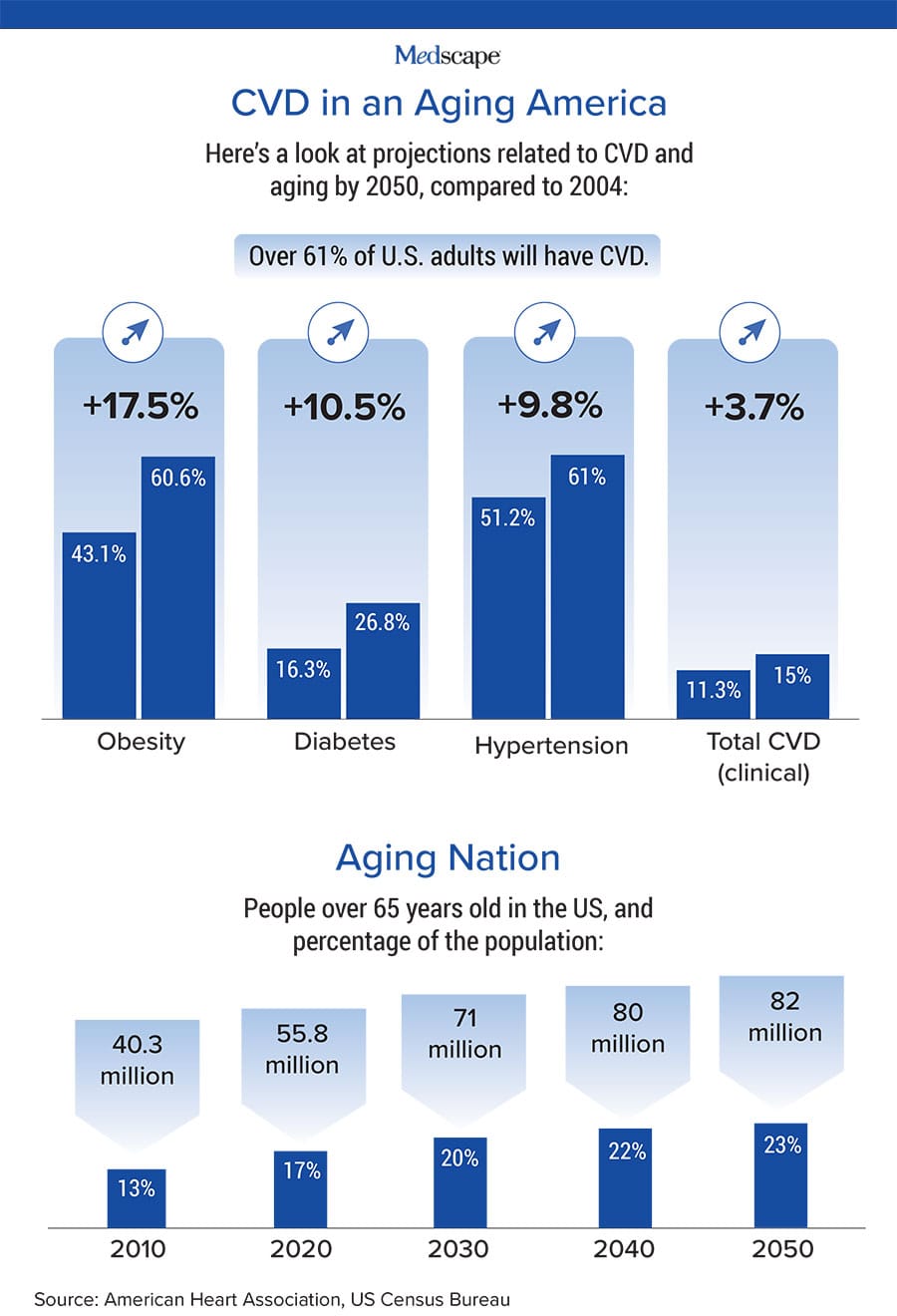
More than a quarter of cardiologists were over 60 years old in 2020, and general cardiologists were the oldest subspecialty on average in 2022. The field will face growing demand during the next decade, with people over age 65 years expected to outnumber those under age 18 for the first time in US history by 2030.
Goyal’s 2025 research quantified the “supply-demand mismatch” in the cardiovascular workforce, projecting a deficit of about 7900 full-time specialists by 2036. Many more cardiologists may be needed if barriers to care are reduced, pushing the workforce deficit to about 12,000 by 2036. Expanded insurance coverage and more racially equitable access to care, for instance, would likely increase demand for cardiovascular care.
But the challenge is already here: In 2024, about 46% of US counties served as the home for 22 million residents, and about 86% of rural counties had no cardiologists. Lower regional cardiologist density has been correlated with higher rates of mortality among patients with heart failure and myocardial infarction.
“The workforce crisis is a big flaming dumpster fire,” Maddox said.
Roadblocks at all Career Stages
Aspiring general cardiologists are plentiful, but barriers to training and early-career challenges are pushing many out of the field.
Every fellowship position in cardiovascular disease (general cardiology) has been filled for the past 5 years. But in 2026, more than 1 in 3 applicants (794 out of 2141) failed to match.
“There’s not a lack of interest in cardiology as a field,” Goyal said. “We don’t have enough fellowship spots available, and a lot of that has to do with funding.”

Medicare caps graduate medical education, limiting payments to teaching hospitals for residency positions. Training funds may not be keeping pace with demand for cardiologists overall, whose job growth is expected to increase 4% from 2024 to 2034, compared to about 3% for other specialties, said Laxmi S. Mehta, MD, director of preventive cardiology and women’s cardiovascular health at The Ohio State University.
“The number of cardiology fellowship spots isn’t significantly expanded for the changes that have occurred over the last several decades,” Mehta said.
Some subspecialties are facing the opposite problem: a lack of demand for training. Interventional cardiology, for instance, filled only 236 of 307 available positions (76.9%) in 2025, with 247 total applicants. Only about 27% of interventional cardiology matches were US MD graduates, while about 20% were US graduates of international medical schools. The shortage of fellows has raised concerns about the pipeline for future interventionalists.
Work-Life Tensions
Cardiologists in different stages of their careers are feeling strained by the demands of the specialty. Some are dialing back their level of commitment, while others are throwing in the towel before reaching retirement age.
“Yes, cardiologists tend to be older, but we are starting to see people wanting to retire earlier than before, so that’s having an impact as well,” Mehta said.
Inflexible schedules and administrative burdens can quickly become intolerable for a younger generation taught to prioritize mental health.
“The applicant pool of today is much more aware of self-preservation and work-life balance,” Goyal said.
That awareness has led many cardiologists in their early 30s who recently completed their training to demand reduced on-call coverage, an inpatient-only practice, or fewer overall hours, Maddox said. Others quit because of the constant battles with insurance companies, documentation demands, and regulatory requirements from the Centers for Medicare & Medicaid Services. The result is fewer full-time cardiologists and uneven workloads.
Women cardiologists and those in the middle of their careers are the most prone to burnout, according to Mehta’s 2019 research. Mehta found that 3 of 4 US cardiologists surveyed in 2022 reported workplace mistreatment, such as discrimination and emotional or physical harassment. Women were 50% more likely to say they had experienced such episodes. Women physicians also spend more time interacting with the electronic health record system, including responding to emails from patients.
“ Patients expect more time with their female clinician, they send more MyChart messages, and that’s extra time sunk,” said Mehta, who is also the chief well-being leader of Wexner Medical Center and chairs a working group on clinician well-being for the ACC.
“We need to continue to destigmatize mental health conditions,” Mehta said. “We need to lose our superhero mentality within cardiology, normalize being humans, and learn from the younger generation, who are really about work-life balance.”
As they get older, cardiologists may struggle to manage more demanding responsibilities, such as being on call at night or working in the catheterization lab, said L. Samuel Wann, MD, a retired cardiologist based in Milwaukee. They may also tire of continuing education and bureaucratic requirements, Wann said. Being granted greater flexibility might convince some to postpone retirement or take a volunteer position, potentially relieving pressure on the field.
Wann helped develop the ACC’s Advanced Career section for members aged 60 and older and recently published an article in JACC on ageism in cardiology. An active volunteer for primary care and cardiology clinics in New Mexico up until this year, he’d planned to continue volunteering in Milwaukee (and New Mexico through telehealth) but hit a snag when he was chosen at random to submit forms on his continuing education progress.
“I find it very annoying, and I’m sure if I’m annoyed, others are less tolerant than me,” Wann said. “That’s not how to encourage people to stick around and help out, and most of us like what we do. I don’t consider it a burden to go to this free clinic. It’s a privilege. I’m delighted that I’m needed.”
Leaning on New Teammates
Maddox leads an effort by the ACC to address the workforce crisis. Later this year, the group plans to request funding for initiatives that could reshape how cardiologists deliver care. These approaches could make it easier for older adults in particular to manage their health by cutting down on appointments and harmonizing advice from various clinicians.
“Right now, everybody’s kind of siloed,” Maddox said. “Patients are running all around, it’s not very coordinated, and we’re not talking to each other, so sometimes we’re accidentally giving conflicting advice.”
Initiatives may involve building teams of care providers with Advanced Practice Providers, cardiovascular technicians, physical therapists, and dietary specialists, for instance. Patients could be grouped into programs targeting their conditions, such as coronary disease management, to relieve pressure on physicians. As AI matures, it could also help monitor patients who show signs of potential problems — a much-needed extra set of eyes for cardiologists whose older patients have multiple morbidities.
“Then the entire group is working with you rather than just me as an individual cardiologist,” Maddox said. “The conveyor belt method of trying to manage hypertension, diabetes, lipid control, stable coronary disease — it’s just not scalable. Designing care teams will help expand the capacity, primarily for general cardiology.”
The ACC is also considering initiatives that would reduce cardiology training by 1 or 2 years (inspired by a pilot program in cardiac electrophysiology), incorporate business management into training, and teach cardiologists how to design a satisfying work-life strategy.
Goyal hopes his cardiology workforce projections lead to more investment in training. Already, some patients commute 2 hours from rural areas to see him in Columbus, and he worries that many more people could slip through the cracks during the next decade. In scenarios with reduced barriers to care, his analysis projects a cardiovascular workforce adequacy of just 76%, and just 32% in rural areas, by 2036.
“That’s unfathomable almost, that so much of our population won’t have access to care,” Goyal said.
Still, cardiology practice today looks dramatically different than it did a few decades ago, and telehealth, AI, and team-based care may be poised to transform the field again, Goyal said.
“How we practice cardiology in 10 or 15 years may look very different,” he said. “I’m still optimistic that we can find solutions that make sense.”
Resources for Cardiologists
Below are several online resources for cardiologists practicing in an aging America.
ACC’s Geriatric Cardiology Section
ESC’s Geriatric-Cardiology Resources
Heart Failure Society of America Learning Page
Overview of CVD Conditions for Older Adults
AHA Scientific Statement on Coronary Artery Revascularization in Older Adults
Geriatrics Healthcare Professionals Site
GeriKit Assessment App (Apple)
GeriKit Assessment App (Google)
Gerontological Society of America Learning Center
Michigan Surgical Quality Collaborative’s Frailty Resources
The 10-TaGA Geriatric Screening Instrument
Disclosures
Goyal is supported by National Institute on Aging grants R01AG085420, R01AG088522, and R01AG091005.
Mehta reported honorarium for speaking at Continuing Medical Education conferences on occasion.
Maddox and Wann reported no relevant financial relationships.
Sarah Amandolare is a freelance journalist and independent science and health reporter who regularly contributes to Medscape Medical News. Her work spans a variety of topics at the intersection of medicine, technology, and longevity.