Admin_Adham
If an astronaut suffered a sudden cardiac arrest in space, could their life be saved? The US National Aeronautics and Space Administration and the European Society for Aerospace Medicine have plans in place for just such an emergency. But they rely on cardiopulmonary resuscitation involving innovative techniques for manual chest compression — methods that do not meet guidelines for depth of compression on terra firma, a study has found.
What does work is an automated standard piston device for chest compression, said Nathan Reynette, who presented experiments conducted in microgravity at the European Society for Cardiology meeting in Madrid earlier this month. Reynette, who has a master’s degree in biomedical engineering and is now completing a medical residency in a cardiology, conducted the research through the Université de Lorraine and the Hospital Center Regional University in Nancy, France. The study was published last year in the journal Resuscitation.
A lifelong space enthusiast, Reynette and a multidisciplinary team focused on the problem of cardiac arrest in space. Fortunately, this emergency has never happened, Reynette said, thanks in part to the fact that astronauts are young, fit, and screened for cardiovascular disease before flight. But hazards of space flight, such as electrocution and hypoxia, could lead to cardiac arrest even in healthy astronauts, he said.
“There’s a different risk profile than on Earth,” Reynette said.
In a recent example, a blood clot was found in the internal jugular vein of an astronaut on the International Space Station in 2020. This episode highlighted the risk for venous thrombosis and blood pooling in the head and neck in microgravity, Reynette said. The clot was treated successfully but could have led to pulmonary embolism if not detected.
Older people going into space — as “space tourists” — and longer missions could also increase the risk of cardiac arrest in space in the future, said Reynette.
Bear Hugs and Handstands
Current guidelines direct astronauts to start CPR if a fellow astronaut suffers a cardiac arrest. On the International Space Station, a stricken astronaut must be taken to a dedicated medical room.
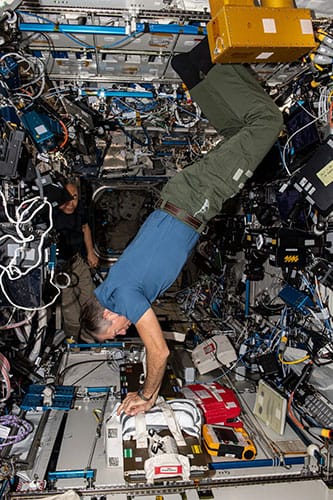
Because traditional methods of CPR rely on gravity, some innovative methods have been tried. One method, called the “reverse bear hug,” involves the rescuer standing behind and wrapping their arms around the cardiac arrest victim to start manual compressions. The advantage of this approach is that a third astronaut can move the two weightless astronauts together into the medical room, Reynette said. Once in the room, there is a restraint system to hold the patient in place. Here, an astronaut can apply manual compressions by bracing their legs against a wall and pressing on the patient’s chest in a handstand position.
The medical room also has a defibrillation system and a system to inject epinephrine directly into the tibia, avoiding the difficulties of venous access in space, he said.
Creating Microgravity
Researchers decided to test the manual methods and three automated devices to see if they met current guidelines for rate and depth of CPR. They used a “flying laboratory” in a modified Airbus A310 aircraft operated by the French Space Agency. The flights involved periods of freefall, which created microgravity conditions, allowing researchers to test the various CPR methods on a mannikin.
Guidelines from the American Heart Association and European Resuscitation Council call for a compression depth of 50-60 mm and a rate of 100-120 compressions per minute during CPR. But space methods have trouble hitting those marks, Reynette said.
The only technique that achieved the recommended depth reliably was the LUCAS Automated Chest Compression system, with a median compression depth of 53 mm. Compression rates were within the target range for manual compression and two of the automated devices, but keeping up the rate was an issue for the manual methods.
“It’s very exhausting to perform CPR on Earth, and it’s even more exhausting in space,” Reynette said. One researcher who tried the handstand method in microgravity could not continue after a single minute, he said.
By contrast, automated devices are reliable, don’t get tired, and free up astronauts to carry out other medical tasks in an emergency, Reynette said.
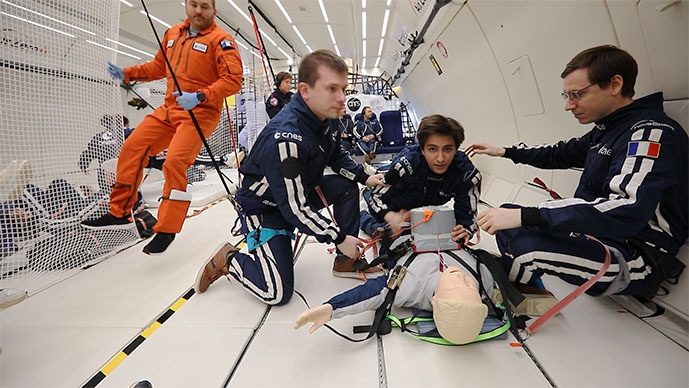
“Our findings support the use of automated chest compression devices in spacecraft in case of cardiac arrest,” Reynette said. But weight and space constraints on spacecraft affect equipment choices, he said. “Cardiac arrest during a space mission would be a very high danger event but has a relatively low risk.” Space agencies will have to decide whether automated devices are worth taking on missions, he said.
This research was funded by the French Space Agency. Reynette reported no relevant financial conflicts of interest.
Carolyn Brown is a freelance scientific journalist, editor, and publishing consultant in Ottawa, Canada.