Admin_Adham
The comeback drug is on a winning streak.
New findings from the DIGIT-HF trial show low-dose digitoxin can reduce the risk for hospitalization and all-cause mortality in patients with symptomatic heart failure. The results, presented at the 2025 annual congress of the European Society of Cardiology and published in The New England Journal of Medicine, show adding low-dose digitoxin to optimized guideline-directed medical therapy (GDMT) in patients with symptomatic heart failure and reduced ejection fraction (HFrEF) is superior to GDMT alone.
The findings add evidence to the ongoing question of whether treatment of HFrEF should include, or exclude, a cardiac glycoside such as digitoxin or digoxin.
Udo Bavendiek, MD, of Hannover Medical School in Hanover, Germany, said the findings support the efficacy of digitoxin in this population of patients, but highlight that low dosage is critical for safety.
In the DIGIT-HF trial, patients were started on a digitoxin dose of 0.07 mg once daily and doses adjusted at 6 weeks to aim for a target serum concentration range of 8 to 18 ng/mL. “This finding is consistent with the observed effects of low serum digoxin concentrations on mortality in the DIG trial,” Bavendiek and his co-investigators write in the current NEJM paper, “whereas high serum digoxin concentrations (> 1.0 ng per milliliter) seemed to be harmful.”
Lower Death Rates in Digitoxin-Treated Patients
DIGIT-HF, a phase 4, double-blind, placebo controlled trial, randomly assigned 1212 patients with symptomatic HFrEF at 65 European sites to digitoxin or placebo, on top of GDMT. Over a median 36 months of follow-up, outcomes favored digitoxin:
- Lower rate of primary-outcome events (death from all causes or hospitalization for worsening HF) in the digitoxin group (39.5% or 12.8 events per 100 patient-years) vs the placebo group (44.1% or 15.7 events per 100 patient-years). The hazard ratio (HR) was 0.82 (95% CI, 0.69-0.98; P = .03).
- Lower death rate from any cause in the digitoxin group (27.2% or 7.8 deaths per 100 patient-years) vs the placebo group (29.5% or 8.9 deaths per 100 patient-years). The HR was 0.86 (95% CI, 0.69-1.07).
“We started DIGIT-HF to demonstrate whether digitoxin at low serum concentrations improves outcomes on top of a modern guideline-directed medical therapy, and to show that the use of digitoxin is safe,” Bavendiek told Medscape Medical News earlier this year. “If digitoxin shows a benefit in this severely ill population already on optimized therapy, this finding would be of great interest.”
The trial included patients with a high symptom burden: 70.4% had NYHA class III or IV heart failure. Bavendiek noted this was a higher proportion of advanced patients than other large HF trials, such as PARADIGM-HF, DAPA-HF, and EMPEROR.
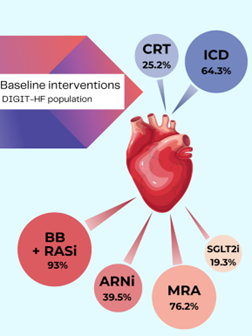
Many DIGIT-HF participants were already using some of the guideline-directed medications for heart failure or had interventions such as cardioversion or cardiac resynchronization (Figure). However, as American Heart Association spokesperson Gregg Fonarow, MD, observed, “the majority of patients were not receiving the full set of guideline recommended medical therapy for HFrEF. Less than 40% of patients were receiving ARNi [angiotensin receptor–neprilysin inhibitors] and less than 20% of patients were receiving an SGLT2i.”
Clinical Effects
In DIGIT-HF, the number of patients needed to treat with digitoxin to prevent one event — death from any cause or hospital admission for worsening heart failure — was 22, with a standard error of 14.
“Despite the higher burden of heart failure symptoms and the better implementation of therapy in our trial, the absolute reduction in the risk of death from any cause or first hospitalization for worsening heart failure — and thus the number of patients who would need to be treated to avoid one primary-outcome event — seems to be similar” to that in other heart failure trials, Bavendiek’s group wrote.
Safety Findings
Because digitoxin slows heart rate and alters electrical activity, adverse events often involve arrhythmias. Serious cardiac disorders occurred in 3.4% of digitoxin patients and 11% of those in the placebo group. Rates of discontinuation were similar: 9.1% with digitoxin vs 10.2% with placebo.
Mean serum concentrations of digitoxin were 17.0 ± 5.9 ng/mL at 6 weeks and 13.5 ± 5.1 ng/mL at 12 months. The authors noted that serum digitoxin can remain stable without dosage adjustments, even among patients with renal dysfunction.
“Amazing Comeback”
Current heart failure guidelines from the American Heart Association state glycoside agents “can be considered for patients with HFrEF who remain symptomatic despite guideline-directed medical therapy or who cannot tolerate such treatment,” with the aim of reducing hospitalizations for heart failure.
“These results are interesting and potentially could influence clinical practice,” Fonarow told Medscape Medical News. “For this patient population, having additional therapies that can improve clinical outcomes is an important clinical need. It would be terrific if one of our oldest medical therapies could stage an amazing comeback.”
Fonarow reported consulting for Abbott, Amgen, AstraZeneca, Bayer, Boehringer Ingelheim, Cytokinetics, Eli Lilly and Company, Johnson & Johnson, Medtronic, Merck, Novartis, and Pfizer. Bavendiek reported receiving travel support and honoraria from Alnylam Pharmaceuticals, Amgen, AstraZeneca, Bayer, Eli Lilly and Company, Novartis, Pfizer, and Vital, and institutional research support from Alnylam Pharmaceuticals. Other study authors declared relevant financial disclosures. See full study for details.
Katherine Wandersee has more than 30 years’ experience as a medical writer for professional medical audiences.