Admin_Adham
Match Day brought disappointment this year — not for interventional cardiology trainees but for fellowship programs left with unfilled positions.
Figures show there were not enough fellows — raising concerns about the pipeline for future interventionalists while experts try to figure out why.
It’s worth noting the sample size is small; this is only the second year these fellowships have been tracked separately. Even so, the concerns are real.
“We need to refine this to understand how many interventional cardiologists we need because there are plenty of underserved areas where there are not yet interventional cardiologists to provide the care that is needed,” said Douglas Drachman, MD, co-chair of the Society for Cardiovascular Angiography & Interventions’ (SCAI’s) Match Task Force.
Many directors of illustrious programs said they did not fully fill, added Drachman, the Heart Center Director of Education and the Teresa G. and Ferdinand F. Martignetti Endowed Chair for Cardiovascular Medicine at the Massachusetts General Hospital in Boston.
Inside the Numbers
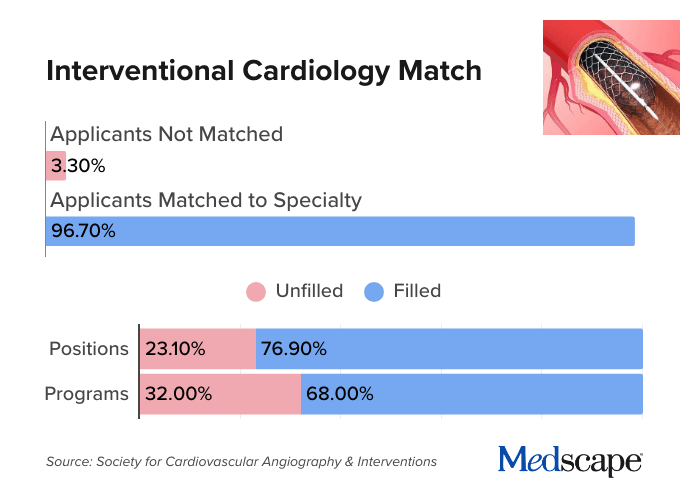
First off, not enough fellows applied this year: 244 for the 307 certified positions. Only 104 of the 159 interventional cardiology programs, or 68%, were filled. On a positive note, only 8 of these 244 applicants did not match to a program, which is “overall an extraordinary outcome,” Drachman said.
These figures compare to 290 applicants for 326 positions the previous year, where 72% of the 156 certified interventional cardiology programs filled on Match Day.
The lower than 100% match in 2025 was unexpected.
“I was actually very surprised with the numbers,” said Jay Mohan, DO, cardiologist at McLaren Cardiovascular Institute in Mount Clemens, Michigan.
“What really hit hard was in the state of Michigan five out of the six major programs didn’t fill fully, including the University of Michigan, a well-known, big national program,” he said.
Why the Mismatch?
Multiple factors could be driving the mismatch between applicants and available programs.
The on-call schedule for interventional cardiology can be “quite onerous” and could be dissuading some general cardiology fellows from applying for interventionalist fellowships, said Bilal Aijaz, MD, interventional cardiologist at UCHealth Highlands Ranch Hospital.
“It’s quite burdensome to be on call that frequently for the rest of your life and doing some very high-risk, high-stakes type procedures at all hours,” Aijaz said. “Many, many applicants who otherwise would have chosen this [career path] clearly say that they just don’t want that lifestyle.”
Another possible reason is some potential fellows want to get optimal training and will wait a year to reapply “rather than matching with a low-volume, low complexity program,” said Lorenzo Azzalini, MD, PhD, interventional cardiologist at the University of Washington in Seattle.
Compensation could be another factor.
“Being an interventional cardiologist, the pay has gone down significantly over the last 10 years while the workload still remains very high,” Mohan said. “Why do a job where you get paid the same amount as a general cardiologist…and still take call many times? We don’t get reimbursed for call.” In a MedAxiom compensation report, general cardiologist compensation was $695,000 in 2025 compared with $750,000 for interventional cardiologists.
Another concern is occupational radiation exposure. Wearing lead protective garments can take a toll on the body, Mohan said. SCAI is promoting more lead-free work environments for interventional cardiologists and staff.
Technology is helping, with advances in the past decade lowering radiation exposure in the procedure room, Drachman said. Examples include dose optimization software, digital flat panel detectors, and newer imaging modalities such as intravascular ultrasound and three-dimensional electro-anatomic mapping.
Inside the Black Box
Because 2025 was only the second year for interventional cardiology fellowship numbers, a lot remains unknown. But experts agree it’s better to start seeing the data, even if it’s not ideal and there is not yet enough to identify long-term trends.
“It’s kind of early in the game,” Aijaz said. “We don’t really know what’s going on yet. It could be that we were just not aware of the number of unfilled positions that always existed.”
“Historically, recruitment of fellows to interventional cardiology fellowship positions was really the ‘Wild West,’” Drachman said. “It’s so fascinating because we’ve been hoping to have a window into the pathway through which people train for interventional cardiology, and now we have it.”
Azzalini noted the number of applicants was lower in 2025 than in the year prior, dropping from 290 to 244, but added the numbers are “not extremely different.”
The general cardiology fellowship match numbers tell a different story because 100% of the 1347 fellows matched to a program.
Possible Solutions
Unfilled fellowship positions can be offset by hiring more registered cardiovascular invasive specialists, Mohan said. But it creates a logistical problem for program leadership.
“When you anticipate you’re going to have five interventional fellows, and you only have two, you have to increase your ancillary support staff and change the way you structure as a program director,” he said.
One potential solution is to create a centralized staff of interventional cardiology fellows that serve a number of medical centers in a region. This strategy is not easy because hospitals generally do not want to share centralized employees. On the plus side, it could help standardize care and keep interventional procedure volume high for trainees, Aijaz said.
Integrating interventional cardiologist training within general cardiology fellowships is another idea. Instead of fellows applying separately in their second year, fellows would be exposed to interventional cardiology from the beginning.
Some cardiologists have floated the idea of restricting the number of positions or programs, but it may not be the best strategy, said Erin Reis, EdD, associate chief academic officer at McLaren Health Care.
“We’ve seen other specialties do that, and then all of a sudden, they’re in big, deep trouble when all of their attendees are retiring, and there’s not enough workforce to fill the gap.” She cited the current shortage of US anesthesiologists as an example.
Unanswered Questions
If the programs that fell short on filling their spots share common attributes, that would be helpful to know, Drachman said. “But we don’t have that granular information just yet.”
That’s just one of many unanswered questions.
- Because of its novelty, was there a learning curve associated with the new systems for interventional cardiology matching?
- Is the mismatch a supply and demand issue?
- How many fellows matched outside of the official system?
- Which areas of the country are most in need of interventional cardiologists?
Could uncertainty about H-1B visas play a role? “I do think there’s a fear out there from a H-1B status. No one knows what’s going to happen in the medical field space,” Reis said.
A Happy Ending
SCAI helped fellows who did not match through the official process ultimately pair with programs, Drachman said. “I do not know of a single candidate who did not match at the end of the process.”
The match algorithm could be partially responsible.
“It isn’t that these people are not qualified to have matched. It’s just that the way the algorithm worked in terms of where they applied, how they rated the programs, and how the programs rated them didn’t successfully align everything,” Drachman said.
Interventional cardiology is an evolving and innovative field, Reis said.
Fellows “play a huge role in that from their research and also from the care they provide. They bring a huge value to every hospital that they’re in, both from a clinical productivity standpoint and in recognizing and developing new technologies that need to be deployed to deliver better, safer patient care and minimally interruptive interventional care.”
Drachman, Mohan, Azzalini, Aijaz, and Reis reported having no relevant financial relationships.
Damian McNamara is a freelance contributor to Medscape Medical News. He worked full-time for Medscape Medical News and WebMD from 2018 to 2024. Damian has a BA in chemistry and an MA in science, health, and environmental reporting or journalism. He works out of a home office in Miami, with a 100-lb chocolate lab known to snore under his desk during work hours.