

 Admin_Adham
 Jump to Key Points
The millions of Americans living with implanted medical devices rely on regulators and manufacturers to keep things working properly and safely. When problems arise, protocols guide whether and how to pull devices from the market.
That sounds simple enough. Yet recalling a device relies on a system that undercounts adverse events, fails to keep track of all the devices implanted in an estimated 32 million patients, misses deadlines, and entrusts device manufacturers to make decisions that critics say should be made by the government agency overseeing the recall process.
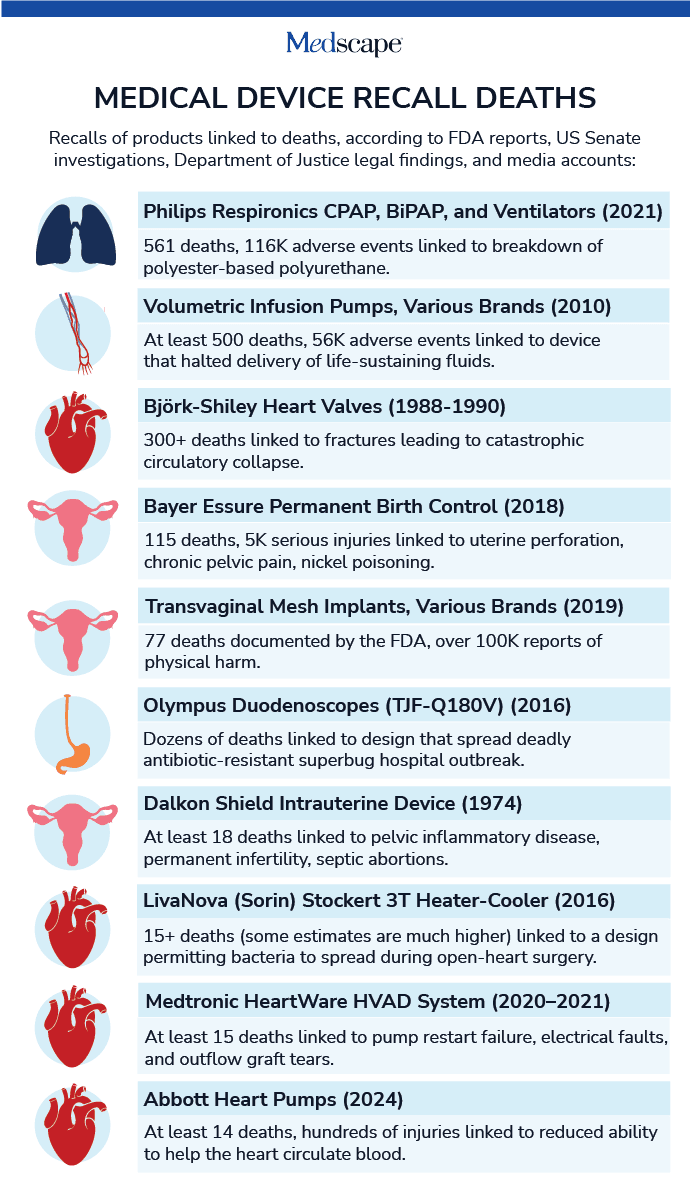
Critics also say the recall process is confusing and ineffective and can lead to death or serious injury for patients and legal liability for clinicians. They fear the system could contribute to catastrophes such as the 2021 recall of Philips CPAP machines, BiPAP machines, and ventilators that were linked to 561 deaths and about 116,000 adverse events.
“I don’t know anyone who thinks the recall process is working well. It’s a very primitive system. There are problems in all steps,” said Rita Redberg, MD, MS, a cardiologist at the University of California, San Francisco, who researches high-risk medical devices.
- Implanted devices affect >32 million Americans; recall failures can cause serious harm.
- 2025: ~1100 device recalls; 145 Class I recalls, 5th straight yearly increase.
- GAO: FDA missed 90-day recall completion timeline in ~75% cases; mean 263 days.
- Adverse event reporting undercounts problems; clinicians often rely on device reps/MedWatch.
- Device tracking gaps + delayed patient notification increase safety risk and legal liability.

Richard Kovacs, MD, chief medical officer at the American College of Cardiology (ACC), added: “What keeps me up at night is that there’s a device being used in a lot of people, and we don’t catch the problem before it happens. That’s the nightmare.”
The FDA, which oversees device recalls, has acknowledged problems but said the system is safe overall. “Voluntary recalls remain one of the quickest, most effective ways to remediate an issue with a medical device already on the market,” the FDA said in a statement emailed from its press office in response to written questions from Medscape Medical News.
By the Numbers
The American Medical Association estimated in 2021 that 10% of the US population— or more than 32 million people — will have a medical device implanted in their lifetime.
In 2025, about 1100 recalls in total were issued, according to the FDA. Of that total,145 were Class I recalls – the most serious type for devices that could lead to death or injury. It was the fifth straight year of increases in Class I recalls. The FDA did not respond to an email asking why this figure has increased yearly.
A December 2025 audit by the US Government Accountability Office (GAO) found that the FDA was missing its 90-day timeline for formally completing all steps of the recall process in nearly 75% of cases. The average for recalls from 2020 to 2024 was 263 days, the GAO found.
The FDA said most of those were open only because of unfinished paperwork. “A recall awaiting termination does not necessarily mean the affected product remains uncorrected or that an underlying safety issue is ongoing,” according to the agency’s press email.
The volume of recalls is likely to grow, as software repairs, cybercrime threats, and AI-related problems could impair implanted medical devices, Kovacs said.
What’s Not Working
Concerns about the recall system have persisted for years, including assertions from critics that the FDA is not staffed to enforce it.
Some experts, including Redberg, say the FDA and industry are too cozy — an allegation the agency denies. “Appropriate FDA oversight and clearly defined expectations help prevent business considerations from compromising public health decisions,” according to the agency’s press office email.
Device makers and sellers are the only entities required to report adverse events to the FDA, which can put clinicians in a sort of limbo.

“When a physician does report, what they’ll generally do is tell the device rep,” Redberg said. “After that you’re just trusting that device rep is going to fill out a MedWatch report in a timely fashion, but none of that is monitored. It is a bit like the fox watching the henhouse.” (AdvaMed, the industry group representing device makers, did not respond to requests seeking comment or answer written questions for this story.)
MedWatch is the portal where clinicians can report problems, although many physicians are unfamiliar with it or lack the time to make reports. In a 2024 UCSF survey published in Health Affairs, only 17% of physicians said they had a moderate or better understanding of the FDA’s medical device approval process.
“When I talk about this around the country, I often poll the audience and say, ‘Have you ever filed a MedWatch form?’ Very few hands go up,” said Kovacs, whose recent column in the ACC’s magazine urged reforming the device surveillance system.
Reporting requirements aside, “[w]e have a lifelong duty to our patients with implanted devices to manage that device and ensure the safety of that device for the entire lifespan of the device and/or the patient,” Kovacs said.
Fulfilling that duty also can guard against legal liability.
While lawsuits against device makers are more common, physicians leave themselves open to liability by failing to obtain informed consent from the patient, negligently implanting a device, and failing to take appropriate actions after receiving a recall notice, according to MagMutual, which provides liability and malpractice insurance.
Ignoring Real-World Evidence
When patients or the public report problems to the FDA, they generate “real-world evidence.” But these anecdotal reports often are not weighed in recall decisions, said Hooman Noorchashm, MD, PhD, a research professor of law at Northeastern University in Boston and co-director of the Amy J. Reed Medical Device Safety Collaborative.

Noorchashm is frustrated by the inattention to real-world evidence found in the database of those reports in the FDA’s Manufacturer and User Facility Device Experience (MAUDE) database.
“If you go into MAUDE, it’s absolute carnage in terms of the level of adverse events that are being related,” he said. “You may have thousands of adverse events on a particular device and not see a recall. Why is that? If a particular device has 500 adverse events associated with it, we should really put out a warning there or slam on the brakes.”
Conversely, some recalls don’t mention complaints at all, Redberg said. “Then why was there a recall? It doesn’t make any sense.”
The Tracking Problem
To track which devices are in which people, every device has a unique number. However, those are not recorded frequently enough to help speed up recalls, Kovacs said.
“We should be able to do this in the modern age,” Kovacs said. “We have barcodes on everything. But I would say in the majority of cases, the exact identity of the device doesn’t readily track with the patient across time and space.”
As an example, Redberg recalled seeing a patient who had just received a subcutaneous cardioverter-defibrillator.
“I said, ‘Do you know that your device was recalled last month?’ She said, ‘No, nobody told me that,’” Redberg said.
Oversight Under Strain
FDA officials told the GAO in its report published last year that the agency often lacks sufficient personnel for tasks such as manufacturer reports and in-person checks.
“FDA’s challenges — such as insufficient staffing — can create inefficiencies in the process and potentially put lives at risk,” the GAO report said.
In March 2025, the Department of Health and Human Services, which oversees the FDA, started laying off about 3500 FDA employees as part of a reorganization. Since then, however, the agency announced plans to hire up to 2000 people.
Even with all the layoffs and then hiring efforts, the FDA told Medscape Medical News, no positions related to processing recalls were eliminated.
Problems From the Start?
The FDA approves and clears devices for the marketplace two ways.
Premarket approval requires clinical evidence, is expensive, and can take years to complete.
The 510(k) pathway became an option 50 years ago. Instead of requiring evidence from clinical trials, device makers only need to show a device to be “substantially equivalent” to an already approved product to gain FDA clearance.
Although it began as a loophole, the 510(k) pathway is now the main route. A 2023 study found that about 99% of all devices cleared for the market went through 510(k). The FDA said this process is important to keep pace with changes in technology, the marketplace, and patient needs.
Noorchashm has worked to improve the recall process for more than a decade.
In 2013, his wife, Amy Reed, MD, PhD, then a physician at Harvard, was diagnosed with cancer after undergoing a procedure that used a power morcellator, which had been cleared through the 510(k) pathway.
Noorchashm blamed use of the morcellator, which uses a spinning blade to remove fibroids, for spreading Reed’s previously undetected cancer. The couple launched a campaign to ban the procedure.
The FDA issued safety communications and restricted boxed warnings for the procedure, saying it has been linked to the spread of cancer and worse outcomes.
Reed died in 2017 at age 44.
What Can Clinicians Do?
Professional education and training are needed to improve awareness, Redberg and Noorchashm said.
Moreover, clinicians should do everything they can to notify patients of recalls as soon as they learn about them, fulfilling their duty and also potentially averting legal liability.

Linda Turley, JD, of Turley Law Firm in Dallas, has heard from several patients over the years who “learn about a recall of their device just by happenstance or never learn about it until after they’ve gotten in touch with us.”
There have been efforts over the years to improve the system’s patient notifications and other aspects of the system, most recently the Medical Device Recall Improvement Act that was introduced in the US House of Representatives and Senate in December. The measure calls for improved patient communications and guidance from the FDA and device makers. Lawmakers have not taken action on the bill.
Kovacs said an overhaul is probably past due.
“We probably need a different system that’s more transparent to the public, to our patients, so they can feel that their implanted device is not only effective and helps them but also is being watched for its ongoing safety and effectiveness,” he said.
The experts cited in this article had no relevant disclosures.
Adam Marcus and Matt Slagle contributed to this report.
John McFarland is the editorial director for cardiology at Medscape Medical News.



