Admin_Adham
 Jump to Key Points
In June, a research team from the US, Netherlands, and India announced their discovery of the first gene mutation linked to pyoderma gangrenosum (PG), a rare disorder that causes deep, painful, recurring skin ulcers.
It’s a giant step for people with this inflammatory condition. The ulcers resist antibiotics and corticosteroids and can be disabling, even deadly. Until now, no causes had been found.
Scientists cracked the mystery by identifying a mutation in a gene regulating OTULIN, an inflammation-controlling enzyme, in three adults with severe, early-onset PG. For one study participant, who’d had repeat ulcers since age 13, the discovery led to better treatment. He received an inflammation-blocking TNF inhibitor that healed a large ulcer on his neck and has kept him in remission.
Senior study authors Janet Markle, PhD, of Vanderbilt University Medical Center in Nashville, Tennessee, and András Spaan, MD, of UMC Utrecht in Utrecht, Netherlands, had been working separately on PG genetics. Their labs teamed up after a former mentor heard about their common research focus. “This study is the product of a highly productive scientific collaboration with a direct clinical impact,” they noted in Nature Immunology.
- OTULIN-pathway mutation identified first genetic cause of severe PG.
- PG ulcers: deep, painful, recurrent; often antibiotic/corticosteroid-resistant.
- TNF inhibitor induced healing/remission in one mutation-positive patient.
- IEIs now include autoimmune/inflammatory phenotypes, not infections alone.
- Genetic testing + targeted therapy/gene therapy increasingly guide IEI care.
Their study also illustrates the huge strides transforming the field of inborn errors of immunity (IEIs). That’s a diverse group of hundreds of rare disorders that cause severe infections, autoimmune and inflammatory problems, and even some cancers because part of the immune system is missing or malfunctioning. Faster, cheaper, more accessible gene tests — including specific genetic panels for various IEIs as well as whole genome and whole exome sequencing — have identified gene mutations behind hundreds of IEIs. That’s led to improved diagnosis, targeted treatments, and gene therapies and also expanded the definition of IEIs.
“There is a once-in-a-lifetime kind of excitement in the field,” said Paula Henao, MD, an associate professor of allergy, asthma, and immunology at Penn State Health Milton S. Hershey Medical Center in Hershey, Pennsylvania, and medical director of the Immune Deficiency Foundation in Hanover, Maryland. “We can now identify a genetic problem and provide curative gene therapy or treatment targeting an immune pathway. This changes things dramatically for patients.”
A New View of Immunodeficiency
First identified in 1952, IEIs captured public attention in the 1970s with the story of David Vetter — the “bubble boy” with severe combined immunodeficiency (SCID) who lived in sterile, germ-free environments (including isolation rooms at home and at a hospital, a special transport vehicle, and even a NASA-designed containment suit) from birth until his death at age 12.
With the advent of gene testing, the mutations behind a handful of IEIs were identified by the early 1990s. Today, over 555 have been found and hundreds more await discovery. Each individual IEI is relatively rare — just 6 in 100,000 people have PG, for example, and 1 in about 58,000 newborns have SCID. But collectively IEIs affect about 1 in 1200 people.
“IEIs are probably more common than people think,” said Niraj C. Patel, MD, associate professor of pediatrics, allergy, and immunology at Duke University School of Medicine and an immunologist treating adults and children at Duke Health. “That’s particularly important for primary care providers and specialists who are often the first to recognize potential signs of [IEIs] in a patient.”
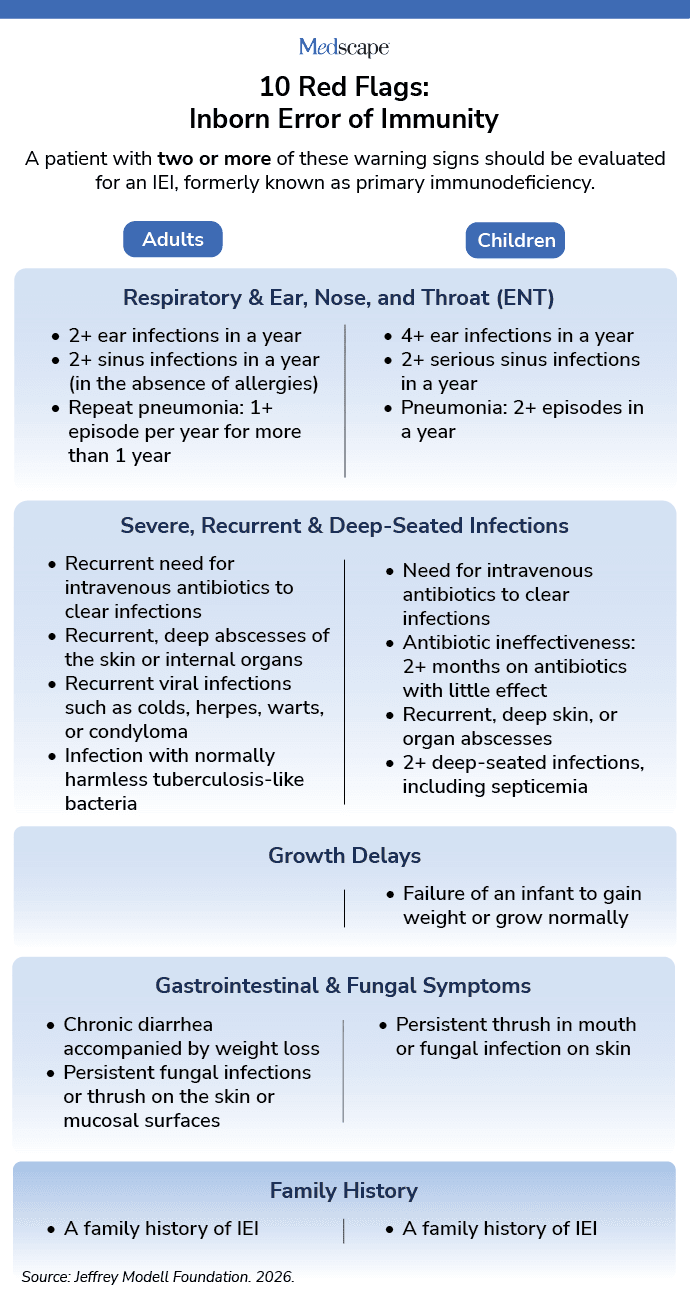
That list of warning signs is expanding (see graphic below for red flags in adult and pediatric patients). Until recently, IEIs were called primary immunodeficiency diseases. The key symptom: severe, unusual, and difficult-to-treat infections. The name change to IEIs reflects a new understanding that 1 in 4 people with IEIs may have autoimmune or inflammatory conditions instead of infections.
“It’s not just about infections anymore,” Patel said. “It’s also about inflammation, autoimmunity, and even malignancies. You can have an IEI without an infection. Or infection may be just part of the picture.”
This new view is reflected in new IEI practice guidelines, the first update in a decade, released in 2025 by the American Academy of Allergy, Asthma & Immunology; the American College of Allergy, Asthma and Immunology; and the Clinical Immunology Society. In addition to infections, clinical signs of an IEI now include chronic fevers, unusual or severe atopic dermatitis, lymphocyte proliferation (persistent, unexplained enlargement of lymph nodes or the spleen), lupus, inflammatory bowel disease, and some cancers.
“The field of IEI has grown substantively in the past decade and continues to expand,” the guideline authors noted.
Diagnostic Odyssey
Early diagnosis and treatment of IEIs can prevent infections and hospitalizations; control autoimmune and inflammatory conditions; and help avoid damage to the lungs, kidneys, skin, eyes, digestive system, and other organs in people with IEIs. “Patients do better when they’re diagnosed sooner,” Patel said. “It’s really important to understand the signs and symptoms.”
Despite these advances, many people still wait decades for a diagnosis — a median of 23 years and as long as 71 years, as noted in a 2023 National Patient Survey by the Immune Deficiency Foundation. “We still have this huge, huge issue with a long diagnostic odyssey for many patients,” Henao said. “We don’t recognize patients soon enough. IEIs aren’t always on physicians’ and patients’ radar screens.”
Before their diagnosis, survey takers were hospitalized an average of 3.4 times and 39% developed permanent organ damage or mobility impairments. Those with an autoimmune condition were more likely to wait more than 10 years for a diagnosis than those with infection symptoms.
Overall, 70% were diagnosed by an allergist-immunologist. Henao and Patel recommend physicians refer patients with suspected IEIs to these specialists for testing and treatment. “Patients are seen by their primary care provider. They may go to an ear, nose, and throat physician, a rheumatologist, a [gastroenterologist], and it really takes somebody to put all of it together and to think, ‘Hey, is there something underlying this?’” Patel said.
Gene Tests, Precision Medicine, and Gene Therapy
As advanced genetic testing uncovers new gene variants behind more IEIs, it’s also improving patient care. Genetic testing and diagnosis — recommended for the first time in the new practice guidelines — can match people with a range of targeted treatments or even gene therapy. Targeted therapies, also called precision medicine, are small molecules and biologics that address imbalances in immune pathways in various IEIs.
“We now have treatments targeted at specific genes, and we’re also talking about cures with gene therapy,” Henao said.
In late 2025 and early 2026, the FDA approved the first gene therapies for IEIs in the US: Waskyra (etuvetidigene autotemcel) for Wiskott-Aldrich syndrome and Kresladi (marnetegragene autotemcel) for severe leukocyte adhesion deficiency type I. Others are in clinical trials.
Currently, gene testing using next-generation sequencing finds IEIs with a known genetic mutation in about 22%-42% of people with a suspected IEI who are tested, according to a 2026 study of 5991 people tested through the Jeffrey Modell Foundation’s partnership with clinical testing laboratories around the world and also according to a 2024 review.
“Testing is actually very widely available and relatively inexpensive for people with certain conditions, though there can be insurance barriers,” Henao said. “An immunology clinic can help.” If a test doesn’t find a genetic cause, an IEI can still be diagnosed and treated based on immunology tests. And patients can ask to have their test sample (a cheek swab) rechecked in the future.
“A gene that seems to have no relevance today could have a significant impact on treatment 10 years from now,” Henao added.
Meanwhile, since 2018, babies born in all 50 states are screened for SCID using the T-cell receptor excision circle test, done with a blood sample from the baby’s heel. “It’s referred to as the ultimate equalizer because every baby is tested, whether they’re born in the hospital or at home, rich or poor, insured or uninsured,” Henao said. A positive test leads to a medical referral, further evaluation, and treatment if needed. If SCID is confirmed, treatment saves lives, she added.
The experts cited in this article had no relevant disclosures.