Admin_Adham
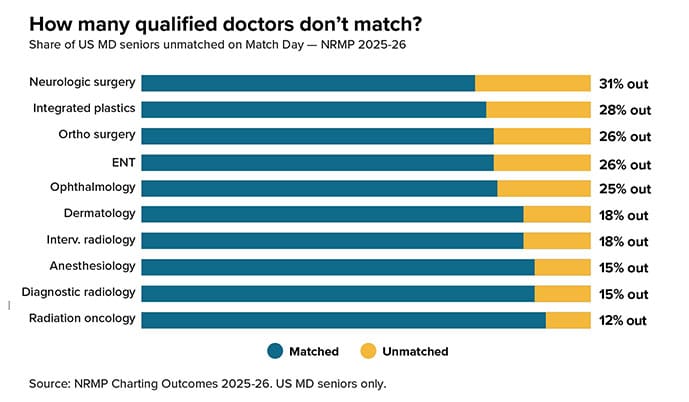
Every March, thousands of newly minted doctors find out in a single anxious moment — Match Day — whether they have a job. Most do. But in the most competitive specialties, nearly 1 in 3 qualified applicants walks away empty-handed according to The 10 Most Competitive Medical Residencies Report 2026. And the bar keeps rising.
Medical residency competitiveness is measured on a few key dimensions: the percentage of US MD seniors who go unmatched, average board scores (Step 2 Clinical Knowledge [CK]), volume of research required, and how brutal the lifestyle actually is. Look at all four together and some surprising patterns emerge.
Specialties at a Glance
Neurosurgery sits at the brutal extreme. It has the highest unmatched rate of any specialty (31%) meaning programs reject nearly a third of highly qualified applicants every year. Training lasts 7 years. Matched applicants average 25-37 research products. The program is so demanding and so long that some programs have started favoring nontraditional applicants: ex-military, former professional athletes, career changers. People who’ve already proven they can absorb punishment.
Dermatology is the other kind of extreme. It’s consistently ranked as the happiest specialty — dermatologists work predictable hours, almost never face emergencies, and sit at the intersection of essential medicine and a $500 billion global aesthetics market. That combination makes board scores ferociously competitive. Matched derm applicants averaged the highest Step 2 CK scores of any specialty; and with only about 550 spots nationwide, roughly 1 in 6 qualified seniors still won’t match.
Then there are the surprises. Ophthalmology uses a completely separate match system — the San Francisco Match — that releases results in January, months before everyone else. Applicants who don’t match have almost no ability to pivot to a backup specialty in the same cycle. It’s a high-stakes bet with an early deadline, and matched applicants in 2025-2026 posted the highest average board scores of any specialty.
Anesthesiology is also having a moment. Three years ago, a Step 2 score of 240 was safe. Today, matched applicants average 252 — a 12-point jump driven by a national shortage, rising salaries (now $450k-$550k to start), and sometimes, a shift-based scheduling model that offers something surgical specialties rarely do: a possible “end” to the workday. Applicants who don’t signal interest to specific programs match at just a 5% rate. The specialty has gone from safety school to scramble.
And diagnostic radiology — once feared as the specialty AI would kill — is booming. Rather than replacing radiologists, AI tools have made them faster and more valuable. The added draw: You can read scans from home and still earn above $500,000. The unmatched rate has climbed back to 15% as interest surges.
What links all these fields is a structural mismatch. Medical school enrollment has grown. Interest in competitive specialties has grown. But residency slots haven’t kept pace — they’re funded by Medicare, and Congress hasn’t significantly expanded that funding in decades. More qualified doctors, same number of seats. That’s why a perfect candidate can still be left without a match, and why the numbers keep getting harder every year.
Jennifer Nelson is the features editor at Medscape Insights. Her work has also appeared on WebMD, Medical Economics, and MedPage Today, as well as in The Washington Post, AARP, US News & World Report, The Oprah Magazine, Women’s Health, and other publications.