Admin_Adham
WASHINGTON — The underappreciated acantholytic disease known as Grover disease — originally coined transient acantholytic dermatosis — belongs in the differential diagnosis of an itchy rash composed of keratotic papules with erosion and crusting, especially when such lesions appear on seborrheic areas such as the chest and back.
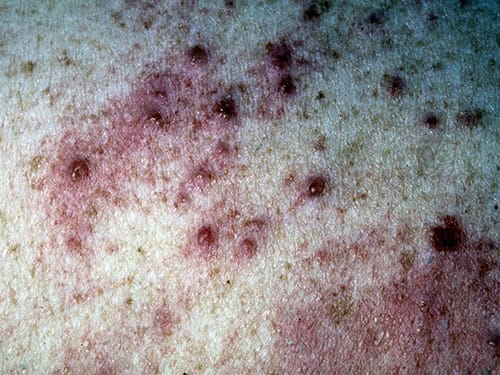
“I think we are underdiagnosing” Grover disease, an acquired condition, Adam Friedman, MD, professor and chair of dermatology at the George Washington School of Medicine and Health Sciences in Washington, DC, said at the ElderDerm 2025 conference on dermatology in the older patient population.
While its prevalence is still not well known, Grover disease, first described in the 1970s, is more common than both Darier disease and Hailey-Hailey disease. These other acantholytic diseases, by definition, involve disruption of intracellular adhesion between keratinocytes, Friedman said at the meeting hosted by the Department of Dermatology at George Washington University.
Grover disease is reportedly more common in men than in women. However, he noted that he sees it “equally in both.”
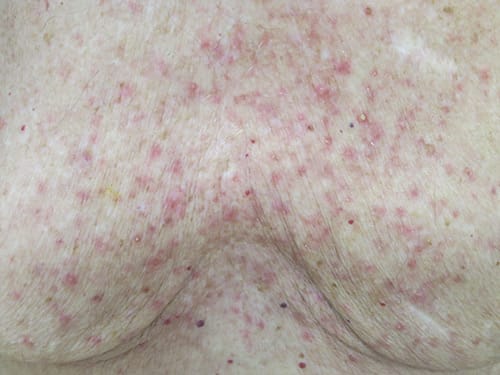
Solitary papules, as are sometimes seen in Grover disease, are “great mimickers of nonmelanoma skin cancers,” Friedman said. In an interview after the meeting, he added that Grover disease may be misdiagnosed as folliculitis, truncal acne, or even miliaria. “It can definitely fool you.”
The term transient acantholytic dermatosis is a misnomer because while lesions can sometimes spontaneously resolve, they can also last for a long time, and [moderate-to-severe disease] can be very disabling,” Friedman said at the meeting.
Heat, sweating, sun exposure, and extended bed rest can each trigger or worsen the condition. Grover disease can also be drug-induced in patients treated with immune checkpoint inhibitors, BRAF inhibitors, mTOR inhibitors, and other chemotherapeutics — and in these cases, lesions may be more widespread, appearing beyond the trunk and back.
Making a Diagnosis
Across the acantholytic diseases, lesion location can be a key distinguishing feature of Grover disease given its predilection for the trunk and back. It can also occur on the shoulders and arms, but “fortunately, it does not occur on the face,” Friedman said.

As described in a recently published review of Darier, Hailey-Hailey, and Grover disease — the most comprehensive review published thus far, according to Friedman — Darier disease is more prominent on the scalp, face, neck, and upper trunk, though it can also affect the hands, feet, and nails. Hailey-Hailey disease in particular affects the skin folds of the neck, axillae, inguinal creases, and gluteal cleft.
“For the most part,” Grover disease presents much later in life than do the genetic acantholytic diseases, Friedman said at the meeting. The clinical picture and history are different; “the locations can certainly be different, and the histopathology can be helpful” in making a diagnosis, he added.
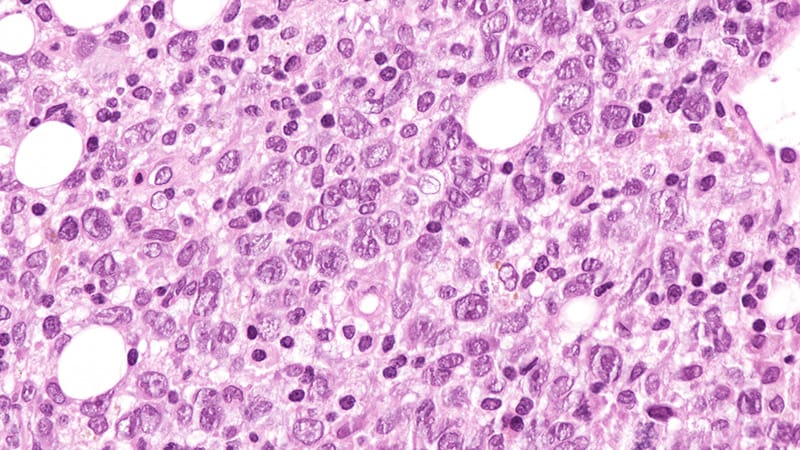
Histologically, Grover and Darier disease can be identical, with prominent dyskeratosis in addition to acantholysis. Biopsies of patients with Grover disease can show Hailey-Hailey-like areas as well. Whereas with Darier and Hailey-Hailey disease, “the histologic pattern might be a little more linear and reproducible, in Grover, it can be an all-comer,” he said, with variable features including spongiosis, focal superficial infiltrate containing lymphocytes and eosinophils, and overlying scale crust in addition to acantholysis and dyskeratosis.
Technically, Grover disease is a biopsy-driven diagnosis. A 2017 case report suggested that dermoscopy may be useful in some cases, particularly once early lesions have evolved from an unspecific initial appearance to a later-stage appearance with more characteristic dermoscopic features.
As described by the authors, these later-stage features include a central yellowish to brown star-like pattern surrounded by a white halo. Dermoscopy “could potentially be helpful in a patient who would not be suitable for a biopsy,” said Friedman, adding after the meeting that he does not feel comfortable using dermoscopy to make the diagnosis.
Pathophysiology and Management
There have been more questions than answers about the pathophysiology of genetic acantholytic diseases, but “if you dig deeper into Darier’s and Hailey-Hailey, it really comes down to the [defective] pumping of calcium” and resulting loss of desmosome adhesion, Friedman said.
The molecular underpinnings of Grover disease are even less understood, but researchers “think now that there’s probably something similar going on with this condition as well,” he said, referring to the 2025 review and a 2023 study showing acquired mutations in the ATP2A2 gene in patients with Grover disease. Germline variants in the calcium-pump encoding gene ATP2A2 are among the mutations associated with Darier disease.
In the 2023 study, 80% of the 15 patients with Grover disease were found to have somatic single-nucleotide variants in ATP2A2, the same gene and calcium pump factory involved in Darier disease, Friedman said. This finding could explain the histologic similarities between the two. (The specific variants suggest that ultraviolet light-induced mutagenesis may have contributed, the authors reported).
In addition to avoiding triggers and making lifestyle changes, such as wearing loose-fitting and moisture-wicking clothing, Friedman has found that topical corticosteroids combined with antimicrobial washes (such as benzoyl peroxide, salicylic acid, and chlorhexidine) are effective for some patients. “If you have barrier dysfunction, there probably will be dysbiosis,” he said.
And for most patients with moderate-to-severe disease, “my go-to will be isotretinoin,” Friedman said. These choices are reflected in a 2020 review of 116 published articles on Grover disease — mostly case reports and case series — that found topical corticosteroids to be the most frequently used treatment, followed by systemic retinoids or systemic corticosteroids, with reported response rates of 70%, 86%, and 64%, respectively.
In addition, there is growing evidence supporting the off-label use of dupilumab, which Friedman has utilized in his practice. “This makes sense given that you have water getting out and more antigen getting in [in acantholytic disorders], which can lead to T2-type immunostimulation.”
Friedman disclosed having relationships with Galderma relevant to this content.