

 Admin_Adham
The field of neurogastroenterology is reshaping how clinicians understand the gut-brain connection and its role in conditions such as irritable bowel syndrome (IBS). For Trisha Pasricha, MD, MPH, director of the Institute for Gut-Brain Research at Beth Israel Deaconess Medical Center, Boston, translating those scientific advances for patients has become a defining part of her career.

For Pasricha, who is also an assistant professor of medicine at Harvard Medical School, Boston, better communication often starts with a simple word many clinicians avoid: poop.
The author of the recently published You’ve Been Pooping All Wrong: How to Make Your Bowel Movements a Joy, Pasricha grew up in what she calls a “poop-positive household” as a gastroenterologist’s daughter. That early comfort with bowel talk now shapes both her clinical practice and her public communication, including her work as a columnist for The Washington Post.
“Language matters,” Pasricha said. “If you sound remotely distant or uncomfortable talking about it, how can you get other people to feel comfortable and share something they might consider shameful or embarrassing?”
That blend of scientific rigor and charming candor runs through her book, which uses humor not to trivialize bowel symptoms but to make them easier to discuss. In a conversation with Medscape Medical News, Pasricha discussed gut-health myths she commonly encounters and why clear, comfortable conversations can help patients with understanding and managing their symptoms.
This interview has been edited for length and clarity.
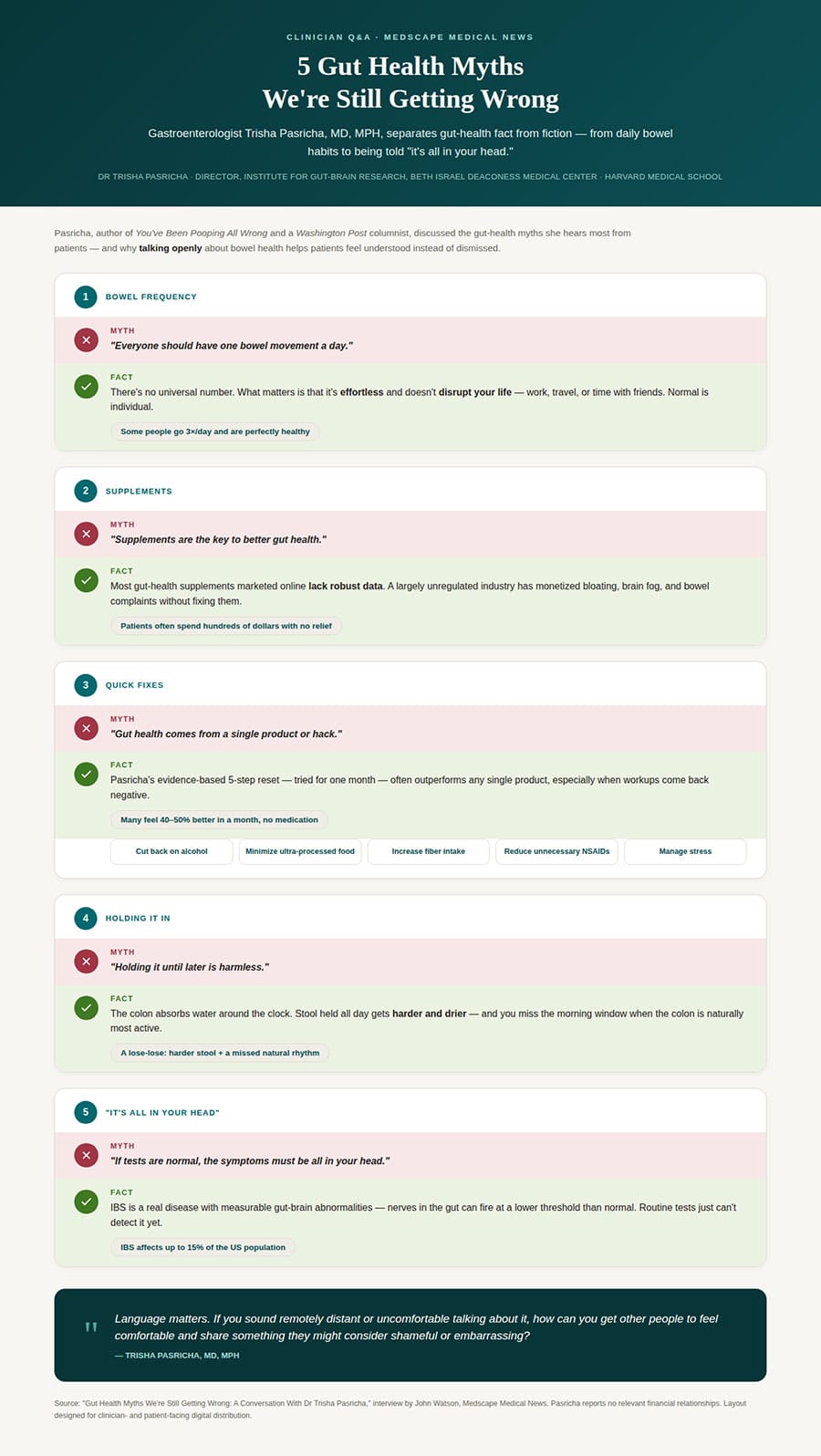
Myth #1: Everyone Should Have One Bowel Movement a Day
Many people believe that having one bowel movement a day is the definition of normal. Why isn’t that necessarily true?
Having one bowel movement a day really has a chokehold on people. It dates back generations, partially, I think, because there is a window early in the morning when the colon is naturally most active. Your colon has a circadian rhythm too, and for many people, that’s the easiest time to go.
I don’t worry so much about a specific number. I focus on two things. First, it should be effortless. I don’t want people straining or coming out of the bathroom feeling like they’ve run a marathon. Second, it shouldn’t disrupt your social life. It shouldn’t interfere with your ability to work, travel, or spend time with friends.
What is normal is highly individual. Somebody could go three times a day and be perfectly healthy. Another person might find that frequency disruptive and consider it diarrhea. The important thing is whether it works for that individual.
Myth #2: Supplements Are the Key to Better Gut Health
If you could eliminate one piece of bad gut-health advice from social media, what would it be?
It would be the rise of the supplement industry in gut health. Most supplements simply do not have robust data behind them.
What I see online is influencers saying, “I have bloating, I have trouble with my bowels, maybe I have brain fog. And this is the supplement that worked for me.” Industry has really come to monetize the popularity of gut health and, frankly, prey on people’s vulnerabilities.
I understand the appeal. It can be hard to get an appointment with a gastroenterologist, and it’s easy to scroll through social media and find someone who seems to have the same symptoms you do and the solution.
But I see patients who have spent hundreds of dollars on unproven supplements and microbiome tests. They’re still struggling with symptoms, and now they’re financially struggling too. That’s incredibly frustrating.
Myth #3: Gut Health Comes From a Single Product or Hack
Your book includes a five-step guide to gut repair. What do you recommend people try if they’re experiencing gastrointestinal (GI) symptoms?
This is something I’ve been recommending to many of my patients if various tests (endoscopies or blood tests) have come back negative and we don’t really know the cause. That’s actually a large percentage of the population.
For example, 1 in 10 people have functional dyspepsia, and there’s not a good biological marker available for this.
The five things I recommend, which are supported by multiple studies, are cutting down on alcohol, minimizing ultraprocessed foods, increasing fiber, reducing unnecessary use of nonsteroidal anti-inflammatory drugs (NSAIDs), and managing stress.
Alcohol can cause microscopic inflammation in the gut. Ultraprocessed foods have been linked to disruption of the microbiome and to IBS symptoms. Fiber helps fortify the gut barrier, yet about 95% of us aren’t getting enough. NSAIDs can damage the lining of the GI tract. And stress can increase intestinal permeability within hours.
I often ask patients to try all five changes for a month. The point isn’t necessarily that they have to live that way forever. It’s that many people are surprised by how much better they feel. Some tell me they’re 40% or 50% better without starting a single medication. Then we can talk about how to make those changes sustainable.
Myth #4: Holding It Until Later Is Harmless
As you note in your book, many people tend to avoid public bathrooms. Why can that be a problem?
We often ignore the urge to have a bowel movement because we’re at work, traveling, or sharing a bathroom with other people. It seems harmless, but it can contribute to constipation.
One of the colon’s most important jobs is absorbing water. It’s doing that 24 hours a day. The poop that’s sitting there at 9 AM isn’t going to look the same at 9 PM. if you’ve been holding it all day. It becomes harder, drier, and more difficult to pass.
At the same time, you’re missing the period when your colon is naturally most active. So, when you finally try to go later, you’re working against your body’s normal rhythms and dealing with harder stool. It’s a bit of a lose-lose situation.
I think this is one reason so many people struggle with constipation. We’re simply not responding when our bodies tell us it’s time to go.
That’s why I advocate scheduling time to go to the bathroom in the place where you feel the most safe and comfortable, which is usually your home bathroom.
Myth #5: If Tests Are Normal, the Symptoms Must Be ‘All in Your Head’
You write extensively about, and conduct research on, the gut-brain axis and its bidirectional role in many GI disorders. What’s the clinical value of sharing that with patients?
The field of neurogastroenterology is exploding with research breakthroughs every year. Yet I don’t think we’ve disseminated that rapid pace of knowledge as well as we possibly can. That’s allowed probably the most harmful myth of all to persist: that when GI tests are negative, it’s all in people’s heads.
When I diagnose someone with IBS, many have already been told that they’re exaggerating their symptoms or that everything is psychological because their tests came back normal. I try to explain that IBS is a real disease affecting up to 15% of the US population. We know there are molecular and cellular abnormalities in the gut. We know that, in many patients, nerve cells in the gut become activated at a much lower threshold than in people without IBS. Those signals travel to the brain and can influence mood and anxiety, creating a feedback loop. The tests used in research to measure these abnormalities aren’t available in routine clinical practice, but that doesn’t mean the biology isn’t there.
When patients understand that, they’re much more likely to view their physician as a partner rather than someone dismissing their symptoms and accept treatment recommendations that might include an antidepressant. It’s not because I’m telling them it’s all in their head; it’s because they’re neuromodulators, and I think they’re going to raise the sensitivity of the nerves in their gut.
I think that’s the myth we still need to work hardest to overcome: the idea that GI disorders without obvious abnormalities on testing aren’t real diseases. We’ve known for decades that they are. Yet that misconception continues to harm patients every day.
Pasricha reported having no relevant financial relationships.
John Watson is a freelance writer in Philadelphia.


