

 Admin_Adham
 Jump to Key Points
For those who treat atopic dermatitis (AD), the introduction of biologics over the past 9 years has had a major impact on how the disease is treated and on the lives of patients, following the era of traditional systemic treatments.
In this third installment of a series on biologics in dermatology, Medscape Dermatology asked four experts to share their experience and perspective on biologics to manage AD, including how these agents offer more than just another treatment option and boost patient quality of life, and the promise of more targeted and effective biologics in the future. They also offered tips on when to extend dosing intervals and how to manage a patient with a partial or waning response.

Achieving complete clearance is the goal, although biologics for AD have not yet achieved their level of success seen in treating other conditions, said Eric Simpson, MD, professor of dermatology at Oregon Health & Science University School of Medicine in Portland. “Biologics have been transformational in atopic dermatitis but have not reached the proportion of patients clearing across the board like in psoriasis. There is still a ceiling; we can only clear about 40%-60% of patients.” So there is room for more innovation, he said.
Even so, these experts remain grateful that they can offer many patients with AD more effective treatments with fewer side effects compared with previous anti-inflammatory therapies.
- Biologics transformed moderate-to-severe AD; dupilumab approved 2017.
- FDA biologics now include tralokinumab, lebrikizumab, nemolizumab.
- Goal = complete clearance; current biologics clear ~40%-60%.
- Biologics improve sleep, function, work, and overall QoL.
- Partial/waning response: add topicals, switch biologic, or extend dosing.
The Pre-Biologics Era
“I most certainly did treat before biologics, and the difference is remarkable,” Peter A. Lio, MD, clinical assistant professor of dermatology and pediatrics at Northwestern University Feinberg School of Medicine in Chicago, told Medscape Medical News. “For patients with severe atopic dermatitis, our systemic options were largely borrowed from other diseases: cyclosporine, methotrexate, mycophenolate, azathioprine, phototherapy, and unfortunately, far too much systemic corticosteroid use.”

These previous treatments helped, Lio added, but they were not specifically developed to treat AD and often required significant monitoring and were associated with many side effects. “I used to feel that it was a form of failure to have to rely on these medications.”
Simpson noted that previous treatments were not ideal, in part because of potential side effects such as infections and end-organ adverse effects. As a result, undertreatment of patients with moderate-to-severe AD or overuse of topical and systemic steroids was common. “We saw patients who were miserable or had cutaneous adverse events from topical steroid use, like stretch marks and acne. I don’t blame the providers. I don’t blame the patients. There were just no great options back then,” he said.
Almost a Decade of Biologics
The FDA’s approval of dupilumab (Dupixent) in 2017 “really revolutionized our treatment of atopic dermatitis for the first time,” said Linda Stein Gold, MD, director of dermatology clinical research and division head of dermatology at Henry Ford Health in Detroit. “We were excited to see these moderate-to-severe patients because we had something that truly got them under control,” she told Medscape Medical News.
“I would say at this point there is no atopic dermatitis patient that we cannot get better,” Stein Gold added.
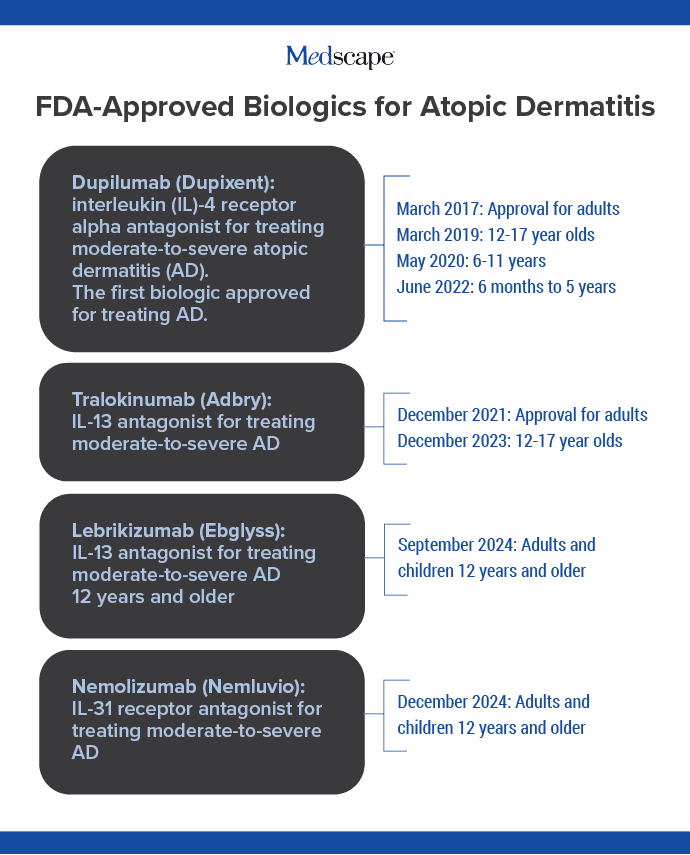
The other three biologics that have been approved by the FDA for treating moderate-to-severe AD since dupilumab was approved are tralokinumab (Adbry) in 2021, lebrikizumab (Ebglyss) in 2024, and nemolizumab (Nemluvio), also in 2024.

It is helpful to explain to patients that biologics can be effective because they are “immune correctors” and not immune suppressants, said Emma Guttman, MD, PhD, Waldman Professor of Dermatology and Immunology and Health System Chair of the Kimberly and Eric J. Waldman Department of Dermatology at the Icahn School of Medicine at Mount Sinai in New York City. “Biologics are working very selectively…and because of that, they are fixing a problem that we have with the immune system that is overactivated, rather than widely suppressing the entire immune system.”
Having the more targeted biologics as an option “has completely changed the conversation,” Lio said. “Instead of asking, how do we suppress this disease enough to get someone through the next few months, we can increasingly think about long-term disease control, safety, quality of life, and matching the treatment to the individual patient.”
A Potential ‘Life-Changing Impact’
For some patients, their response to biologics “can truly be life-changing,” Lio added. “And what is striking is that they often don’t talk first about how their skin looks. They talk about sleeping through the night, wearing clothes they couldn’t wear before, exercising again, concentrating at school or work, or simply not thinking about their skin every minute of the day.”
For example, one patient filed for permanent disability because of severe hand eczema. After the patient started a biologic, the eczema cleared to the point that Lio could write “an amazing letter” about the reversal of permanent disability so the patient could start work again.
“One of the great lessons of the biologics era has been how uncontrolled AD affects virtually every aspect of a person’s life and how much of that burden can improve when we achieve good disease control,” Lio said.
It is an “amazing feeling” for dermatologists to be part of this treatment transformation, Simpson commented. The biologic agents “release these people to become who they’re supposed to be,” with small to large effects that can include better sleep, being intimate with a partner, or returning to work, he added. “That’s why people come back, hugging you and crying, because you’ve given them their life back.”
Managing a Partial or Waning Response
“There is no doubt that we have come a very long way in a short time,” Lio said. “Of course, not everyone has that kind of response,” he added, noting that some patients taking a biologic have only a partial improvement, some have persistent problem areas, and others lose response over time.

When Stein Gold sees a patient with a partial response, she considers combining a topical agent with a biologic or other systemic therapy. “The biologics we have for atopic dermatitis are very good,” although a lot of patients “don’t reach that high bar of clear or almost clear,” she said.
“If patients are doing well initially and they lose efficacy, or they’re really not in a good place, I also have no problem switching systemic medications,” Stein Gold added. “You can stay within the biologics and try another one.”
“The growing number of choices is also making us more comfortable with the idea that failure of one targeted therapy does not mean failure of the entire class or approach,” Lio said. He added that he’s accustomed to starting at a point of inadequate response in patients who are referred to him. “In the past few years, almost 100% of my referrals have already failed a biologic in one way or another.”
Some patient referrals do not reflect true suboptimal responses to biologics, Simpson pointed out. Patients who are also taking systemic steroids can experience rebound if they suddenly stop the steroids when switching to a biologic. “You’re always going to rebound from that. They actually end up doing well on that biologic once we’re able to accommodate that systemic steroid rebound. That could involve giving some of the traditional immunosuppressants longer, or a longer taper of the steroid, or a JAK inhibitor early on.”
Always a Long-Term Commitment?
AD is a chronic condition, and most patients will require long-term therapy, all four experts pointed out. Patients may ask about discontinuing treatment after they achieve a complete response, but there are risks. Extending the time between doses can be another option instead of stopping therapy when appropriate.
Simpson said that most patients ask about the duration of biologic therapy. He advises patients to stay on treatment for a year “and then, depending on how you’re doing, we can talk about what the options are for tapering off or adjusting your dose.” The most common strategy is increasing the time between doses and monitoring for any changes, he said. With this approach, he said, “There’s a proportion of patients who do well, and there’s a proportion who need more topical therapy, and there’s a whole spectrum in between.”
Lio sees it as a sign of progress that with the exception of dupilumab, the other biologics approved for AD have FDA-approved reduced-frequency dosing regimens. Remission is also starting to be discussed. In a February 2026 review paper, he and his coauthors suggested a definition for remission in AD. “This concept of remission is exciting, but I try not to overpromise. AD is a chronic disease, and for many patients, stopping an effective biologic will eventually allow the disease to return.”
Patients do not like hearing that long-term therapy may be required to keep their AD under control, Guttman said. “I explain to them that their disease may go away and they will feel normal.” In that case, they might be candidates for extending the time between injections, she added.
Access and Affordability
Biologics for AD come with a reality check for many patients and physicians, who may face resistance from insurers unwilling to cover the cost, at least initially, all four experts interviewed reported.
“Unfortunately, with insurance, sometimes we have to go through some type of a step therapy,” Stein Gold said. Her strategy is “to try to get patients the medications that I think they need, and then I deal with the insurance companies second.” When appeals to the insurance companies fail, she said that she’s had some success appealing directly to the pharmaceutical companies with programs to help with access.
Prior authorization requirements, formulary restrictions, step therapy, specialty pharmacies, copay assistance, reauthorizations, and insurance changes can create an enormous administrative burden for patients and practices, Lio said. “It is truly one of the hardest parts of my job because so many are affected by this issue, and it’s something that medical school and residency did not prepare us for in any way.”
Navigating insurance issues can be challenging for providers and their staff, Simpson said. But the effort is worthwhile to help patients, he added. The American Academy of Dermatology and National Eczema Association each have online resources to help.
Guttman said she is fortunate to work at an academic medical center with the staff and resources to address insurance challenges regarding biologics. When she learns of dermatologists facing considerable insurance challenges, she offers to see their patient temporarily as a referral to expedite insurance reimbursement. “The patient needs to get their treatment. That’s the bottom line.”
An Active AD Pipeline
Simpson estimated that there are about 20 different biologics in development for treating AD. “Different companies are mixing and matching the cytokine targets, so we’re going to learn a lot about biology and hopefully push the efficacy higher with these new therapies,” he said. Other researchers are focusing on more convenient dosing, he added, including the possibility of dosing once every 6 months.
“There is a lot of research and development in the area of atopic dermatitis,” Stein Gold added. “I run the clinical trials, and we are inundated with new mechanisms of action, and we have new drugs in both the oral and the biologic arenas.”
“The bar for new therapies in AD is getting much higher,” Lio commented. “We already have several very effective targeted treatments,” he said, and any new biologic will increasingly need to distinguish itself through greater efficacy, better control of particular phenotypes or symptoms, longer dosing intervals, better durability, or effectiveness in patients who have failed existing therapies.
“The future may be less about simply adding another biologic and more about identifying which mechanism is right for which patient, with more precise or personalized care,” Lio added. “We have now entered what I like to call the ‘virtuous cycle of drug development’ for atopic dermatitis. We first developed effective targeted treatments, and those treatments not only helped our patients but also taught us more about the disease itself. That improved understanding, which led us to new and often better treatments, which in turn further refined our understanding of AD.
“The cycle continues,” Lio said. “It is an incredibly exciting time because drug development and our understanding of the disease are now advancing together.”
Lio reportedbeing on the speaker’s bureau and/or consulting/advisory boards for multiple companies, including AbbVie, Arcutis Biotherapeutics, Eli Lilly, Galderma, Incyte, Pfizer, Pierre Fabre Dermatologie, Regeneron Pharmaceuticals/Sanofi Genzyme, Almirall, Amyris, Apogee, Astria Therapeutics, Castle Biosciences, Dermavant Sciences, Kenvue, LEO Pharma, Lipidor, Merck, Nektar Therapeutics, Nia Health, Pelthos Therapeutics, Novartis, Stratum Biosciences, and Sun Pharma, and has stock options with Alphyn Biologics, Codex Labs, Concerto Biosciences, Thimble, Topaz Biosciences, and Yobee Care. He also receives royalties for a Theraplex product and is a scientific advisory committee member emeritus of the National Eczema Association.
Simpson reported receivingpersonal fees from multiple companies, including AbbVie, Aclaris Therapeutics, Almirall, Amgen, Arcutis Biotherapeutics, Astria, Attovia Therapeutics, Bambusa Therapeutics, Castle, CorEvitas, Dermira, Eli Lilly, Evomunne, FIDE, Genentech, Impetus Healthcare, Incyte, Infinimmune, Innovaderm Research/Indero, Inmagene Biopharmaceuticals, Janssen, Khanda UK Employco Ltd., Kymera, La Fonderie Ressources, Leo, Nektar Therapeutics/PPD Development, Numab Therapeutics AG, Pfizer, Recludix Pharma, Regeneron Pharmaceuticals, Roche Products Ltd., Sanofi-Genzyme, Sitryx Therapeutics, and UCB Biopharma; and received grants fromor served as principal investigator on studies funded by AbbVie, Acrotech, Amgen, Arcutis Biotherapeutics, Aslan, Castle, Dermavant Sciences, CorEvitas, Dermira, Eli Lilly, Incyte, Kymera, Pfizer, Regeneron Pharmaceuticals, Sanofi-Genzyme, and Veriskin.
Guttman, an employee of Mount Sinai, has received research grants paid to the institution from Regeneron Pharmaceuticals, Sanofi, Eli Lilly, Pfizer, Amgen, GSK, Bristol Myers Squibb, AnaptysBio, AbbVie, Opsidio, Apollo Therapeutics, Aclaris Therapeutics, Concerto Biosciences, Apogee, Enveda Biosciences, Nektar Therapeutics, Triveni Bio, Sitryx, Concert Pharmaceuticals, and Target PharmaSolutions. She is a consultant to multiple companies, including AbbVie, Aclaris Therapeutics, Almirall, Amgen, AnaptysBio, Apogee Therapeutics, Apollo Therapeutics, Arcutis Biotherapeutics, Artax Biopharma, Astria, Bambusa Therapeutics, Bionyra Pharma, Boehringer Ingelheim, Bristol Myers Squibb, Canyon Therapeutics, Celldex, Cue Biopharma, Eli Lilly, Galderma, Generate Biomedicines, Gilead Sciences, and GSK.
Stein Gold reported serving as an investigator, consultant, and/or speaker for AbbVie, Amgen, Arcutis Biotherapeutics, Alumis, Galderma, Incyte, Johnson and Johnson, Leo, Organon, Oruka Therapeutics, Regeneron Pharmaceuticals, Sanofi, Takeda, and UCB.



