Admin_Adham
Every night at Southwark Playhouse, the cast of Lifeline the Musical ended the show with an unexpected reveal: The chorus members who had spent 2 hours playing hospital workers were, in their day jobs, exactly that — doctors, nurses, and public health scientists. Not once, according to composer Robin Hiley, did the audience remain seated for the final bow.
"We are pinching ourselves. The achievement is testament to everyone involved, but particularly the scientists and healthcare professionals who gave up time in their busy lives to be part of the production, share their stories, and give the show such authenticity," said Hiley.

Lifeline has just finished its run in London, after previously being shown at the Edinburgh Fringe and off-Broadway in New York as well as on the floor of the United Nations. The musical highlights the growing global threat of antimicrobial resistance (AMR) and the need for action. It follows the story of Sir Alexander Fleming's discovery of penicillin in 1928, weaving in a contemporary story about a junior doctor in Edinburgh.
From Wards to the Stage
As well as a professional cast, it featured real-life health professionals in the chorus. A different group of 12 people took part every week of the run.
Sixty health professionals successfully auditioned for chorus casting, many using their precious holiday entitlement to take part.
At the end of each show, the chorus members, who play the parts of hospital staff, stepped out in turn to introduce their real selves and their real jobs.

Among them was Dr Eleri Davies, who serves as deputy medical director and head of healthcare associated infections and AMR programme at Public Health Wales. She told Medscape News UK: "The experience has been fantastic. It has always been a dream of mine to appear in a musical and the combination of my professional interest in microbiology and AMR with an opportunity to perform in a musical was too good to miss."
She added: "I think this show functions at two levels: It potentially brings a greater understanding of AMR to the public but also to professionals who don't always see or recognise the effect AMR has on some of our basic treatments such as hip surgery and cancer therapies."
Dr Isra Husain is a paediatric resident doctor at University Hospitals Sussex NHS Trust and National Institute for Health and Care Research Academic Clinical Fellow at Brighton and Sussex Medical School. She told Medscape News UK that she was proud to have been in the chorus. "It feels like a real achievement to be part of a team that put on something beautiful that has a really important message. You know AMR is an issue people aren't really aware of, but it's an issue that needs shouting about."
She added: "Audiences I think felt a kind of shock and maybe... were a bit worried. But the play is excellent at telling the audience the facts and why we should take action. I think the reason it hit home was because it was told in such a relatable story."
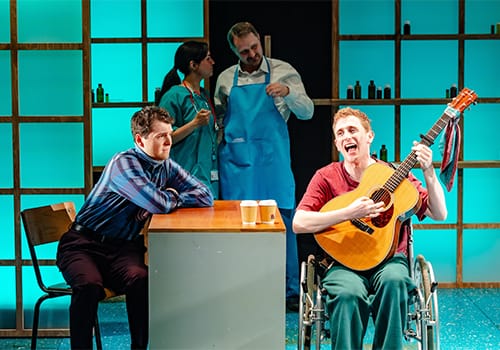
Lifeline traces two timelines: Fleming's discovery of penicillin, and the story of Jess, a junior doctor whose childhood sweetheart falls gravely ill with an infection that is growing resistant to treatment.

Another chorus member was Dr Madi Oliver, a paediatric doctor at Great Ormond Street Hospital for Children. She told Medscape News UK: "The atmosphere every night was really electric, the audience has been really responsive and engaged. Art is such an amazing way of bringing complex issues and concepts to the wider public and helping people to understand it and to emotionally engage with it."
Prominent Backing
Educating audiences about the global threat of AMR was the aim of the production, and Lifeline has re-energised the conversation.
The show has drawn endorsement from senior figures in public health. Dr Colin Brown, head of AMR and deputy director of epidemic and emerging infections at the UK Health Security Agency, said: "Lifeline the Musical reminded me why social movement around AMR matters: music and theatre carry urgency, fear, hope, and solidarity in ways a briefing can't, reaching hearts as well as minds and powerfully inspiring public and political action on drug resistance. We must all work together if we are to preserve Alexander Fleming's legacy."
The musical has some prominent supporters. Professor Dame Sally Davies, the former chief medical officer and now a special envoy on AMR, is a champion of the show. She spoke at one of the performances, describing the musical as a "celebration" of what the AMR community has achieved so far and the "beginning" of a bigger movement.
Prince William has also demonstrated his support for the cause. He wrote a letter included in the theatre programme, thanking the health professionals and scientists for "sharing their stories so generously with audiences”. He wrote about AMR being a "shared responsibility" which requires a "whole society effort, to save modern medicine and ultimately save lives”.
Oliver agreed that it needs a joined-up response: "It needs an integrated approach with problem-solving from all different areas of society. I feel getting us all to sing and dance together has been really inspiring and fun, but it has also facilitated so many meaningful conversations around the issue of AMR."

Husain said AMR is not a distant threat: "I see it every day as a paediatric doctor, currently working in a respiratory medicine department. We have some vulnerable patients with conditions such as cystic fibrosis and chronic suppurative lung disease who do actually need long courses of antibiotics, but we have growing bacteria that are already resistant so they're increasingly hard to eradicate. That really strikes a chord with me personally, but, also, I am an unashamed musical theatre fan. So I jumped at the chance to bring my two worlds of medicine and music together."
What Next for Lifeline?
Now that the Southwark run has been such a success, Hiley wants more people to see the show.
"We played to mostly sold-out audiences who laughed and cried in all the moments we hoped they would. I don't think there was a night the audience wasn't on their feet at the end applauding the finale when we reveal the real-life, day-to-day jobs of our chorus members," he said.
Hiley has plans for the future. "2028 marks the centenary of the discovery of penicillin, so watch this space!"
Contributors to this article reported no relevant disclosures.
Siobhan Harris is an experienced health, medical, and news journalist. She works in broadcast media and online.