Admin_Adham
 Jump to Key Points
 The white coat was supposed to make Amber K. Brooks, MD, MS, unmistakably look like a physician. It did not.
Early in her career, Brooks, now a professor of anesthesiology and pain medicine at Wake Forest University School of Medicine, Winston-Salem, North Carolina, wore one over her scrubs in the pain clinic. Patients still referred to the young Black doctor as a nurse or a medical student. She would politely reintroduce herself as Dr Brooks, their pain medicine physician.
“I truly believe that no matter what I wear, if you hold a particular bias about me based on race or gender, you will be unswayed by a white coat,” Brooks said.
These days, she wears scrubs with an institution-branded vest or jacket. Patients with chronic pain are frequently stigmatized and often mislabeled as drug-seeking, she says, and she doesn’t want a white coat to reinforce the hierarchy between physician and patient. Scrubs help her meet patients “with humanity, professionalism, and most importantly, kindness.” When she stopped routinely wearing a white coat, she noticed no change in how patients spoke to her.
- White coat = symbolic; limited effect on patient trust/role recognition.
- Scrubs favored for OR + many clinical settings; function often outweighs symbolism.
- Healthcare attire frequently contaminated; transmission risk remains theoretical.
- Antimicrobial scrubs: no доказательства ↓ HAI; surrogate studies show no clear benefit.
- Facility-laundered scrubs + bare below elbows improve hygiene; white coats laundered less often.
Her wardrobe reflects the two jobs medical clothing is expected to perform. The white coat identifies the physician and reinforces professional rank. Scrubs are designed for the physical demands of clinical work, but they’ve also become a broader badge of belonging in healthcare.
“Scrubs exist both as a functional piece of PPE and as a symbol of clinical group membership and status,” said Lucy E. Dunne, PhD, professor of apparel design and co-director of the Wearable Technology Lab at the University of Minnesota, Minneapolis. “There are many, many clinical environments where the symbol is needed but not necessarily the function.”
Nearly everything that’s happened to medical clothing over the past 60 years follows from that split. The garment invented for a sterile operating room has spread through the hospital and out onto the sidewalk, and most of the places it’s landed need what it means far more than what it does.
From Bloodstained Coats to Surgical Greens
Before scrubs, surgeons often operated in street clothes. Through much of the 19th century, that could mean a dark frock coat, stiffened with blood and pus from previous procedures, and a heavily stained coat could be read as evidence of experience rather than as a serious hygiene problem.
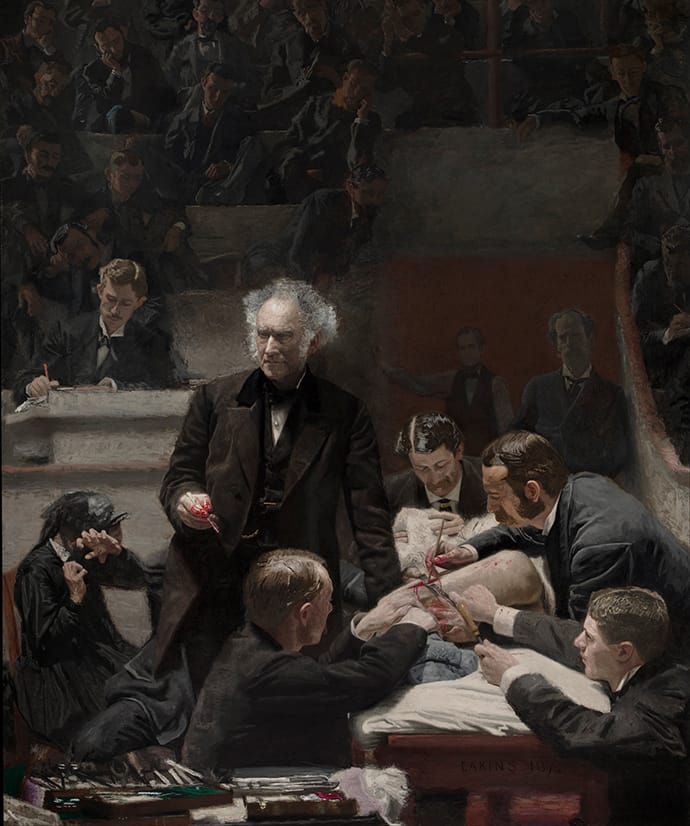
The rise of antisepsis gradually changed that calculation, and medical clothing began to protect the patient rather than merely the surgeon’s wardrobe.
Doctors also exchanged black for white as medicine aligned itself with laboratory science and professional reliability. The white coat became medicine’s most durable symbol and eventually acquired its own initiation ceremony for medical students.
It was never one garment, though. Cynthia Connolly, PhD, RN, professor of nursing emerita at the University of Pennsylvania School of Nursing, Philadelphia, points out that the coat has always encoded rank in the way it’s cut. Medical students traditionally wear a very short jacket, residents wear longer ones, and senior or attending physicians wear thicker coats with their names embroidered on the chest. A patient who can’t read that system only sees the white coat, but those employed by the hospital see a hierarchy stitched into the hem.
Operating-room clothing followed a different path. White gowns initially symbolized cleanliness, but powerful lights reflecting off all-white surroundings caused eye strain, and by the 1960s many hospitals had switched to green. By the 1970s, surgical attire had settled into a short-sleeved V-neck top with drawstring trousers, built to be durable, easily laundered, and easily replaced.
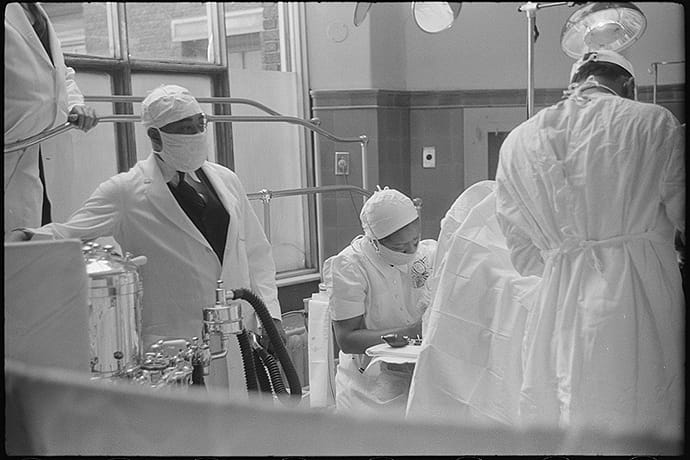
Nursing uniforms supplied another branch of the family tree. Connolly says Florence Nightingale wanted to distinguish trained nurses from the lower-class women who’d traditionally cared for the sick in British almshouses and other institutions. The pressed uniform of a Victorian gentlewoman helped attract middle-class recruits and gave nurses identity and authority, while school-specific caps and insignia marked a student’s progress through training the way military stripes mark rank.

By the 1960s and 1970s, younger nurses were challenging all of it. Nursing education was moving from hospital apprenticeships into colleges and universities, and second-wave feminism made the nurse-as-handmaiden image untenable. The caps were also simply bad equipment, Connolly says, since they caught on traction rigs and fell off, and their Victorian origins felt out of place in postwar America. Scrubs let nurses move. For Connolly, who practiced in pediatrics, colorful tops and pants made her less frightening to children and made it possible to crawl around on the floor with them.
Something disappeared along with the caps. Connolly says the profession never replaced rituals such as the capping ceremony, so some trainees feel less connected to nursing’s history. Patients lost something more immediate, which is the ability to tell who had walked into the room.
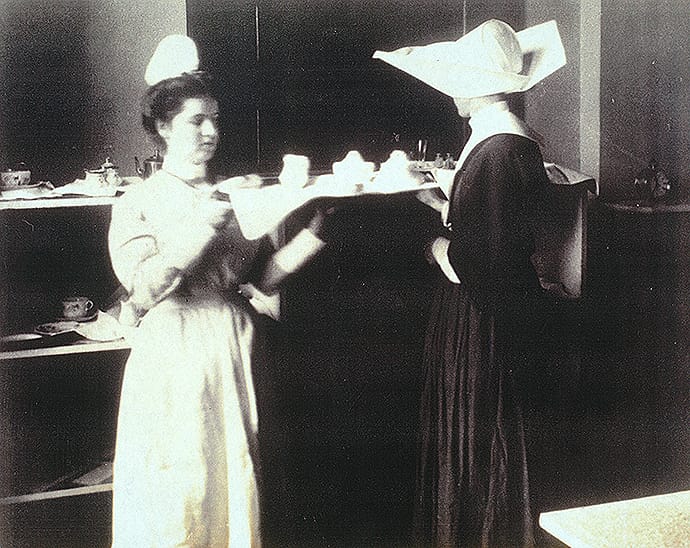
“Family members and friends have told me it is impossible to tell who is a nurse,” Connolly said, “and indeed I’ve found that myself.”
Why the Simplest Uniform Was So Bad for So Long
Scrubs look simple enough, but Dunne says designing them well means balancing an unusually long list of competing demands.
The same uniform may be worn by someone lifting patients, someone sitting at a computer all day, and someone working a ward that’s not reliably air-conditioned. A clinician doing manual handling needs mobility and passes through a much wider range of body temperatures than a colleague taking vitals and typing intake notes, and both may be wearing the identical garment. It must also survive industrial laundering, stay inexpensive, and be tracked through a vast inventory system.
The inventory math turns punishing fast. Dunne ran the numbers for a range of five sizes offered in three lengths, which comes to fifteen garments to track rather than five, and then added a curvy fit and a straight fit on top of that.
“Now you have thirty to maintain,” she said. “Each option adds more waste and error into the system, in that you might not have the right stock in the right sizes for each location at any given time, and keeping everything organized gets a lot more complex.”
Cost compounds it. Cutting and sewing an ergonomic sleeve can be twice as complicated as a simple one or worse, Dunne says, and fit elements that create a more complex shape raise manufacturing costs quickly. Hospital laundry is engineered to be fast and sanitary, which is often harsh on fabrics, and high temperatures can degrade advanced finishes. There are also open questions, she notes, about the long-term health effects of some of those finishes.
None of this was a failure of imagination. Plenty of researchers have redesigned scrubs, and the methods for studying what clinicians need have been well established for decades.
“It’s relatively easy to design a scrub set that works better for a specific user group,” Dunne said. “Getting that design adopted by an institutional process is a very different, and in a lot of ways a much harder, challenge.”

Clinicians who buy and launder their own scrubs escape the system entirely. They can choose stretch fabric, tapered legs, multiple inseams, and pockets sized for the tools they carry, and they can pay a premium for it. They’re also absorbing a cost and a chore that the institution used to carry.
Whether those features are function or marketing depends on the wearer. A tapered leg is an aesthetic choice for someone at a desk, Dunne says, and a safety consideration for someone working around snag hazards. Pocket placement depends on what a person carries and on whether that pocket creates a contamination risk.
“Fashion is an important function as well, though,” she said. “There’s evidence that people who feel better about how they look do better at their jobs.”
The Business That Grew in the Gap
That demand created an opening for companies such as FIGS and Jaanuu, which sold scrubs with the fit and polish of athletic wear directly to clinicians. FIGS later boasted that it had branded a previously unbranded industry. The company reported $631.1 million in net revenues for fiscal 2025 and surpassed three million active customers in the first quarter of 2026.
The marketing became contentious. Strategic Partners, a longtime medical apparel manufacturer that later changed its name to Careismatic Brands, sued FIGS in 2019, alleging false advertising and unfair business practices. The complaint centered on claims that FIGS scrubs treated with an antimicrobial chemical called Silvadur killed bacteria on contact. A federal jury in the Central District of California rejected every claim in November 2022, finding that the statements were neither literally false nor deceptive to a substantial segment of FIGS customers. The two companies settled all related litigation early the following year.
A jury verdict about advertising is not a finding about biology, and the underlying science is thinner than either side’s press releases suggest.
Michael B. Edmond, MD, chief medical officer and professor of infectious diseases at West Virginia University School of Medicine, Morgantown, says there’s conclusive evidence that healthcare workers’ clothing is frequently contaminated with pathogens, and laboratory evidence that those pathogens can move from clothing to skin and to objects. What doesn’t exist is evidence that changing what clinicians wear reduces transmission. Contaminated clothing, he says, is a theoretical risk.
Antimicrobial fabrics have not closed that gap. Edmond says no study has shown that antimicrobial scrubs reduce healthcare-associated infections, and that studies using surrogate measures, such as culturing scrubs after patient care, haven’t shown significant benefit either. Part of the problem is that the trials are close to being unrunnable because such infections are relatively infrequent events, which makes an adequate sample size hard to reach, and because infections may not appear until after a patient has been discharged.
Scrubs still carry real advantages, and they are unglamorous ones. Short sleeves make hand hygiene easier and keep cuffs from dragging across patients and surfaces. Scrubs also get washed far more often than white coats. In one survey of 160 healthcare providers, white coats were laundered every 12.4 days on average, compared with every 1.7 days for scrubs.
Asked to describe the ideal uniform, Edmond skipped fabric technology altogether. He would put clinicians in facility-laundered scrubs donned after arrival at the hospital, with no white coat and no jacket, though he conceded that is impractical outside the operating room. For everyone else, he recommends scrubs washed at home daily on a hot, full-length cycle with detergent and a color-safe oxygen bleach, and a bare-below-the-elbows approach to sleeves.
His one note on outerwear complicates the vest Brooks reaches for on cold mornings. Fleece has been shown to be contaminated more frequently than other fabrics, Edmond says, and jackets and vests are laundered less often than anything else a clinician wears. He’d rather see a waterproof vest that can be wiped down. He’d rather that everyone wiped their stethoscopes and washed their hands, which remains the only intervention he considers clearly effective.
Does the White Coat Still Command Respect?
Patients say it does, at least in the abstract. A study in BMJ Open surveyed 4,062 patients at 10 academic medical centers and found that 53% considered physician attire important to their care. Formal clothing worn with a white coat received the highest overall rating. Context shifted the answer considerably, and scrubs were the preferred look for surgeons. The survey ran between 2015 and 2016, pre-COVID, and respondents were rating photographs of models rather than physicians who’d treated them.
Joshua Lerner, MD, a board-certified emergency physician and assistant clinical professor of emergency medicine at UMass Chan Medical School, Worcester, has not seen a physician work an emergency-department shift in a tie in at least 15 years. The reasons are practical. “You never know what is coming into the ER [emergency room],” he said. A doctor may be suturing a wound one moment and reducing a dislocated joint the next, so “you need to be wearing something comfortable and not afraid to get dirty.”
But when Lerner begins working at a new hospital, he deliberately wears a long white coat until the staff learns who he is. After that, he returns to dark-blue scrubs embroidered with his name and department. In his case, the coat is less about impressing patients than making sure everyone in the room can immediately identify the attending physician.
Actual treatment appears to wash the effect out. In the DRESS study, published in The American Journal of Medicine in 2026, five hospitalists at a single academic medical center alternated week to week between traditional attire with a white coat and surgical scrubs without one, serving as their own control individuals. Researchers surveyed 274 patients using a modified Trust in Physician Scale and, after a mean of 3 hospital days, found no association between trust and what the doctor had been wearing. Five physicians at one hospital is a small study, and its authors didn’t claim otherwise, but the direction of the finding matches what Brooks describes from 21 years of practice.
The coat may do its work in the first seconds of an encounter, before competence and listening take over, and even then it doesn’t work equally for everyone. Female physicians are more frequently mistaken for nurses, physician assistants, or technicians than male colleagues dressed comparably.
“Ultimately, the way I show up for my patients, which is competence, compassion, and kindness, is what truly sets the tone of the patient visit and experience,” Brooks said.
When the Hospital Reaches the Runway
Fashion’s interest in the hospital is neither new nor, historically, welcome. French couture went after medical uniforms twice in the space of a generation. André Courrèges reached the wards first in the 1960s, when the short shift dress he made famous filtered into nurses’ uniforms and helped shorten sleeves and introduce trousers to the hospital floor.
In 1970, Pierre Cardin designed a line for the staff of the new Ambroise-Paré hospital outside Paris, France, built to the technical constraints of the work. It was judged too eccentric and futuristic and rejected outright. Courrèges returned to the idea in 1985 with the intention of conquering the hospitals.
The pattern that Dunne describes was already fully formed 50 years ago. Designing a better hospital uniform was never the difficult part. Getting an institution to buy it was.
What is new is that the traffic now runs the other way, with designers borrowing from the hospital instead of trying to supply it. Fashion has borrowed nurses’ caps, medical crosses, hospital blue, doctor’s bags, and bandages, an aesthetic the Financial Times has dubbed “first-aid chic.” The associations are unusually dense for a designer to work with because doctor-inspired pieces suggest expertise and control while patient-inspired pieces suggest exposure and repair. After a pandemic put masks, gowns, and scrubs into everyday visual culture, the hospital wardrobe became legible far outside the hospital.
The irony is that the runway is buying the symbol at exactly the moment the profession has finished proving how little the symbol reliably does. Clothing couldn’t make patients see Brooks as a physician or tell Connolly which person at her relative’s bedside was the nurse. And it’s never been shown to stop an infection.
Scrubs are still being asked to do two very different jobs. In the operating room, hospitals need garments that can withstand the job. Clinicians working elsewhere have more freedom to choose the fit, fabric, pockets, and other features that suit them. Dunne expects sensors and smart textiles to become more common, but the major advance would be fabric that could clean or sterilize itself. That may never exist.
Until then, the white coat isn’t going anywhere because medicine still needs a way to announce itself to a room in the first ten seconds. It’s simply no longer the only garment doing that job, and it was never as good at it as everyone assumed.
The experts cited in this article reported no relevant disclosures.