Admin_Adham
“We want to allow people to forget that they have diabetes.”
That’s Daniel Anderson’s dream. He and a team of researchers have pushed ahead in that quest: An implantable device “a little smaller than a US quarter” that delivers islet cells to the body to manage blood sugar, thus eliminating the burden of insulin injections.
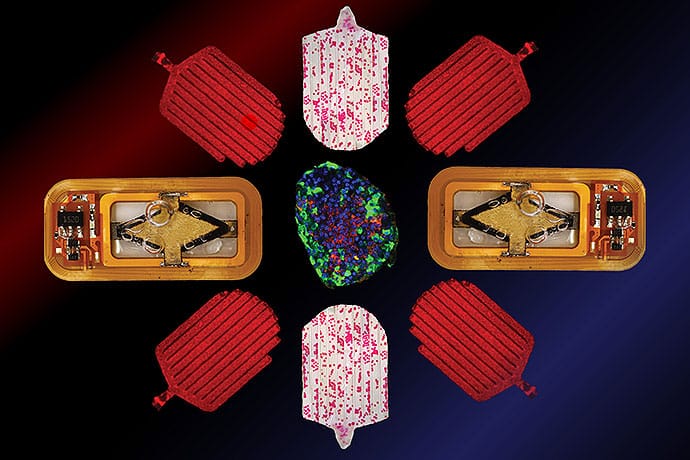
Islet cell transplantation isn’t easy and requires immunosuppression. Detailed in their recent study published in Device, the team has developed an implantable that checks all the complicated boxes: Requires no immunosuppression, works for an extended period, and keeps islet cells alive and well the whole time.
First Problems: Oxygen and Power
Getting islet cells — pancreatic cells that help control the level of glucose in the blood — to survive long-term “has been a real challenge,” explained Anderson, professor in Massachusetts Institute of Technology (MIT)’s Department of Chemical Engineering and Institute for Medical Engineering and Science and member of MIT’s Koch Institute for Integrative Cancer Research, Cambridge, Massachusetts. “Islets can be pretty hungry for oxygen, and the devices have a tendency to fibrose.”

Their goal was to figure out how to get oxygen to a cluster of cells without plugging in an air hose — which was exactly as difficult as it sounds. The solution: Splitting water.
The first author of the study, Siddharth Krishnan, PhD, assistant professor of electrical engineering at Stanford University, Stanford, California, went through a lot of creative tries before finding something that worked. “It involved materials that are used in the fuel cell industry to split water and wireless power harvesting,” he explained.
Those experiments involved another problem: A power source. Batteries were too cumbersome and short-lived to encapsulate in a device, said Krishnan. Once they decided to pursue battery-free power, they “sidestepped” those issues.
“What that means is the device actually harvests power wirelessly,” explained Krishnan. “That was a really useful design choice early on to get this to work for months.”
More Problems: Immunosuppression and Islet Cell Sourcing
Once they were able to create a device that lasted for 3 months, was less prone to cracking, more resistant to water, and autoclave-compatible, they saw some exciting outcomes. “The really important experiment was if you could take a diabetic mouse, put this device containing islets in without any immune suppression, and actually functionally reverse the diabetes,” said Krishnan. “[We] would measure that by lowering the blood glucose and having it be at a controlled, stable range over several weeks. That was the really important moment where we thought this could maybe be a promising concept.”

Ultimately, they achieved diabetic reversal for 3 months in rodents using allogeneic and xenogeneic islet cells. They also achieved allogeneic cell survival for 1 month in a nonhuman primate.
Stem cell-sourced islet cells also proved crucial, eliminating the need for cadaver cells. “This idea of using stem cells as an essentially indefinite supply of [islet] cells is super exciting for the field,” said Krishnan. The stem cell-derived islet cells they tried in a mouse produced promising results. “As we think about the future, this idea that this [device] would be compatible with these stem cell-based dilute products is particularly exciting to us,” he said.
Mollie O’Connor, MD, endocrinologist and clinical assistant professor in the Department of Medicine at NYU Grossman School of Medicine in New York City, who was not involved with the study, also noted that the use of stem cells could eliminate a large blocker to patients getting access to islet transplantation. She was also optimistic about the fact that this device eliminates the second major blocker: the need for immunosuppression.
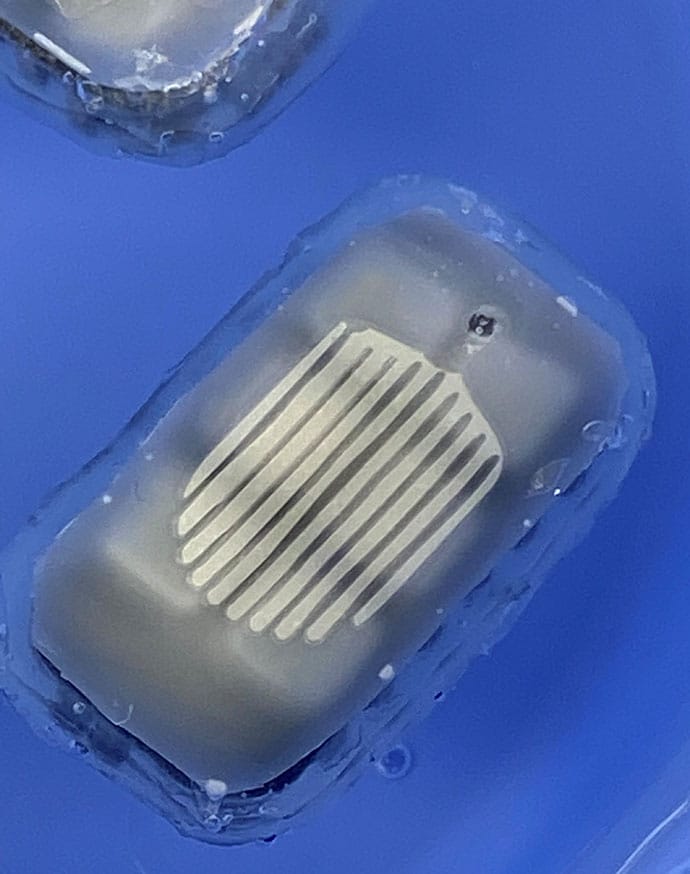
“There have been many people working on similar devices, but thus far, appropriate oxygenation has been a bit of a limiting factor,” she said. “Other strategies have included pre-vascularization, devices that deliver oxygen via an external battery, or the introduction of pores to improve oxygenation, which then reintroduces the requirement for immunosuppression. This is the first research I have seen where charging is wireless/battery-free and without pores and therefore without the need for immunosuppression.”
The Long Road Behind and Ahead
The eureka moment didn’t come overnight. Getting to a device that worked successfully in mice took about 4 years.
“There were a lot of generations of devices and different concepts that aren’t in the paper but led to the paper’s results,” said Anderson.
While the researchers are excited by the results, there is more work to be done before the devices can be tested in humans.
“We’re interested in showing that it can last longer [and] further validating the technology in larger animals,” said Anderson.
O’Connor is optimistic about the hope these could offer patients living with diabetes. “In order for a cure for type 1 diabetes to be feasible, we need to eliminate or minimize as much as possible the need for immunosuppression,” she said. “Encapsulation devices such as the one discussed in this [study] provide a way to provide life-changing islet cells to patients with type 1 diabetes without the use of immunosuppression. I cannot overemphasize how important and incredible this is.”
People forgetting they have diabetes: “That’s the dream,” said Anderson. “We’re not there yet, but that’s certainly what we hope to achieve.”
O’Connor reported having no conflicts. Disclosure information for study authors is available in the original study publication.