Admin_Adham
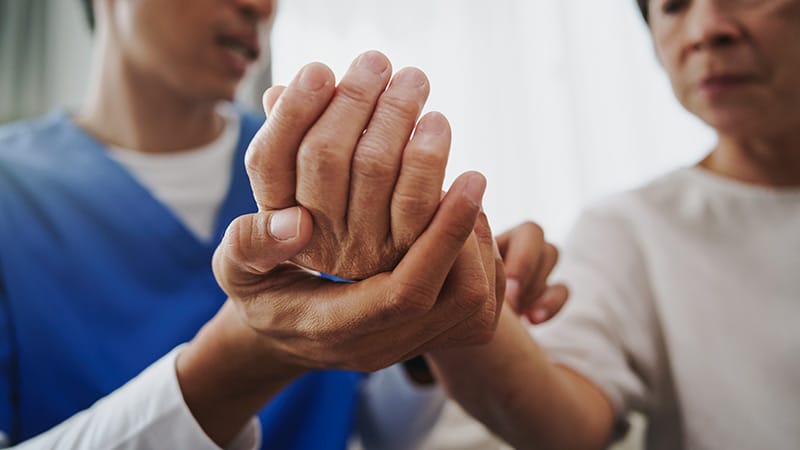
Targeted therapy of the ipsilesional, or “good” arm, improved motor function, including control and speed, in chronic stroke survivors with severe paresis.
In a small randomized clinical trial involving 53 adults with chronic stroke and severe contralesional arm weakness, investigators found that participants who underwent targeted training of the ipsilesional arm demonstrated significant gains in motor function. On a standardized dexterity assessment and a simulated feeding task, participants performed 5.87 seconds faster than at baseline, representing a 12% improvement.
“This is the first project to use a rigorous randomized clinical trial design to investigate the use of ipsilesional limb training — training the less-impaired arm — in chronic stroke survivors with severe paresis,” study co-author, Carolee Winstein, PhD , professor emerita and adjunct faculty, Division of Biokinesiology and Physical Therapy, University of Southern California, in Los Angeles, said in a news release.
The study was published online on February 2 in JAMA Neurology.
Rethinking Stroke Rehab
Individuals with severe contralesional paresis depend almost entirely on their ipsilesional arm for daily activities, yet these impairments remain amenable to improvement even years after a stroke, the investigators noted.
Stroke rehabilitation has traditionally focused on the contralesional — more affected — arm. However, the ipsilesional arm can also demonstrate slow, poorly coordinated, and imprecise movements that interfere with everyday tasks.
These deficits can be especially critical for patients with severe contralesional paresis who rely heavily on the ipsilesional arm for independence and self-care.
Although a substantial body of research has focused on the function and post-rehabilitation deficits of the contralesional arm, the investigators noted that no evidence-based interventions have yet been shown to improve outcomes in the ipsilesional arm.
The goal of the study was to determine whether targeted training of the ipsilesional arm could lead to sustained motor improvements in chronic stroke survivors with severe contralesional arm hemiparesis.
The phase 2, two-site, parallel-group randomized clinical trial included 53 participants (mean age, 59 years; women, 32%; White, 60.4%) with radiologically confirmed unilateral middle cerebral artery stroke who were randomly assigned to ipsilesional (n = 25) or contralesional therapy (n = 28) in an outpatient lab.
Participants completed baseline and at least one posttreatment assessment, in addition to a modified intent-to-treat analysis. They were assessed before the start and end of the trial and 3 weeks and 6 months after the trial concluded.
Evaluators were blinded to group assignments, and all participants were 6 months or more poststroke, right-handed, and cognitively able to participate.
The ipsilesional group had a longer mean time since stroke (7.1 vs 4.7 years) and fewer right hemisphere lesions (44% vs 61%).
Improved Arm Control and Speed
Participants attended supervised 60-minute sessions three times weekly for 5 weeks (15 sessions total), with therapy dose and therapist contact time matched between groups.
Ipsilesional therapy started with 20-30 minutes of virtual reality-based motor training tailored to hemisphere-specific deficits: left-hemisphere stroke participants performed a shuffleboard-style reaching game emphasizing predictive trajectory control.
Right-hemisphere stroke participants completed cursor-tracing tasks requiring continuous precision adjustments. Participants unable to use the virtual system performed matched tabletop tasks.
Sessions concluded with a 6-minute resistive warm-up using bands or putty and 30-40 minutes of real-world dexterity exercises focusing on speed, accuracy, and coordination.
Contralesional therapy included a 10-minute warm-up (stretching, passive range-of-motion, and proximal weight-bearing), a 20-minute therapeutic block incorporating two of three approaches (proximal strength training, motor imagery/mental practice, or mirror therapy), and 30 minutes of active-assisted, goal-directed reaching and object manipulation using familiar items.
Motor function was assessed primarily with the Jebsen-Taylor Hand Function Test (JTHFT).
Secondary outcomes included functional independence (Barthel Index), contralesional impairment (Fugl-Meyer Assessment), and patient-reported manual ability (ABILHAND-Stroke).
At the first posttreatment assessment, participants in the ipsilesional therapy group completed the JTHFT in 5.87 seconds faster than the contralesional group (95% CI, -8.89 to -2.85 seconds; P = .003), a 12% improvement from baseline.
Improvements in ipsilesional motor performance were sustained at 3-week and 6-month follow-ups. No significant between-group differences were observed for Fugl-Meyer Assessment, Barthel Index, or ABILHAND-Stroke scores, which suggests that benefits were primarily task-specific rather than an indication of global functional changes.
“Gains in this treatment group were maintained through 6 months of follow-up, suggesting durable benefit,” the investigators noted.
‘A Promising Target’
Study limitations included the fact that the intervention was designed to enhance overall ipsilesional arm function, making it unclear which specific exercises contributed most to the observed improvements. In addition, outcomes were assessed in a laboratory setting rather than during daily activities, leaving the extent of their impact on real-world function uncertain.
The findings point to a potential shift in rehabilitation practice, which has traditionally prioritized recovery of the contralesional arm. The investigators concluded that targeted ipsilesional arm training improves motor performance in individuals with chronic stroke and severe hemiparesis, positioning it as a “promising target” for rehabilitation.
“We’re changing the function of the less-impaired hand so that their activities of daily living can be more efficient,” study co-author Robert Sainburg, PhD, Dorothy F. and J. Lloyd Huck Distinguished Chair in Kinesiology and Neurology at Penn State in University Park, Pennsylvania, stressed about the novelty of targeting the ipsilesional arm as a therapeutic focus, said in the release.
To translate these findings into broader clinical practice, the investigators underscored the need for additional research that focuses on complementary rehabilitation strategies.
“Future research should explore integration of ipsilesional training with home-based practice and combined bilateral approaches that optimize recovery and independence,” they wrote.
The study was funded by the Eunice Kennedy Shriver National Institute of Child Health and Human Development (2 R01 HD059783-06A1). Candice Maenza and Sainburg reported receiving grants from the US National Institutes of Health (NIH) during the conduct of the study. Winstein reported receiving grants from the NIH during the conduct of the study; personal fees from Enspire DBS Therapy, Medtronic, and MicroTransponder; and royalties from Stroke Recovery and Rehabilitation, 2nd edition, outside the submitted work.