Admin_Adham
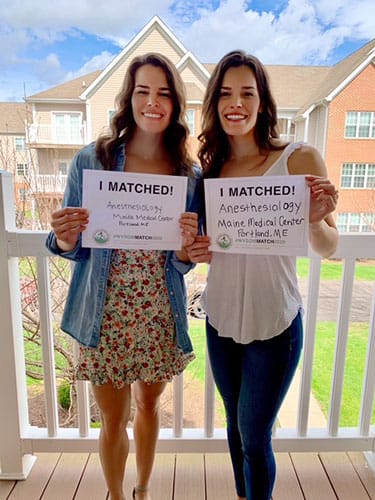
The weeks before Match 2020 were some of the most stressful times identical twins Danielle and Christine Kerr had ever experienced.
The sisters, best friends who had gone to undergraduate and medical school together, had been interviewing in person and applying to resident programs for months. Both had settled on anesthesiology for their specialty.
They hoped to continue their medical educations together but were realistic that maybe they’d have to separate.
In addition, Danielle was engaged and hoped to match at a place where her fiancé could find employment in his field. They both ranked Maine Medical Center in Maine, Portland number one. With only five residency slots in anesthesiology, could they possibly get two of them?
They decided they would be prepared for whatever happened.
“It was a very stressful time. I’d go to bed with my heart pounding,” said Danielle.
But in March of 2020, the entire country became stressed, and not just fourth-year medical students awaiting news about Match. The country shut down because of COVID.
“It was kind of a somber week,” Danielle remembered recently. The sisters opened their emails together, sitting on a couch in their apartment.
“My heart was pounding out of my chest,” Danielle said. She saw that she got her first choice, Maine Medical Center.
Christine was reading her own email.
“You had to scroll all the way to the bottom of the email,” she said, anxiously trying to see the announcement.
“It was a little bit of a nail biter,” she said.
Their stress turned immediately to excitement, even as they celebrated alone in their apartment in Huntington, West Virginia. The Gainesville, Florida, natives, who had gone to undergraduate school together at Dartmouth College and the West Virginia School of Osteopathic Medicine, were going to be able to continue their life’s dream together.
“We knew the chances were slim, so it was just the best day ever,” said Christine.
Getting there had not been easy. At the time, interviews were not done via a digital meeting. The sisters, like all medical students at the time, had been flying hither and yon for interviews, working them in between work and studies.
“We’d probably had 10-15 interviews, most at the same spots,” said Danielle.
They were both exhausted. And worried. They discussed whether to couples match as they knew they both wanted to be in the same place.
They decided to take their chances and apply separately.
“We thought it was more important to be where were wanted to be,” said Christine, and not to make the choice based on being together for that last leg of their medical education.
The outcome shows how the deep soul- and goal-searching that accompanies Match so often works out. While the experience of identical twins having the same specialty and wanting to go to the same residency program may be unique, many other very happy outcomes happen on Match Day.
To optimize the chances of that occurring, medical school advisers repeatedly tell students to do their homework, go with their hearts and then to let it all go after the March 4 deadline.
“The Match algorithm is geared to favor the student,” is how Diane M. Howell, MD, interim assistant dean of students at the University of Florida College of Medicine, Gainesville, Florida, described it.
And yet it is also geared to the best interest of the program, said James Flowerdew, MD, of Maine Medical Center.
“It (Match) has worked really well for us,” Flowerdew said. “We’ve always been happy with the results.”
Or, as others have put it, trust in the process. While that may be hard while you’re waiting for the results, the experts said the matches usually turn out great so long as everyone has prepared well and ranked according to their true preferences.
The Kerr twins paid attention to their hearts as they prepared their rank order list, they said. They knew that they wanted to be together, and they knew they wanted the same program. But they both made the program the key determinant and were prepared to part if they had to. Yet it still all worked out the way they wanted.
The Kerrs also paid attention to location, which medical school advisers and other experts have said is key for medical students to keep in mind.
“There’s a lot of data around where you go to residency and where you might end up for your career,” said Reena Thomas, MD, PhD, a neuro-oncologist and senior associate dean of medical education at Stanford Medicine, Stanford, California. “There’s a high likelihood that you will end up where you do your residency.”
That’s what happened with the twins after residency. Now, they both work for Maine Medical Center.
The twins had fallen in love with Maine and the program during their interviews, which happened on the same day. Being from inland Florida, where the summer heat and humidity can stifle even the most heat-tolerant Floridian, they came to love the change of seasons when they were in undergraduate school in New Hampshire. And they loved being close to the ocean — in a place where it’s cooler in the summer.
Now both married and settled into Portland with their families, the anesthesiologists love the city.
“It honestly feels like home,” said Danielle, who has two children and a third on the way.
Flowerdew at Maine Medical Center was the residency program director when the twins interviewed and did their residencies there.
“We evaluated each of them on their individual merits,” said Flowerdew. “What was amazing was that they pretty much ranked right next to each other.”
There was no doubt that the program wanted both of them, Flowerdew said. So the people in the program at Maine Medical center and the Kerrs were all happy on Match Day.
The Kerrs both turned out to be great residents and physicians. The match made in Maine was great for everyone, Flowerdew said.
“They are both super positive people,” Flowerdew said. “You can understand how far they’ve gone and how well they’ve done.”
Asked what advice they would have for medical students going through Match now, both encouraged students to take a deep breath and to try to let go — both knowing how hard that is to do.
“There’s nothing you can do now to change what’s going to happen,” said Danielle.
And as for the bruising that can happen when a student does not match at one of their most preferred programs, or doesn’t match at all, Christine reminded students to move on and to remember that a good match is a two-way street.
“If that program doesn’t want me, I shouldn’t want them,” she said.
The twins also suggested staying busy during the waiting time. They both love to bake, so they started a baking channel on Instagram called “Twice Baked Twins.”
And if baking isn’t your thing, just try to relax and exercise, the twins said.
“You will end up where you were meant to be,” said Danielle.