

 Admin_Adham
Increasing demand for pediatric subspecialists and declines in much of the subspecialty workforce size are turning long-standing discussions and water cooler conversations into intensified advocacy aimed at improving the workforce and access for children.
Efforts are targeting areas believed to be contributors or key drivers of the challenged subspecialty workforce, including suboptimal levels of early exposure (to both pediatrics and the subspecialties) and mentorship, a financially discouraging training length, and, perhaps most importantly, compensation levels that pale in comparison to general pediatrics and to adult subspecialist counterparts.
Affected pediatric subspecialists “have become more alarmed by the data, and they’ve unified more in concerted efforts to find solutions. We know it’s not getting any better. To really improve the landscape, we need to focus on solutions,” said Darcy Weidemann, MD, MHS, pediatric nephrologist at Children’s Mercy Kansas City and the University of Missouri-Kansas City School of Medicine who works on workforce issues with the American Society of Pediatric Nephrology.

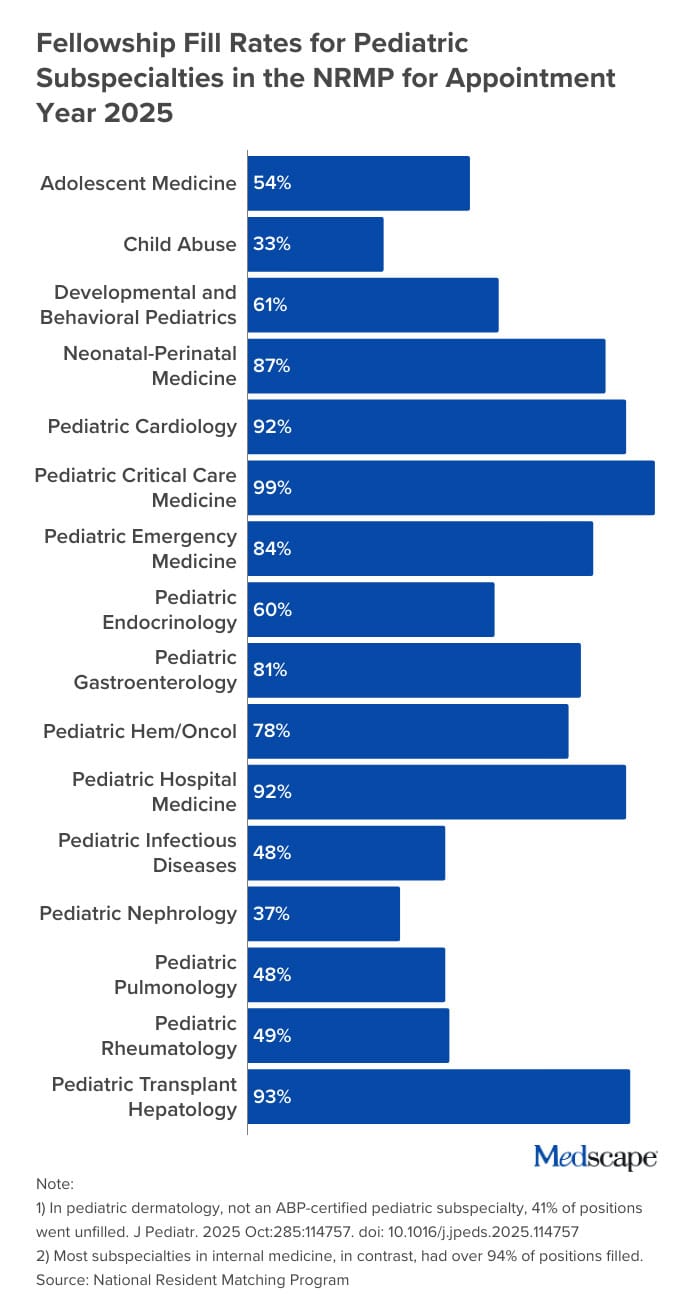
Weidemann is one of several subspecialists contacted by Medscape Medical News to discuss workforce challenges and solutions. Other subspecialists interviewed practice in pediatric rheumatology, endocrinology, and infectious diseases, all of which are The American Board of Pediatrics (ABP)-approved subspecialties that, like nephrology, adolescent medicine, child abuse, and pulmonology, filled under half or just over half of their fellowship positions in the National Resident Matching Program (NRMP) for 2025.
The fate of pediatric subspecialties is tied to that of general pediatrics, which itself has seen declining numbers for over 10 years. In one concerning trendline, the percentage of US MD-degree graduates entering categorical pediatric residencies declined from 9.7% in 2010 to 8.1% in 2018. By 2025, it was worse, with 7.9% choosing pediatrics.
Of similar concern, the percentage of pediatrics residency positions filled through the NRMP declined from 98.6% for appointment year 2021 to 95.3% for 2025. From 2021 to 2025, according to 2025 residency match results and data, the number of graduates of MD-degree-granting schools who have entered pediatrics training has declined, whereas there have been increases in the number of graduates of Doctor of Osteopathic Medicine (DO) degree-granting schools and international medical graduates entering pediatrics training.
Pediatric subspecialists face not only a shrinking pool of generalists from which to recruit but also their own challenges as well. For the appointment year 2025, 28% of all pediatric fellowship positions remained unfilled, while most subspecialties in internal medicine filled over 94% of their training positions, according to a recent paper from the Association of Medical School Pediatric Department Chairs (AMSPDC). (In pediatric ophthalmology and pediatric dermatology, which do not participate in the NRMP, 31% and 41% of positions were unfilled.)
“This is a huge challenge and bigger than any one specialty,” said Scott H. James, MD, pediatric infectious disease specialist at The University of Alabama at Birmingham who leads the workforce development committee at the Pediatric Infectious Diseases Society.

“That’s why it’s very important for us and peds as a whole to make sure we’re forming broad coalitions…to try to accomplish more by banding together for policy reforms,” he said.
Growing Demand, Longer Training, and Lower Pay
Increasing numbers of children are surviving with a history of prematurity, congenital anomalies, and other medically complex conditions that used to be fatal, and more children are living with obesity, diabetes, and behavioral and mental illnesses. On top of this, driving demand in some subspecialties has been the economically driven shift in general pediatrics to focus on wellness checkups and sick visits and to refer out more complicated or chronic problems. Moreover, parents want the referrals, said Cary G. Sauer, MD, MSc, pediatric gastroenterologist at Emory University School of Medicine, Atlanta, who has long been involved in workforce initiatives, including those of the Council of Pediatric Subspecialties, which brings together representatives of the subspecialties and large pediatrics organizations.

“Parents would prefer to hear about how to manage constipation from a gastroenterologist than from their general pediatrician,” he said. “And the pediatrician doesn’t have 30 minutes to talk about it.”
For years, inequity in assigned work relative value units for pediatric vs adult services and low Medicaid reimbursement — significantly lower than that provided with Medicare fee schedules and through private insurance — has taken a toll on pediatrics. According to the National Academies of Sciences, Engineering, and Medicine (NASEM), which issued a report in 2023 on the future of the pediatric subspecialty workforce, Medicaid covers 35% of children overall and a substantially higher share of pediatric subspecialty care.
In Medscape’s 2025 physician compensation report, pediatrics was at the bottom for average total pay ($265,000), almost $30,000 less than internal medicine and $109,000 less than the average of all specialties combined.
What is underappreciated — and unknown by the public and even within parts of medicine, Sauer maintains — is that, except for a few subspecialties, pediatric subspecialists “go through more training to earn less compensation [than their adult counterparts], often significantly less,” as well as less compensation than general pediatricians. Almost all ABP-certified fellowships require 3 years of training compared with 2 years for comparable adult subspecialty fellowships.
In presentations on the workforce, Sauer often shares research published in 2021 by Eva Catenaccio, MD, and colleagues showing that with the exception of pediatric cardiology, critical care, and neonatology, all of the ABP-approved pediatric subspecialties yielded lifetime earning potentials that are significantly less than that of a private practice general pediatrician, ranging from about $70,000 less for emergency medicine to $1,594,000 less for adolescent medicine and $1,927,000 less for developmental and behavioral pediatrics.
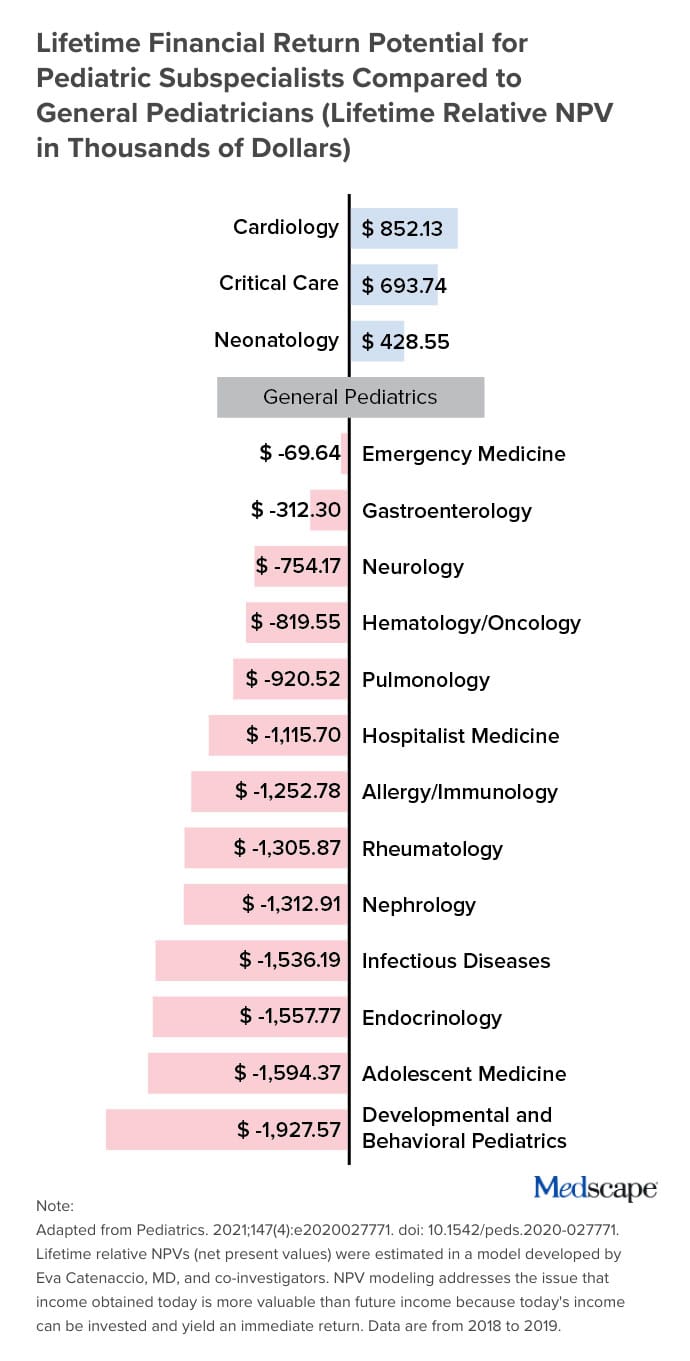
The lifetime financial gap for pediatric nephrology and rheumatology is more than $1.3 million, and the gap for pediatric infectious diseases and endocrinology comes close to that of adolescent medicine, according to the researchers. “The opportunity cost of pursuing a career in pediatric nephrology,” Weidemann said, “is a hard sell for many people.”
(Catenaccio has also modeled differences in lifetime earning potential between academic pediatric and adult medicine generalists and subspecialists. Earning potential for adult physicians across the board averaged 25% more than those of corresponding pediatric physicians.)
Some survey studies have suggested that income considerations are not a primary factor for graduating pediatrics residents in choosing a fellowship. Other studies suggest otherwise. “My feeling is that money is more of a player than most would admit,” said Sauer, professor at Emory and chief of the Division of Pediatric Gastroenterology, Hepatology and Nutrition.
Its importance may be most recently reflected in findings of an ABP-funded microsimulation model that used historical pediatric data to predict the supply of 14 ABP-certified pediatric subspecialists aged ≤ 70 years through 2040. (Pediatric hospital medicine, ABP’s newest certification area, was not modeled because of limited historical data.)
Projected increases in clinical workforce equivalent per 100,000 children from 2020 to 2040 varied from 8% to 78%, and the highest paid subspecialties — those that are “matching well now” — tended to show the highest growth levels, Sauer said.
But “the subspecialties that are at the lower end of the compensation curve and that have seen a decrease in matched fellows didn’t have a lot of predicted growth,” he said.
An interactive data visualization of the ABP-funded model is publicly available on the ABP’s website.
Addressing Compensation Issues, Shortening Training
For the Pediatric Infectious Diseases Society workforce committee, the approach to correcting financial and payment inequities “has been full spectrum,” said James, associate professor of pediatrics at the University of Alabama at Birmingham and director of its Pediatric Infectious Diseases Fellowship Training Program.
“It’s big picture, advocating nationally, speaking to policymakers. It’s also us having conversations within our own institutions” about more accurate valuation of clinical services, he said. “And it’s also even more grassroots, with basics like navigating E&M codes more appropriately, [ensuring the use of] best practices.”
At the Council of Pediatric Subspecialties, Sauer is leading a workgroup dedicated to reframing and better defining clinical full-time equivalents (cFTEs) in ways that will accurately capture the full spectrum of clinical work for pediatric subspecialists, some of which is now unaccounted for and non-billable. (More than half of ABP-certified pediatric subspecialists work primarily in medical school or university settings, and most report some form of academic faculty appointment, according to the NASEM report.)
Individual subspecialty societies, including the Pediatric Infectious Diseases Society and the American Society of Pediatric Nephrology, have their own cFTE workgroups as well that aim to define cFTEs for their specialties. “People are drowning in clinical work right now,” said Weidemann, program director of the Pediatric Nephrology Fellowship Training Program at Children’s Mercy Kansas City. “We need to be better at recognizing our value and advocating for ourselves.”
Pediatric subspecialists also can benefit from loan relief, but the federal government’s 3-year-old Pediatric Specialty Loan Repayment Program has not helped enough physicians, she points out. The program was designed to encourage residents to enter a pediatric medical subspecialty or pediatric surgical specialty and to encourage already practicing physicians, as well as child and adolescent behavioral health or substance use disorder providers, to practice in underserved areas.
But in 2023 and 2024, only 26% and 23% of the award recipients were MD and DO pediatricians and pediatric subspecialists, despite their ranking as the top applicant category. The problem, Weidemann said, may stem from the program’s requirement for 36-40 h/wk of face-to-face patient contact, which is “extremely unlikely” with the academic positions held by most pediatric subspecialists. The American Academy of Pediatrics is among the organizations advocating for reform of the program.
Momentum has been building, meanwhile, for the creation of shorter, clinically focused fellowships. Competency-based medical education in pediatrics that focuses on readiness rather than fixed time has been discussed for many years and endorsed by the ABP, but workforce issues may be bringing more weight to the argument for moving away from a single model of 3-year training programs that the NASEM says prepare fellows mainly for academic careers involving both research and clinical care.
“Why is it that an adult rheumatologist can be trained in 2 years and a pediatric rheumatologist can’t? It makes no sense,” said Beth L. Jonas, MD, professor of medicine and chief of the Division of Rheumatology, Allergy, and Immunology at the University of North Carolina School of Medicine at Chapel Hill, and chair of the American College of Rheumatology’s (ACR) Workforce Solutions Committee.
The current training model “may be slightly outdated and ready for change,” she said, “because there are kids who need care, and they need care from clinicians who aren’t necessarily researchers.”
Development of “distinct fellowship pathways,” including a 2-year option for those who want to focus on clinical care, was among the NASEM-issued recommendations for improving the pediatric subspecialty workforce. But it’s not clear whether shorter fellowships will necessarily lead to increased numbers of pediatric subspecialists.
And there is concern about the impact on research. “Not everyone wants to be a physician-scientist in a research position, and since a good part of 3-year fellowships is research, it makes sense to create a clinical track as well,” said Jesse Hackell, MD, retired general pediatrician who chairs the American Academy of Pediatrics Committee on Pediatric Workforce.

“But there’s potential for harm,” he said, “If you reduce the number of physician scientists, in the long run you start to impact research and new discoveries that will have a long-lasting effect on children over time. I worry about the unintended consequences.”
The ACR’s Pediatric Rheumatology Committee created a standing Task Force on Flexibility in Training that is partnering with the ABP and working with other subspecialists to “think through the issues” involved in designing and evaluating more flexible competency-based training, said Ekemini Ogbu, MD, MSc, who chairs the ACR committee. Ogbu is the director of Neuroinflammatory Disease Services in Rheumatology and co-director of Cincinnati Children’s Lupus Center at Cincinnati Children’s Hospital Medical Center and an associate professor of pediatrics at the University of Cincinnati, Cincinnati.

“We want to make sure [fellows] will feel very comfortable and competent to not only care for patients but also contribute to advancing the field,” she said. “Can we achieve this in a shorter amount of time? We think it’s possible.”
Other subspecialty societies are leading similar efforts. The American Society of Pediatric Nephrology, for instance, is developing a pilot proposal to present to the ABP for a training pathway of modified duration. It will incorporate the Accreditation Council for Graduate Medical Education’s Milestones 2.0 as well as Entrustable Professional Activities (EPAs) that serve as the outcomes-based backbone of competency-based medical education.
EPAs were developed more than 10 years ago by the pediatric subspecialty community and the ABP, and subspecialties have already been incorporating them into their training programs to some degree, said David A. Turner, MD, vice president for Competency-Based Medical Education for the ABP.

In 2028, the board will require the use of EPAs and begin collecting data on readiness to practice using the EPA framework in all subspecialties and general pediatrics. The ABP is “conceptually supportive of shorter training pathways if they are competency-based and lead to each graduate being fully prepared to practice,” Turner said. However, the “optimal duration required to achieve outcomes needed for patients is unclear.”
Illuminating Pediatric Advances, Campaigning for Child Health
For some of the subspecialties, but not all, clinically focused training tracts could lead to more subspecialists practicing in communities, away from academic medical centers — a move that could potentially help to alleviate the significant geographic maldistribution of pediatric subspecialists documented in the ABP’s supply prediction model and other research, according to some sources. So could the establishment of new training programs in areas of need — something which pediatric rheumatology has recently achieved with two new fellowships.
But given current demands for subspecialist care, and often long wait times and often long travel times, improving generalist-specialist interactions may be an area of faster traction for some subspecialties.
“Even with good solutions, we’re going to be struggling with a really diminished workforce for a long time,” Weidemann said. “So, finding ways to better partner with general pediatricians and APPs [advanced practice providers] to better manage bread-and-butter things [such as hypertension] — so we can focus on the most complex issues, some of the more advanced kidney disease — is important.”
What exactly this means is under discussion at various organizations. A small workgroup at the AMSPDC, for instance, is looking at how to improve the efficacy and efficiency of pediatrician-subspecialist interactions, and there is interest at the Council of Pediatric Subspecialties in conducting research to characterize APPs’ involvement in pediatric subspecialties, Sauer said.
Preserving telemedicine, and expanding it so that clinicians can provide care across state lines and not only in the states in which they’re licensed, is important, said Tandy Aye, MD, pediatric endocrinologist at Stanford Medicine Children’s Health and associate professor at Stanford University School of Medicine, Palo Alto, California, who sits on the Pediatric Endocrinology Society Workforce Action Team. “Type 1 diabetes,” she noted, “requires a visit every 3 months.”

Even with telemedicine, however, it still comes down to the numbers and having a robust workforce. “There’s what I call an unlimited supply of patients,” Sauer said. In Atlanta, in his subspecialty of pediatric gastroenterology, “I could hire 20 new physicians tomorrow and fill their schedules without a problem.”
Early exposure to subspecialties has long been a priority and will continue to be, the subspecialist leaders all said. Most, if not all, of the pediatric subspecialty societies have programs that sponsor medical students and residents early in their training to attend their national meetings.
“We’re hoping to incite interest in pediatric rheumatology” through such programs, said Ogbu, noting that “most people in the community don’t realize that children have arthritis or lupus or the other diseases we treat.”
Robert J. Vinci, MD, professor of pediatrics at Boston University School of Medicine, Boston, and co-leader of the AMSPDC Pediatrics Workforce Initiative, said that subspecialists can play an important role in recruiting for their fields — and for pediatrics as a whole — by describing the scientific advances in their fields and in “telling their stories” to medical students and to high school and college students as well.

A 2025 paper from AMSPDC published in The Journal of Pediatrics, titled “A Rising Tide Lifts All Boats: The Role of the Subspecialist in Recruitment into Pediatrics,” urges subspecialists to “see themselves as representing pediatrics and all subspecialties.” Focusing on recruiting from pediatrics residencies “may be a zero-sum game,” it warns.
The authors also point to research showing that approximately 40% of students who went into pediatrics made the decision before medical school.
AMSPDC’s workforce initiative, which was bolstered by the NASEM report, includes efforts to optimize the depth and duration of medical school training in pediatrics and to address pediatrics’ economic challenges. The AMSPDC is also planning a national public awareness campaign to “emphasize the importance of improving child health” and the role of pediatricians, Vinci said, noting concerns that the 2025 One Big Beautiful Bill Act will further worsen children’s health.
“We’ve lost our compass,” he said. “We’re so aware of the healthcare needs of older adults and the growing older population, but if we really want to improve long-term health outcomes, we need to invest in children and families.”
Change happens slowly, he and other sources emphasized. “Everyone’s feeling more urgency,” Sauer said. “But it’s a long game [that includes] getting people interested in pediatrics and valuing pediatricians in our healthcare system, including but not limited to compensation.”
“Eventually,” he added, “I hope this trickles up to national changes with payment systems and Medicaid and Medicare [parity].”
None of the physicians quoted in this story reported having any relevant financial disclosures.
