

 Admin_Adham
 Jump to Key Points
Despite the current administration’s attempts to rewrite the childhood vaccine schedule, a new survey suggests most US clinicians will continue to follow long-standing immunization recommendations.
The survey, conducted by The Larry A. Green Center at Virginia Commonwealth University in Richmond over 7 days in early March, found that more than two thirds (67%) of the 463 clinicians with pediatric patients said they would adhere to the American Academy of Pediatrics’ (AAP’s) vaccine schedule over the new federal guidance.
The survey also found patients are increasingly confused or hesitant about vaccines, and clinicians may be burning out as a result.
In January, the US Department of Health and Human Services announced that six vaccines, including those for meningococcal disease and hepatitis B, would be removed from the childhood immunization schedule.
- 67% of 463 clinicians w/ pediatric pts favored AAP schedule over federal guidance.
- Federal move removed 6 childhood vaccines; judge temporarily blocked it.
- AAP schedule remains aligned w/ prior CDC recs: vaccination vs 17 diseases.
- 37% reported ↑ patient tension; 12% staff uncertain which schedule to follow.
- 52% reported high burnout/moral injury; disruptions worsened strain.
A federal judge temporarily blocked the move, but in August, President Donald Trump signed an Executive Order reiterating the overhauled recommendation, which is intended to reduce the number of shots children receive.
In comparison, the AAP’s guidance mirrors the previously established recommendations from the CDC that all children be vaccinated against 17 diseases.
Rebecca Etz, PhD, co-director of The Larry A. Green Center, said the new findings were both unsurprising and indicative of an “unusually politicized” health system.
“I think that the medical profession is trying to be professional,” said Etz, who led the survey. “It surprises me that we would reject decades of science, and, so quickly and easily, adopt guidance that is the ideological belief of a select few.”
Ashlesha Kaushik, MD, MS, president of the AAP’s Iowa Chapter, agreed the findings of the survey were not unexpected, given how medical organizations and states across the country are ignoring the updated recommendations.
Twelve professional societies, including the American Medical Association and the American Academy of Family Physicians, have publicly endorsed the AAP’s schedule. Earlier this month, New York joined 15 other states and the governor of Pennsylvania in a lawsuit against the federal government to restore the previous vaccine guidance.
The majority of clinicians are “continuing to do what they have always been doing” by observing the previous schedule, Kaushik said. “You don’t want to suddenly steer away from it for no good reasoning.”
Separate surveys have drawn similar results. A February poll of almost 1000 Medscape readers found the majority also supported the AAP’s guidance.
Signs of Strain
Yet the new survey also suggests the conflicting recommendations may be taking a toll on medical practices and patients. Among the 623 clinicians polled, 12% reported their staff were uncertain about which schedule to follow, and 37% said there was new tension with patients who were also confused.
Roughly half of those clinicians also reported patients are now questioning vaccines they previously accepted, while discussions around immunizations are taking longer than they once did.
“It’s interesting to me that, in a very short order, clinicians are having to engage in conversations about things that used to be pretty standard for decades,” Etz said.
This shift also appears to be harming clinician well-being, the survey found, with 52% of respondents reporting high levels of burnout or moral injury.
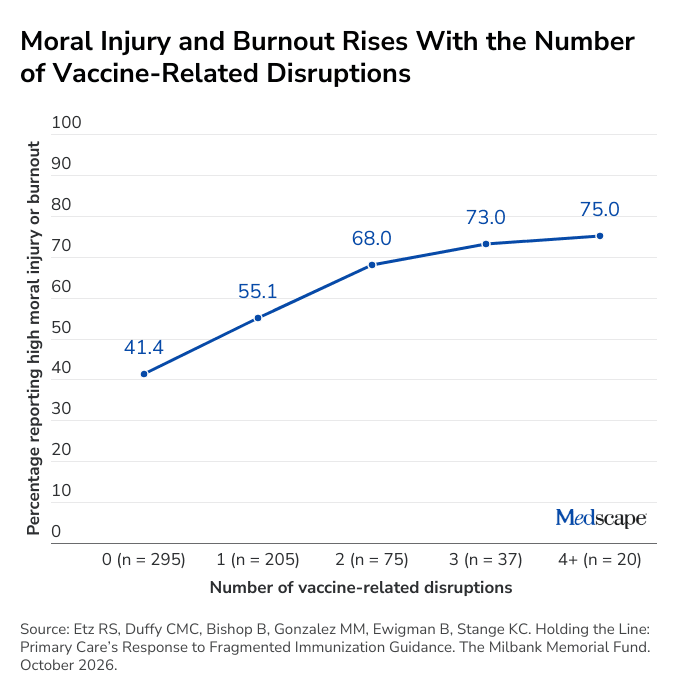
This figure increased among clinicians who more often dealt with vaccine disruptions, which, according to Etz, include vaccine hesitancy and the potential increase in the cost of a shot. “For each obstacle they encountered, their level of moral injury and burnout increased,” she said.
Discussions around vaccines require energy, Kaushik said, adding that they also time taken away from other concerns that require a clinician’s attention. “It’s just putting a lot of burden on our already burdened workforce.”
The sources cited in this story reported no relevant financial conflicts of interest.
Sam Nichols is an Australian science journalist, whose work often covers healthcare, drug policy, addiction, and medicine.



