Admin_Adham

As myopia rates climb, eyecare experts are urging clinicians to take frontline action and get ahead of the condition before it escalates to something worse.
“It is a serious visual disease that greatly increases the risk of retinal degeneration, choroidal neovascularization, retinal detachment, and blindness,” said Jose Manuel Alonso, MD, PhD, a professor at the State University of New York College of Optometry in New York City.
Even low myopia is linked to grave risks, said Robert A. Clark, MD, clinical associate professor of ophthalmology at UCLA’s Stein Eye Institute. Citing his own preliminary data analysis, Clark said that a patient’s risk for glaucoma and cataracts doubles just by progressing from -2 to -3. Moderate myopia starts above -3, and high myopia is -6.0 or higher.

Many physicians “think low myopia is just glasses, and high myopia is bad. And if the child’s not that bad, I’m not going to worry about it,” Clark said. “Well, guess what. You would not let somebody who had high blood pressure go another year or two, and say, ‘Your risk is relatively low, we don’t mind a doubling of your risk of these problems.’ You would go ahead and treat that.”
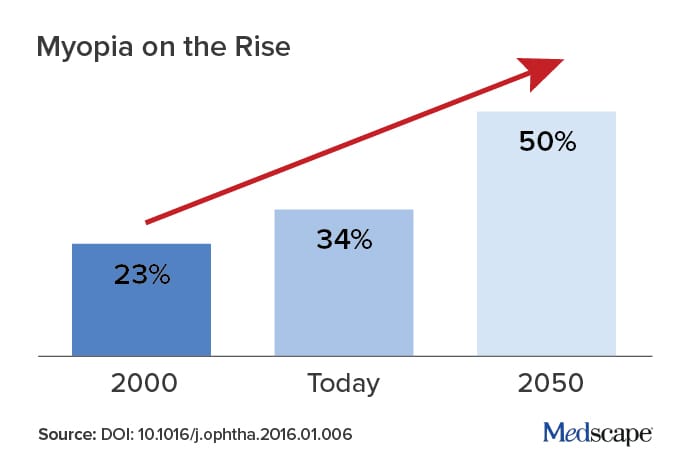
Myopia now affects about 1 in 3 people, rising from 1 in 4 around the turn of the century. Its prevalence is projected to reach 1 in 2 by 2050. Experts blame not genetics but environment, with lack of outdoor time considered a stronger influence than the oft-cited screen time.
Scientists are responding with new treatments and a better understanding of myopia’s causes — tools clinicians can use to potentially delay its onset and slow its progression.
What’s Driving Myopia?
New research co-authored by Alonso and published in February in Cell Reports proposes a new mechanism for myopia: Reduced retinal stimulation during low-light near work weakens neural pathways.
Comparing 34 participants in their twenties, including 14 without myopia, the researchers found that people with myopia have excessive eye vergence (inward turning) and pupil constriction when focusing on near objects. Myopia also appears to disrupt the automatic management of pupil constriction during blinking. These disruptions, stemming from prolonged lack of light activation of the retina, likely weaken neuronal pathways — which could cause myopia. “According to this mechanism, myopia can be prevented with visual diets that maintain a healthy retinal illumination throughout the day, which require healthy lighting conditions when reading indoors in addition to spending time outdoors,” Alonso and his co-authors suggested in their paper.
If their hypothesis is proven correct, finally zeroing in on a myopia mechanism would be a huge breakthrough for eye researchers — something that has eluded them despite a consistent set of clues, like observed links to outdoor time, screen time, and reading under low light, all of which relate to pupil constriction.
Cutting Edge Treatments With Big Unknowns
Ohio State University researchers are starting a new study to examine whether atropine eye drops, which relax eye muscles, can delay the onset of myopia. The study will enroll 660 US kids recruited from school system vision screening sessions, use enhanced screening to pinpoint risk, and then randomly assign them to 0.05% atropine or placebo eye drops.

Debate persists about concentration — whether 0.01% or 0.05% is more effective. More than 800 children in Clark’s practice are taking low-dose atropine to delay myopia progression, and he said fewer than five have progressed. He noted that a higher concentration is tough to tolerate and found the lower 0.01% dose works well.
Atropine for FDA-approved uses comes in a 1% concentration, so lower doses need to be compounded, resulting in variability that can be problematic, said Lisa Ostrin, OD, PhD, professor of optometry and vision science at the University of Houston College of Optometry in Houston.
Another sticking point is that the mechanism behind atropine’s effect remains a mystery, despite being used for myopia for decades. “In medicine, it makes us very nervous giving a child something that we don’t know how it’s working,” Ostrin said.
Defocus spectacle lenses offer another emerging treatment. Designed to slow myopia progression, the lens is etched with a ring of tiny, raised dots that “defocus” (or blur) peripheral light. A clinical trial reduced progression by 71% in 24 months, according to data reviewed by the FDA and cited in its 2025 approval of the first defocus lens in the US, called Stellest from lens maker Essilor International.
Clark is making defocus glasses in his office now. “That’s where the market’s going to go, just because it makes the most sense,” he said. “Why would you do additional therapy, expose your kid to light, expose your kid to medication, if you did not need to?”
Steps You Can Take

The main thing for clinicians to do right now is to emphasize behavioral strategies that help patients get ahead of myopia and delay its progression. Here are some practical suggestions from eyecare experts:
Maximize outdoor time: For all kids, but especially those younger than 5 years, aim for 2 h/d. “Framing outdoor time as ‘protective for growing eyes’ can be powerful,” said Síofra Harrington, PhD, a children’s eye health and early myopia identification expert at Technological University Dublin in Dublin, Ireland.
Look for an opening: Just noting that a parent has thick-lensed glasses could be an opportunity to bring up environmental and behavioral changes, suggested Robyn Liu, MD, MPH, a family physician in Portland, Oregon, and member of the board of directors for the American Academy of Family Physicians.
Prioritize early screening: Between ages 3-5 is the ideal time to start identifying who’s close to or just a bit over the line — because it’s early enough to fully delay progression, said Jeffrey J. Walline, OD, PhD, associate dean for academic affairs at Ohio State University’s College of Optometry in Columbus, Ohio.

Undergo clinical evaluation: The vision chart is all you need. If a child can’t see the smallest letters, there’s a good chance they could already be developing myopia, Ostrin said.
Advise windows and arm’s length: Tell parents to ensure kids are doing near work next to a window or with very bright indoor light, and to keep devices and books at arm’s length. (Patients with an iPhone can turn on screen distance alerts.) Kids should also take regular breaks, which allows the pupil to release its light-blocking constriction. Research has found a dose-dependent link between screen time and myopia, with each hour boosting the odds of developing myopia by 21%.
Tell adults not to sleep on vision changes: Encourage older patients with myopia to have annual eye exams and to call you or their eye specialist if they experience sudden floaters or other vision changes. Adults often notice vision changes and decide to literally sleep on it to see if they’re better in the morning, Harrington said, but “if they’re seeing flashing lights, they need to be seen that day.” A detached retina, if not treated promptly, can result in permanent vision loss within 24 hours.
What’s Next?

Defocus lens options are coming, Clark said. Several brands are already approved in Asia (where myopia rates reach 90% in some regions) and FDA applications are expected to be cleared in the next 6 months to 1 year. For now, defocus lenses for managing myopia are typically not covered by insurance but that could change if the FDA approves them.
Alonso said his team is continuing to home in on myopia’s mechanism, and their latest findings not yet published have him feeling confident.
“I really think there is a chance that we will solve the problem within my lifetime,” Alonso said. “This is not Parkinson’s disease, it’s not schizophrenia. It’s something that I think we can solve.”
Clark disclosed that he is a consultant for the following companies that make atropine eyedrops and/or defocus contact lenses: CooperVision, Vyluma, and Sydnexis.