

 Admin_Adham
 Jump to Key Points
At the 2026 European Respiratory Society (ERS) Congress, the ERS unveiled its updated clinical practice guidelines for the treatment of pulmonary arterial hypertension (PAH). The revision reflects important therapeutic advances and new evidence on risk stratification that have emerged since the last edition in 2022. We reviewed the guidelines with Gabor Kovacs, MD, Ludwig Boltzmann Institute for Lung Vascular Research, Graz, Austria, lead author of the 2026 guidelines.
New Treatment
In the 2022 European Society of Cardiology/ERS recommendations on the diagnosis and treatment of PAH, several treatments targeting three therapeutic pathways — the endothelin pathway, the nitric oxide (NO)-soluble guanylate cyclase (sGC)-cyclic guanosine monophosphate (cGMP) pathway— were introduced.
“However, since then, major advances have expanded the therapeutic arsenal,” said Kovacs. “In 2024, sotatercept, the first activin signaling pathway inhibitor of its class, was approved by the FDA and the EMA for the treatment of PAH. An update was necessary.”
Specifically, this fusion protein serves as a type IIA activin receptor ligand trap and directly alters bone morphogenetic protein signaling.
- 2026 PAH guidelines add sotatercept as 4th pathway therapy.
- Sotatercept recommended for follow-up low-intermediate to high-risk PAH on existing therapy.
- Evidence: improved clinical worsening, NT-proBNP, 6MWD, hospitalization risk.
- Low-risk PAH: no routine sotatercept recommendation; case-by-case decision.
- Repeat RHC advised if results may change management; low-risk follow-up remains individualized.
By targeting a fourth therapeutic pathway, sotatercept provides a new treatment strategy, with additional benefits shown in pivotal studies, including among patients already receiving optimal medical therapy.
What About Invasive Hemodynamics?
Furthermore, recent studies have evaluated the added value of invasive hemodynamics in risk stratification tools to guide therapeutic decisions during the follow-up of patients with PAH.
Right heart catheterization remains the gold standard for assessing pulmonary hemodynamics and establishing a diagnosis of PAH.
“However, its role during follow-up to guide the treatment strategy remains less clearly established,” Kovacs conceded. “A review of the literature and the development of evidence-based medicine recommendations could thus help better define its use in patient management.”
The new recommendations are divided into four patient/population, intervention, comparison, and outcome (PICO) questions.
PICO 1: Should patients with PAH who, during follow-up, have a low-to-intermediate, intermediate-to-high, or high risk for mortality, and who are already receiving one or more PAH-specific treatments, be treated with activin signaling pathway inhibitors (compared with no treatment with activin signaling pathway inhibitors)?
To answer this question, four randomized controlled trials — the most robust studies on the efficacy and safety of sotatercept — were selected: PULSAR, STELLAR, ZENITH, and HYPERION.
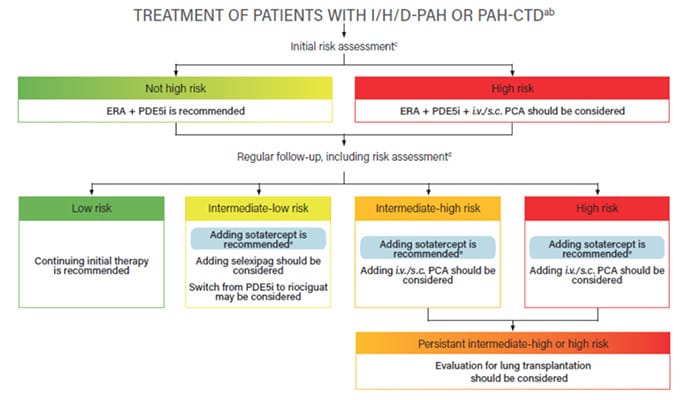
“The meta-analysis of these four randomized controlled trials showed improvement in patients with PAH treated with sotatercept,” Kovacs said, citing benefits across time to clinical worsening, changes in N-terminal pro-B-type natriuretic peptide levels, 6-minute walk distance, and hospitalization risk. As a result, sotatercept is recommended for patients with PAH who are already receiving one or more PAH-specific therapies and who, during follow-up, are at low-to-intermediate, intermediate-to-high, or high risk for mortality. The recommendation is supported by high-certainty evidence and is strong.
PICO 2: Should patients with PAH who, during follow-up, have a low risk for mortality and are already receiving one or more PAH-specific treatments be treated with activin signaling pathway inhibitors?
“Since the number of low-risk patients included in clinical trials was much smaller,” noted Kovacs, “the working group was unable to make a recommendation on this issue. This does not mean that this treatment should not be administered or that it should be administered routinely. Treatment decisions for these patients must be made on a case-by-case basis, after considering all available clinical data.”
Because the risks and benefits of sotatercept treatment in PAH patients with a low risk for mortality are less clearly established, regular follow-up at centers specializing in PAH is essential.
“Administered subcutaneously every 3 weeks, sotatercept is now classified in the 2026 update of the guidelines as a second-line treatment for patients at intermediate or high risk who are already receiving oral therapy and who have not achieved low-risk status,” commented David Montani, MD, PhD, a pulmonologist at the French National Referral Center for Pulmonary Hypertension at Bicêtre Hospital in Le Kremlin-Bicêtre, France. “For low-risk patients, this should be discussed on a case-by-case basis.”
First-line treatment relies primarily on oral therapies, particularly phosphodiesterase type 5 inhibitors and endothelin receptor antagonists. For patients whose disease remains inadequately controlled, sotatercept can now be introduced as a second-line treatment.
If the response remains inadequate despite these treatments, other options are available, notably prostacyclins administered via continuous intravenous or subcutaneous infusion. And in cases of persistent disease, lung transplantation remains a possibility. “The goal is to bring as many patients as possible to low-risk status, which is associated with a more favorable prognosis and lower mortality,” continued Montani.
PICO 3: To help guide treatment decisions, the panel asked whether patients with PAH who, during follow-up, are at intermediate-low, intermediate-high, or high risk for mortality and are already receiving one or more PAH-specific therapies should undergo repeat right heart catheterization compared with no repeat catheterization?
To guide treatment strategy, the recommendations advise repeat right heart catheterization in patients with PAH who are already receiving one or more PAH-specific therapies and who, during follow-up, are at low-to-intermediate, intermediate-to-high, or high risk for mortality, when the procedure is likely to lead to a change in therapeutic management. The recommendation is conditional and is based on very low-certainty evidence.
PICO 4: To guide the treatment strategy, should patients with PAH who, during follow-up, have a low risk for mortality and are already receiving one or more specific treatments for PAH undergo reevaluation via right heart catheterization?
Given the very low certainty of the evidence, the working group made no recommendation on this question. “Although the complication rate of right heart catheterization is very low in specialized centers, the benefit-risk balance of the procedure may be less favorable in patients at low risk of mortality,” Montani noted. The decision to proceed with right heart catheterization should therefore be shared with the patient and should consider the duration of low-risk status, any residual hemodynamic abnormalities seen on a prior catheterization, the cause of PAH and associated comorbidities, patient preferences, and whether treatment could alter the disease course and prevent progression rather than simply maintain current stability.
Treatment Algorithm
Grant support was reported from Boehringer-Ingelheim, Johnson & Johnson, MSD, and the European Respiratory Society. Honoraria or consulting fees were reported from several companies, including Boehringer-Ingelheim, Chiesi, Johnson & Johnson, MSD, and United Therapeutics, among others.
This story was translated from Medscape’s French edition.



