

 Admin_Adham
In the first human trial of robotic-assisted cataract surgery, 10 patients underwent the procedure with good outcomes with no complications related to the treatment, according to the Los Angeles-based physician who performed the operations.

“It’s a neat first step,” Uday Devgan, MD, who performed the procedures in El Salvador, told Medscape Medical News.“The first step is always bold, it’s always scary, and there’s always this sub-element of risk.”
The results have not yet been published, but they have been publicized by the American College of Surgeons and the University of California, Los Angeles (UCLA), home to the team that developed the robotic cataract surgery system.
The patients in the proof-of-concept study underwent a cross-section of cataract procedures, Devgan said, with a similar number of male and female patients, right and left eye procedures, and myopic and hyperopic eyes. “We had the whole spectrum,” he said. The system, called Polaris, from Horizon Surgical Systems, has not been approved for use in the US.
Inside the System
The Polaris platform Devgan and his colleague, David Lozano Giral, MD, director of the ocular trauma service at Jules Stein Eye Institute at UCLA, used consists of a surgical cockpit at which the surgeon sits and manipulates the instruments while viewing a three-dimensional monitor that displays ocular anatomy captured through a three-dimensional video system and real-time optical coherence tomography.
Surgical robotic arms attached to a cart near the patient’s head use interchangeable microsurgical tools to make small corneal incisions, through which the eye’s natural, cataract-affected lens is removed and the prescription intraocular lens is implanted to restore 20/20 vision.
“The goal of the robot is not to replace the surgeon,” Devgan said. “The goal is to make the surgeon a better version of himself or herself. The robot can do certain things that human cannot.”
He noted that his hand has the precision to move the tip of a surgical instrument to within 30-40 microns of its target, whereas the robot has the precision to move within 5 microns. By comparison, a human hair has a thickness of 50-120 microns.
“The robot can take in data much faster,” he said. The human brain can process about 25 frames per second; the robot can process about 100-200 frames per second and combine that input with real-time, high-resolution optical coherence tomography scanning.
“The robot can help us become more precise, have better reaction time, and hopefully also better safety,” Devgan said.
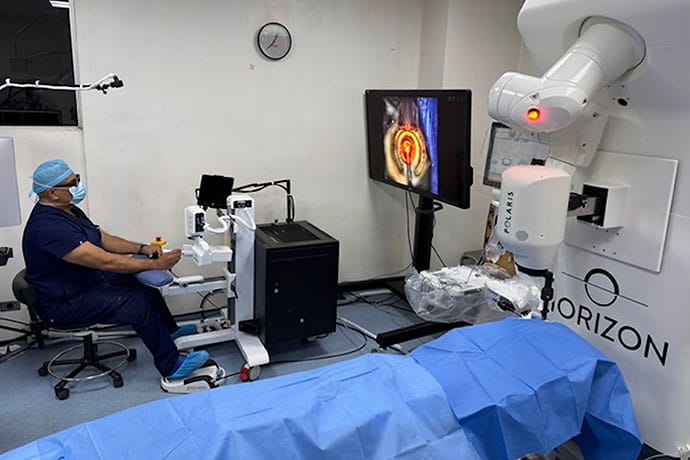
The robotic surgical system offers the potential of remote telesurgery, Devgan added : “I could be 3 m, 3 km, or 3000 km away, so if you have an unusually complex case and you’re a surgeon that has that expertise, you can do it remotely.”
Patient prep for robotic cataract surgery will be the same as the standard procedure, he said, but the robotic approach may result in cost-savings by requiring fewer personnel in the operating room.
Who’s Going to Pay?
Devgan acknowledged the cost of the robotic procedure compared with standard cataract surgery is not “pinned down just yet, but, obviously, there’s a robot you have to buy.”
Robotic surgery has been around for decades, first developed for radical prostatectomy but since moving into other surgical procedures in cardiology, orthopedic surgery, gynecology, and general surgery. The price of existing platforms has been estimated at $500,000 to $2.5 million, according to surgical robot distributor R2 Surgical.
According to the ophthalmic market research site Market Scope, the Medicare physician fee schedule for standard cataract surgery will be around $465 in 2026, roughly an 11% reduction from 2025. After covering overhead, the surgeon nets about $200 per procedure, Devgan said. Horizon Surgical Systems has not released any information on potential costs.
“Part of the problem is, who’s going to end up paying for this?” Devgan said.
John Ladas, MD, PhD, director of Maryland Eye Consultants and Surgeons in Silver Spring and founder of a company developing artificial intelligence and machine learning models for clinical use, called the progress Horizon and Devgan have made “phenomenal.” He added, “They moved from the lab to their first surgery in just a few years, and at this pace, I expect even greater advancement in the near future.”
While other medical specialties have used robotic platforms for years, Ladas said he does not think ophthalmology has lagged behind.
“Cataract surgery involves an extraordinary number of processes occurring within an exceedingly small space, including the coordination of multiple instruments and complex fluidics,” he said. “The technology needed time to catch up with the precision required for such a delicate procedure. It’s important to distinguish between macro and micro scales, particularly in ophthalmology, where measurements are made in microns, not millimeters.”
An earlier version of this story inaccurately described the precision of the robot.
The study was funded by Horizon Surgical Systems. Devgan reported being an investor in and chief strategy adviser to Horizon. Ladas reported being founder and president of Advanced Euclidean Solutions.
Richard Mark Kirkner is a medical journalist based in Philadelphia.
