Admin_Adham
“I have no memory of not being in the water,” says J. Richard Walker, MD, chair of the Department of Emergency Medicine at University of Tennessee Health Science Center in Memphis. Walker grew up at sea. His parents owned a travel agency, and his father was a merchant marine officer and a master open-ocean captain.
“When I was as young as three-and-a-half years old, there is a picture of me in the Bahamas wearing a mask, snorkel, and fins, about to free dive,” he recalls. Walker did his first scuba dive at age 12, became certified a year later, and by age 21, he was an instructor and dive supervisor.
“When your head dips below the water, it is just an indescribable, wonderful feeling,” says Walker. “To this day, there’s nothing like the sensation of the waves washing over your face, and everything calms down. Then all of a sudden, you feel completely weightless underwater. It’s such a familiar world to me.”
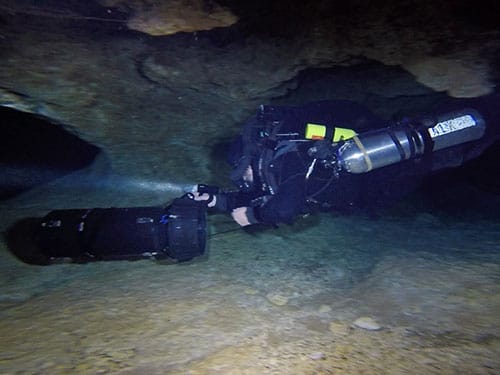
Still an avid scuba diver, Walker is one of a small number of physicians certified in undersea and hyperbaric medicine. For him, and other doctors who have come to love the sport, diving isn’t just an exotic hobby. They describe it as a uniquely effective way to find calm and reduce work-associated stress. The only requirements: a little free time and knowing how to swim.
Diving Into a New Career
Indonesia-based hospital administrator Imelda Fitria credits 2024 as the year that changed her life. By then, she had spent 14 years in hospital management, and the stress was taking a huge toll. Fitria had built up some savings to train to become a dive master, and the contrast with her day job became glaring. “I was beginning to learn a lot more about dive medicine and I was immensely enjoying it.”
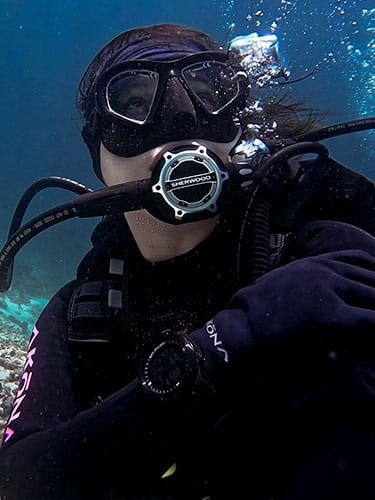
Scuba diving initially provided a much-needed release from Fitria’s highly stressful job. Little did she know at the time, it would eventually lead to a new career as a dive medicine physician with the Divers Alert Network (DAN) World in Indonesia.
“Scuba diving helped with everything I was facing during the working week, and connecting with nature provided fresh air to my tired soul,” she explained. “Underwater, my mind cleared and the experience of being buoyant in the water is incredible. It’s like nothing else in this world.”
But Fitria found that “when you are happy doing something, other aspects of your life that make you feel overwhelmed start to become a nightmare.” When she began to cry every day while travelling to the hospital, Fitria knew it was time to leave. Now, working full-time as a dive medicine doctor, she looks forward to every day.
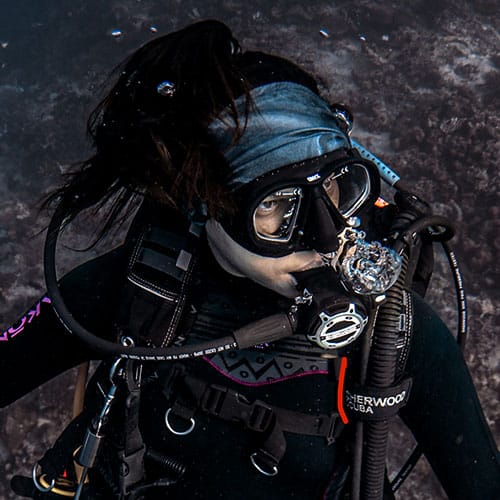
In Fitria’s opinion, “becoming a dive medicine physician is special. At times, you could experience mask squeeze, ear barotrauma, [or] sinus barotrauma and encounter current drag. Learning how to manage and prevent these is important for educating your patients as a dive medicine physician.”
Her job now is to build diving safety awareness in Indonesia, regarded as one of the best diving destinations in the world. This includes education on what divers should do if they have an accident, and how they can access DAN’s emergency hotline. Fitria also works with the emergency hotline physician team. Keeping calm under pressure is a big part of the role, she says. “We receive calls from all over Indonesia and we assist injured divers to get into the nearest medical facility. We even manage evacuations when required.”
‘Diving Is My Reset Button’
Nabeel Ahmad, MD, is a resident at Henry Ford Health in Detroit and developed his passion for scuba diving while doing a Fulbright scholarship back in 2017. Based at the time in Gorontalo, a city in Sulawesi, Indonesia, Ahmad had access to what’s known as the world’s coral triangle. It’s an experience he likens to a scene from the Pixar film Finding Nemo.
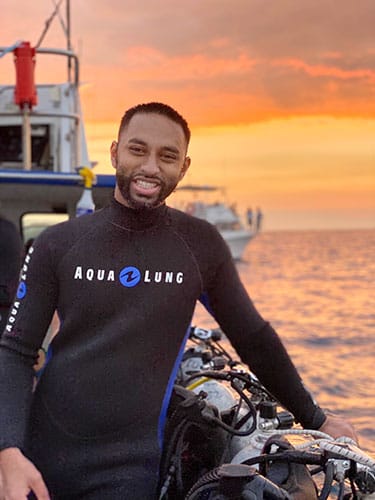
“There is healthy, colorful coral with fish everywhere. It was a common sight to see manta rays, barracudas, and sea turtles, depending on the season. I’ve been diving ever since,” says Ahmad.
Diving has since led Ahmad to Bali, Hawaii, Belize, and Costa Rica and brought him close (but not too close) to nurse sharks, bull sharks, and stingrays. A personal highlight for him was visiting the Galapagos Islands. “While diving, we saw a school of five hammerheads pass by us,” he recalls. “It was so neat to see them swimming by but at a safe distance away.”
Most recently, Ahmad spent a week on a liveaboard diving experience in the Bahamas, which he describes as “filled with adventure.” “We did about three day dives and one night dive each day. Our dives varied from coral reefs, open water, wrecks and caves. We found Caribbean reef sharks were not aggressive at all, and I loved diving alongside them.”
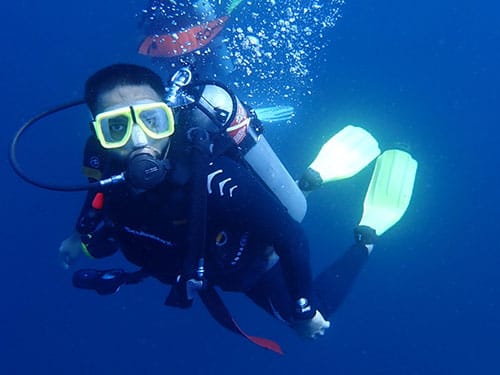
“Diving is my reset button,” Ahmad says. “It enables me to truly disconnect and focus on something completely different than medicine. The calmness of the water slows everything down. I can genuinely relax and enjoy the beauty of the seas. Even planning a diving trip increases my dopamine levels.”
With a resident’s schedule, Ahmad has to plan his dives months to a year in advance. His next adventure will be a diving experience in Japan in September
‘They Don’t Make Pagers That Work Underwater’
Many people don’t realize, Walker says, how diving relates to emergency medicine, as well as environmental medicine and issues such as air and water quality. One essentially dovetails into the other. “I would honestly say that I’ve used diving experience to help me in medicine more than I’ve used medical experience to help me in diving,” he explains. “But it’s certainly a two-way street, as there are critical decisions that have to be made quickly, logically, and correctly in both specialties.”
Walker finds what he’s learned from diving most useful when teaching. It helps him to quickly assess someone’s level of understanding and their natural learning style to enable him to tailor his instruction to their needs, a skill he uses daily with residents, staff, and patients.
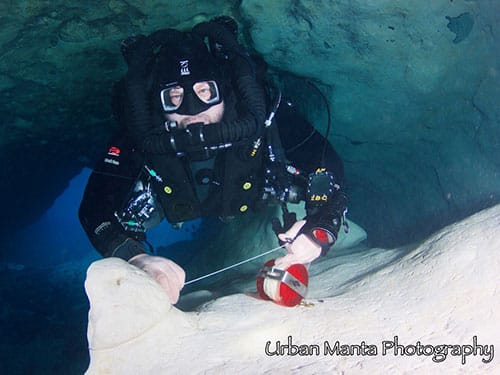
Crucially, diving helps Walker to escape from his hectic emergency medicine role. “One of the nice things about a cave dive is it forces you to focus only on the events at hand,” he says. “So, if you have quite a lot going on at work, you know that nobody can reach you for around 2-6 hours. They don’t make pagers that work underwater, thankfully, so I know no one is going to call or interrupt. For that reason, I find it incredibly relaxing.”
Calm Under (Water) Pressure
No matter how experienced you are as a diver, hairy situations can arise. Walker once got stuck in a tight cave opening as part of a solo exploration dive. He describes trying to squeeze through a gap that was “no bigger than a trash can in your kitchen” and getting tightly wedged. Stopping to think and enjoy being in the water for a few moments, he was able to slow his elevated breathing rate while he worked out a solution. The worst thing he could have done in that moment was panic.
“This would crank your breathing up and you might run out of gas before you solve the problem,” he explains. “It’s easier said than done in those types of situations, and that’s certainly happened to a bunch of people I know over the years.”
Staying calm, Walker managed to free his left arm and then identified where his kit had gotten stuck on a rock. As he freed his kit, he was able to pass everything piece by piece through the gap and then get through it himself. Once through to the other side, much to his relief, he was able return to the mainline, a cord often used in cave diving to mark a safe route.
“But those are the skills that we use daily in medicine,” Walker adds. “When you have a 12-year-old that has drowned in front of you and a screaming mother in the same room, you have to step back mentally to focus solely on the next three things that need to happen if there’s any chance of resolving the situation. That compartmentalization that you learn and use routinely on each of these jobs does help the other in my experience.”
After completing around 4300 dives to date, Walker has encountered other dangerous scenarios: people spearfishing on top of his dive group, sharks coming close to their diving area, underwater changes impeding clarity of vision, losing track of fellow divers and having to divert plans to find them — all examples of critical situations that you’ve simply got to work through.
Ready to Take the Plunge?
Ahmad highly recommends learning to dive as an antidote to the stress of medicine. “Each dive is so memorable, and it definitely makes you appreciate nature more. I would advise that doctors first try snorkeling and see whether they enjoy that. From there, a beginner open-water diving course can be completed in 3-5 days,” he suggests.
Fitria seconds this, adding that getting plenty of diving experience is important for any physicians that might be interested in the specialty.
The adventure, they say, is also in exploring the oceans that are largely unknown. “The driving force for me and many of the others is almost a Star Trek thing,” Walker says, “to go where people haven’t been before. When you go cave diving and you turn a corner, and you find a crystal-clear spring where no human being has ever been before. It’s such a special moment.”