Admin_Adham
In 2005, Michael Grady, DO, found himself driving 6 hours up a mountain to a medical clinic in a remote village in Haiti. What he found there was light-years away from any medicine he practiced in the US.
“People would be lined up, waiting in the hot sun to be seen by probably the first medical care that they may have received in their entire life,” Grady said.
He was hooked.
Grady, now 71, was in his early fifties at the time and had recently retired. He wasn’t looking to get into medical humanitarian work, but he was open to his next chapter. He was an ob/gyn but also had experience in emergency medicine, having worked in an emergency department in Detroit in the early 1980s. He knew he enjoyed working in “austere” medical environments. So when a friend introduced him to the small nongovernmental organization (NGO), ServeHAITI, he volunteered.
“There’s something much more exciting than being able to push a button and order an MRI,” Grady said. “You really are much more hands on” when you practice this type of work, a back-to-basics type of medicine that is “a lot more challenging,” he said.
Grady’s recent assignments read like a where’s-where of disaster and war zones: He delivered supplies to first aid workers at sites along the Guadalupe River in Kerr County, Texas, after catastrophic flooding last summer. He ran a trauma center in Gaza in 2024 where people came in with open chest wounds and missing extremities. He was most recently in Jamaica assisting in disaster relief in the aftermath of Hurricane Melissa in late October 2025.
What drives doctors, nurses, and other clinicians to take on this type of humanitarian aid work? They may spend long periods of time away from family and friends, working in harsh and even dangerous conditions, treating the worst injuries and illnesses. It can also be complicated to return home after such intense experiences. Medscape Medical News spoke with some of these clinicians to find out their “why.”
On Call Around the Globe
Grady now serves as a volunteer with International Medical Corps (IMC), a global first responder that provides emergency medical and related services to those affected by disaster, conflict, and disease.
Like Doctors Without Borders/Médecins Sans Frontières (MSF), Samaritan’s Purse, and other large NGO, IMC monitors the world “24/7”, Grady said. When an event happens, IMC and other similar groups reach into their emergency rosters to see who is available for a particular response.
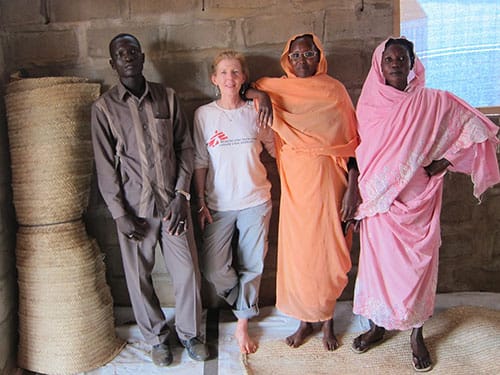
Laurel Cassidy, PhD, a 69-year-old nurse and mental health activity manager for MSF, has worked in many locations around the world. They include Ukraine where she trained a team of psychologists in evidence-based treatments for war trauma. She has also been deployed to Myanmar where she taught basic mental health counseling skills.
“The work can be kind of heavy,” said Cassidy, also an ordained Unitarian Universalist minister. “The degree of suffering that goes on in this world, there’s no words.” But her passion for mental health care is what drives and sustains her.
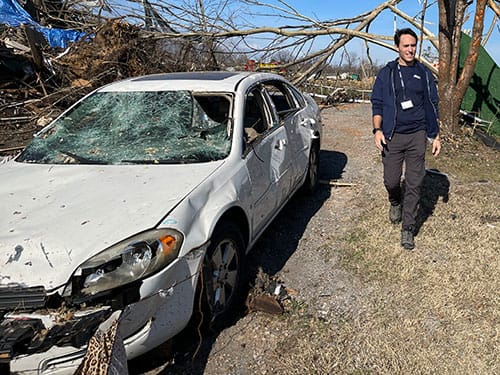
There are a hundred different personality types in this line of work, said John R. Roberts, MD, a senior technical advisor for IMC’s Emergency Response Unit. He describes medical humanitarian workers as “adrenaline junkies” to some degree. Meanwhile, they manage to be both “cynical and hopeless romantics at the same time.”
Roberts initially became interested in disaster medicine and humanitarian work as a college student when he volunteered in Waveland, Mississippi after Hurricane Katrina. When his team took a break from cleaning out houses, someone pointed to the horizon — the state is very flat — and all he could see were the slabs of houses and a few trees. In that moment, he understood something.
“I think what I realized was that I wanted to be in a situation where help was needed now, and help was the difference between suffering and not suffering,” Roberts said.
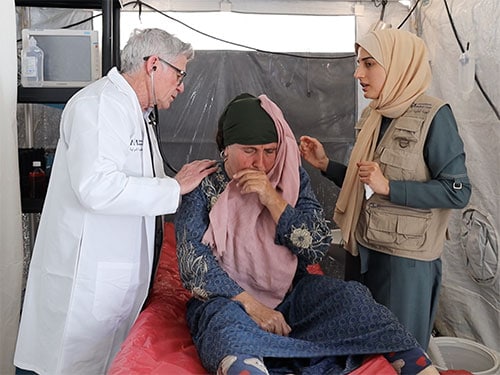
The reason people go into this field, Grady echoed, is because “there’s a tremendous gratification in being able to make a difference in places and for people that are most in need. I think it’s really built into us to do that,” Grady said.
The Challenges
While on assignments, living conditions can be difficult. Grady describes working in tents in Gaza, where nighttime temperatures were in the lower 40’s and in the 80’s during the day, without heat or air conditioning. On an Ebola team in Sierra Leone, Grady said time in the “red zone” was limited to 30 minutes due to the risk for heat exhaustion and dehydration, while wearing full PPE. You may also be eating whatever food is available.
Then, there’s the issue of personal safety.
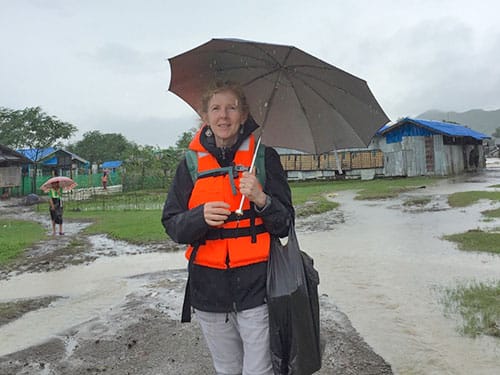
In the summer of 2021, three MSF staff members were murdered in Tigray, the northernmost regional state in Ethiopia. Cassidy was on an assignment in that region at the time. In disbelief and profoundly sad, she was near the end of her contract period and recalls thinking, “How do we get out of here?” Luckily, MSF was able to get staff members out via the airport in Gondar within a week. But the murders left a mark.
“I knew I would never return to Ethiopia because I carried too many feelings of stress, anxiety, disappointment, outrage, and uncertainty about all that transpired while I was working there for the 3 months,” she said.
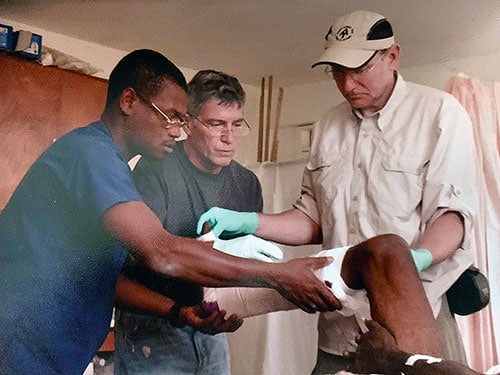
In Grady’s case, his family worries about his safety a lot more than he does. While he trusts the security IMC provides, when you work in a war zone, you are going to hear explosions, detonations “and the windows will definitely shake and rattle and tremble,” he said.
For Cassidy, one of the biggest challenges isn’t about her own safety but rather the sexual violence against girls and young women that she has seen around the world. She has had to ask herself, “How am I going to work in different contexts where women are like second level citizens” without basic human rights?
‘This Is Just What Happens’
For Roberts, one of his biggest challenges took place during his residency when he went to work in the Republic of the Congo. He treated a young child with advanced malaria who was “drowning in pulmonary edema,” he said.
“All I could think about the entire time was, if I was in the United States, this kid would be fine,” Roberts said, “because we have blood transfusions and we have diuretics and ventilators and a bunch of stuff that we could do to help this kid. But because of where he was, we couldn’t do anything.”
Roberts had to watch the child slowly die. It was agonizing. Later, he went outside, sat next to a mango tree, and cried.
The child’s mother came out and told him: “’It’s okay, you tried…This is just what happens.’” She was sad but stoic, Roberts recalled, and he was stunned by her composure in that moment of losing her son.
Many people who work in the medical humanitarian space feel like there’s a “never ending torrent of suffering that we can’t stop,” Roberts said. “It’s like bailing water in a ship with a hole in it, and we don’t have a cork. All we have is a bucket. And that can become incredibly frustrating at times."
The Problem of Privilege
Another mental struggle that many medical aid workers face is comparison — knowing how much they have compared with the people they’re trying to help.
“How do you metabolize the fact that your life — even in the middle of a war zone — is so much better than the people that you’re actually taking care of?” Grady asked.
Cassidy remembers a time early in her career when she returned to her home near Nashville, Tennessee, from a 10-month assignment at a refugee camp in Bangladesh. She walked into a US grocery store and started crying.
“It was just seeing all that food,” Cassidy said. The wide availability of plentiful food everywhere — in sharp contrast to working and living in places where getting food and water is “a day’s work” — set off the tears, she recalled.
Generally, Grady feels energized by his work and doesn’t usually feel guilty when he returns to his life in Asheville, North Carolina. But it can happen.
“The times where I have felt guilty [are] when I’ve come back…and realize the abundance that we have,” Grady said. He can make himself “a nice latte with latte art in the morning, and other people are literally starving to death just a plane flight away.”
The Aftermath
People responding to humanitarian crises should expect complex emotions like guilt and sometimes deep hopelessness in the face of overwhelming need, said Ben Porter, the psychosocial and wellbeing lead at Thrive Worldwide in an email. The organization supports clients such as Oxfam and WaterAid Global with medical, psychosocial, occupational and travel health services.
“But here’s what often gets overlooked: vicarious transformation,” Porter said. “More often than not, responders also witness extraordinary resilience — people rebuilding their lives amid devastation, finding hope in impossible circumstances, healing against all odds. This is profoundly inspiring and can fundamentally change how responders see the world.”
Roberts agrees. “The coolest thing, the most amazing thing about it is the people, and specifically the people that you get to help and the people alongside you that are helping,” he said.
“Many short-term responders work in conditions unlike anything they’ve encountered before,” Porter wrote, “whether that’s resource limitations, unfamiliar medical procedures, or the sheer scale of suffering.” Afterward, people often need help processing their experiences.
Most medical aid workers who encounter a traumatic experience while on a deployment won’t go on to develop post-traumatic stress disorder, Porter said, but a small minority do. “So it’s important to have a professional debriefing and follow-up within 4-6 weeks of a traumatic incident.”
At MSF, doctors and healthcare providers have access to psychosocial resources and must debrief before they go on a deployment and again when they return home, Cassidy said.
Most deployment-related difficulties are reactive in nature, Porter added, and will improve naturally once the person comes back to a supportive environment of friends and family, good physical health, and meaningful work.
Try to decompress with the people that love you and try to get them to see the good and the bad, Grady advises. Family and friends may not be able to relate to what you have been through. But “you have to depend on them to get you back to active level, back to living your normal life, [and] that can be hard,” he said.
Therapy might also be a good idea. “The right time to seek therapy, however, is when symptoms persist beyond the initial readjustment period (typically 3-6 months post-deployment), when they interfere with daily functioning, or when someone feels ‘stuck’ despite having good support systems in place,” Porter said.
Despite the hardships, those who do this type of work often acknowledge it can have a profound impact. Grady’s assignments have brought him into contact with people and places that he likely never would have encountered otherwise. Cassidy called her experiences “a framework for meaning making.” While the suffering in the world may be vast, these clinicians have seen that service, healing, and joy are limitless as well.