

 Admin_Adham
LONDON — For much of medical history, the clinical relationship was straightforward, if paternalistic. “The doctor diagnosed the problem, prescribed the treatment, and the patient followed the advice,” said Anna Fryxelius, a patient research partner and chief advisor of the Norwegian Rheumatism Association, at the European Alliance of Associations for Rheumatology (EULAR) 2026 Annual Meeting. “Expectations were often modest, treatment options were limited, and medical expertise was hardly ever questioned.”
Today, that dynamic has completely shifted. When communication breaks down, it is rarely due to bad intentions; rather, it occurs because physicians and patients are trying to answer fundamentally different questions. “Don’t assume that your perception, as a doctor, of disease activity is the same as the patient’s; don’t underestimate the whole patient experience and perspective; don’t overwhelm patients with information; don’t focus on the disease solely, forgetting the person living with it,” Elena Nikiphorou, MD, PhD, a consultant rheumatologist and reader in rheumatology and medical education at King’s College London in London, England, told Medscape Medical News.
“Modern medicine offers more choices than ever before,” she said. “Effective communication is essential to help patients understand better the benefits and risks, align treatment decisions with their values and goals, and, importantly, build the trust needed for long-term disease management and shared decision-making.”
What Patients Want vs What They Need
A patient newly diagnosed with rheumatoid arthritis enters the room terrified because her mother lost the use of both hands to the disease, Fryxelius recounted in her presentation. The patient looks at her doctor and asks if the same will happen to her. The physician, hearing a query about clinical prognosis, might reassuringly respond that the patient’s C-reactive protein (CRP) is only moderately elevated, an ultrasound shows no joint erosions, and highly effective disease-modifying antirheumatic drugs are readily available.
From a medical perspective, it is an incredibly reassuring answer. From the patient’s perspective, however, her emotional question went completely unanswered, leaving her feeling unheard, Fryxelius said.
“Listening carefully to the patient and understanding the patient’s perspective is crucial, Nikiphorou said. “Shared decision-making requires partnership, not simply information transfer. Trust and continuity of care remain fundamental.”
A patient’s age matters, too. Data from a 2025 multigenerational survey presented by Corinna Elling-Audersch, the president of the German Rheumatism League Federal Association in Bonn, Germany, showed a divide in communication preferences between younger and older cohorts.
Older patients generally place a higher premium on continuity of care, personal trust, and the reassuring feeling that “my doctor knows me,” Elling-Audersch said. They often prefer a more traditional consultation style, expecting clear recommendations and guidance from their physician, while digital health avenues remain secondary.
Younger patients actively reject authoritarian communication styles. They seek communication on equal terms, rapid access to care, transparent digital data, and direct involvement in every treatment decision.
Despite these differences, both generations want to be taken seriously, to receive understandable information, and to have sufficient time to ask questions.
In addition, Fryxelius said that a patient’s needs depend heavily on where they stand in their illness journey. In the highly distressing shock phase immediately following a chronic diagnosis, patients often fixate on worst-case scenarios. Inundating them with complex clinical trial data or mechanistic detail is counterproductive. “The right message at the wrong time is still the wrong message,” Fryxelius warned. “In this phase, information overload can actually be counterproductive. Simple, repeated, reassuring messages are often more effective than detailed education.” Only when patients transition into the adjustment phase do they become truly receptive to extensive self-management strategies and shared decision-making, she said.
The Power of Narrative Medicine
When clinical details are necessary, translating data into narrative metaphors can dramatically improve patient comprehension and treatment adherence.
Oliver Hendricks, MD, PhD, head of research at Esbjerg and Grindsted Hospital, Research Department for Rheumatic and Musculoskeletal Diseases in Esbjerg, Denmark, shared his approach to prescribing methotrexate, a drug that frequently terrifies patients who read online that it is a chemotherapeutic “poison.” Rather than citing safety statistics, he displays the highly similar chemical structures of folic acid and methotrexate side by side. “What I actually do is give you something that reminds you a lot of vitamin B9 — it has just extra forces,” he tells them. “So please think about methotrexate as the big brother of vitamin B, instead of a poison.”
To explain the broader reality of living with a chronic disease, Hendricks utilizes a metaphor involving receiving an unexpected pet:
“I would ask them, ‘Do you like cats?’ What I then tell them is, ‘Well, your very best friend has given you a cat, even though you don’t like it, and now it’s there. You can ignore the cat, and it’s going to sh*t on the floor, or you can say, Well, now I have this cat, and I will take good care of it. In a couple of months, your house will be the house where a cat lives. It’s still your house.’ I have said this more than 100 times, and a lot of patients say, ‘Oliver, I forgot all about what you said about CRP, about medicines, about diagnosis, but I remember the story about the cat.’”
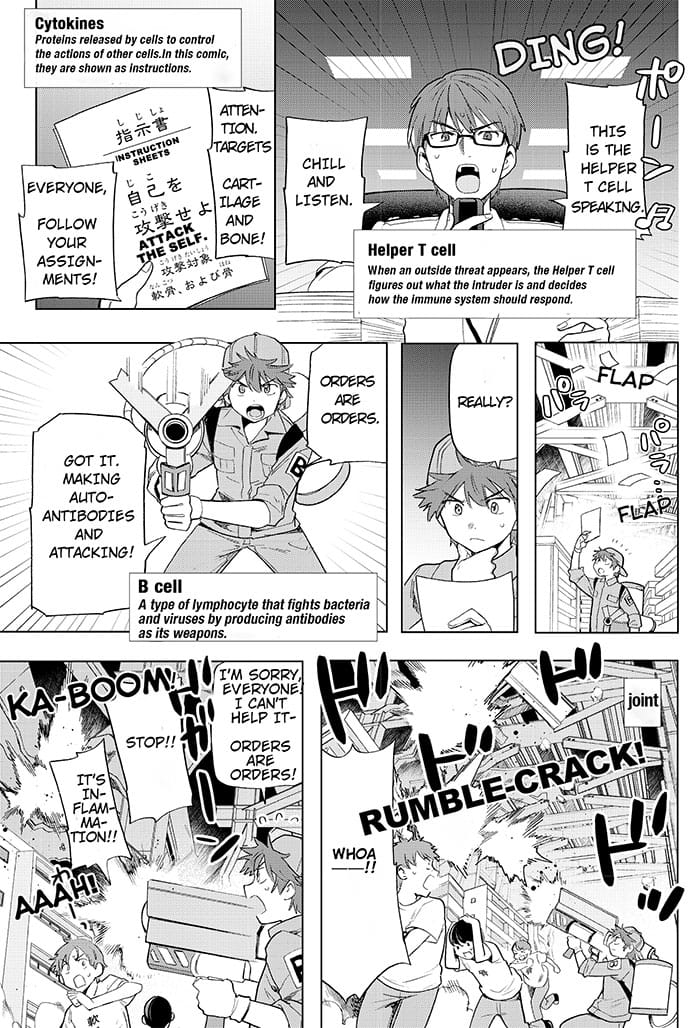
Narrative storytelling with personified characters is also very effective at explaining complex science to patients and families, Takako Miyamae, MD, PhD, an assistant professor at Tokyo Women’s Medical University in Shinjuku-ku, Japan, said at the meeting. In Japan, Manga are used in health education across HIV, cancer, smoking cessation, nutrition, and rheumatology. They work because they are familiar across all ages, she said. (See Manga page example below.)
‘I Have My Limitations’
When navigating highly complex, evolving, or poorly understood conditions, clinicians frequently face questions they cannot definitively answer. In these moments, attempting to project absolute authority can paradoxically erode patient trust.
Hendricks recalled the immense uncertainty of the COVID pandemic. Patients routinely asked whether they should pause their immunosuppressants or receive new vaccines. “To be honest, I didn’t know,” Hendricks admitted saying to his patients. “And sometimes, when you really know the patient, you can bridge this gap with humor,” He said he sometimes tells patients he feels “like a chicken rotating over open fire” and asks for a week or two to gather information before following up via a dedicated telephone consultation.
This radical honesty deepens the therapeutic alliance rather than weakening it. “We really need to remind ourselves as clinicians every time in clinic that we have a person in front of us, and we have to deliver this information and treat that person with compassionate integrity,” Nikiphorou added. Once that human connection is established, patients are far more receptive to shared decision-making, even welcoming a week or two to deliberate on complex systemic therapies.
Communication as a Long-Term Resource Investment
The primary argument against taking the time for deep clinical communication is invariably a lack of institutional resources and systemic time pressures. However, data suggests that investing heavily in communication upfront is highly cost effective. “Our best argument is we have to convince the ones who give the money that it is good used money to use that time,” Hendricks argued. “When patients are confident, feel hope…they actually are less sick.”
He shared metrics from his institution: During the first year of a difficult chronic diagnosis, clinicians spend roughly six or seven thorough consultations empowering and educating the patient. However, because those patients become highly literate and capable of self-managing their conditions, their long-term clinical footprint drops dramatically. “We can show [that] during the next 9 years we will see these empowered patients only twice a year,” Hendricks explained. “Where when the patients are bound and trapped in their fear, they have to be seen much more often.”
Fryxelius, Nikiphorou, Elling-Audersch, Hendricks, and Miyamae reported no relevant financial relationships.
Manuela Callari is a freelance science journalist specializing in human and planetary health. Her work has been published in The Medical Republic, Rare Disease Advisor, The Guardian, MIT Technology Review, and others.


