Admin_Adham
For years, prostate cancer specialists hit a wall when prostate-specific antigen (PSA) levels crept up after definitive treatment.
The cancer was likely back — but where? And to what extent?
Bone plus CT scans were the best imaging tools available, but their sensitivity was often too low to identify whether the cancer had returned or spread, and doctors were frequently left guessing.
When a new imaging technique became routinely available about 5 years ago — a tool that was not only more sensitive but also more specific — clinicians jumped on it.
In clinical practice, the technique — prostate-specific membrane antigen (PSMA)-PET — soon overtook conventional scans as the go-to imaging strategy after biochemical recurrence following definitive therapy.
“From a real-world perspective, this is what we are using now,” said Michael J. Morris, MD, medical oncologist and prostate cancer specialist at the Memorial Sloan Kettering Cancer Center in New York City.
However, some oncologists have raised concerns that the field might have been too hasty in embracing PSMA-PET.
The core issue: There’s no phase 3 trial demonstrating that treating disease seen only with PSMA-PET actually improves survival or quality of life, said Edwin M. Posadas, MD, medical oncologist and prostate cancer specialist at Cedars-Sinai in Los Angeles.
By treating these lesions, “you can expose patients to treatments they may not need at that time and incur harm without benefit,” Posadas explained.
Still, many men with positive PSMA findings end up receiving early, often aggressive, therapies. Even after identifying a few lesions on PSMA-PET, “a lot of doctors will radiate and put men on intensified hormone blockade,” Posadas said.
Overall, Posadas explained, “Folks are now taking men who were classically biochemically relapsed patients, doing a PSMA-PET CT scan, and calling them metastatic. It’s happening everywhere.”
PSMA-PET Benefits and Uncertainties
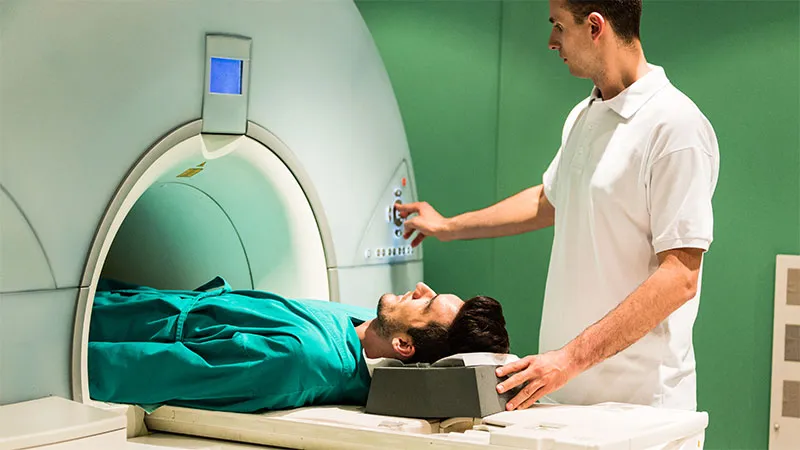
With PSMA-PET, patients are injected with a radiotracer that latches onto the PSMA on cancer cells. The tracer emits positrons, which are detected on PET imaging, with a positive finding indicating the presence of cancer.
FDA approved the first tracer, gallium-68 PSMA-11, in late 2020. Since then, two more — piflufolastat F 18 and flotufolastat F 18 — have been approved.
In practice, a PSMA-PET scan is performed alongside CT or MRI, which provides the anatomic details, such as lesion size, location, and morphology.
The data comparing PSMA-PET with CT or MRI to conventional imaging alone have demonstrated the “superior” accuracy of the newer technique. In one randomized trial, gallium-68 PSMA-11 with CT showed 85% sensitivity and 98% specificity for detecting prostate cancer metastases, while bone plus CT scans were only 38% sensitive and 91% specific.
Overall, the use of PSMA-PET has “exploded because of its clear increased sensitivity and specificity,” said Phuoc Tran, MD, PhD, radiation oncologist and prostate cancer specialist at the University of Maryland Medical System, Baltimore. “The genie isn’t going back in the bottle.”
However, in its most recent guidelines, the National Comprehensive Cancer Network highlighted the benefits with some caution, stating that PSMA-PET with CT or MRI “can be considered an alternative” to conventional scans and “can serve as a more effective frontline imaging tool” for detecting micrometastatic disease.
The more cautious language is important given that PSMA-PET comes with some notable caveats and unknowns.
One key issue: There are limited data on how best to translate a positive PSMA finding into a treatment plan.
“We sort of assume that if you see something with PSMA-PET, you have to treat it, but that may not necessarily be the case,” said David Einstein, MD, prostate cancer medical oncologist at Beth Israel Deaconess Medical Center in Boston.
With PSMA-PET, “we shouldn’t assume that more sensitive equals better, or that earlier intervention equals better,” Einstein said. “There’s a lot to learn, and there’s a lot to question.”
When it comes to treating metastatic disease, all the level 1 evidence comes from patients whose metastases were found on conventional imaging, not PSMA-PET, said Todd M. Morgan, MD, prostate cancer surgeon at the University of Michigan Health, Ann Arbor, Michigan. That means the data on treating conventionally detected metastases may not apply to PSMA-PET-detected lesions, he explained.
“We also can’t just assume that a lesion on PSMA-PET is simply a slightly earlier version of what we are going to see on conventional imaging,” Morgan said.
“There are going to be some PET lesions that we pick up that are destined to be conventional metastatic cancers if you waited 3 months, and there are going to be some that we pick up that really are destined to not impact the patient at all,” Morgan added. And right now, “we don’t know how to tell the difference.”
Is There a Difference?
Emerging data do suggest that there are differences between metastases picked up by conventional imaging and those that show up only on PSMA-PET.
Overall, PSMA-PET lesions appear more indolent. A study from the National Cancer Institute (NCI), found that 76 men had positive PSMA-PET findings at baseline but negative findings on bone plus CT scans. However, at 6 months, only one patient progressed on conventional imaging, even though about a quarter of men had polymetastatic disease and nearly 10% had bone lesions on PSMA-PET at baseline.
The one patient with disease progression at 6 months had a fast doubling time and a lot of disease at baseline, so “I would have been worried about this guy anyway,” said lead investigator Ravi A. Madan, MD, prostate cancer specialist at the NCI.
The take-home is that “just because you’ve got findings on molecular scans, it doesn’t necessarily mean the dam’s about to break,” Madan explained. “It’s more like a glacier.”
Another study also suggested that some lesions detected on PSMA-PET are different on a genomic and clinical level. The analysis compared men diagnosed with oligometastatic disease by PSMA-PET vs those diagnosed by conventional imaging. The conventional group had higher PSAs, higher Gleason scores, more aggressive mutations, and worse overall survival.
“These are two different sets of patients, two different sets of disease biology, and two different sets of clinical outcomes,” said Tran, the study’s senior author.
“It doesn’t make sense to assume that somebody with a PSMA-only diagnosis is going to have the same level of aggressive disease as somebody who’s conventional,” he said. “The preliminary data say they don’t.”
Einstein has seen the issues play out in his own office.
Lymph nodes in one biochemically recurrent patient lit up all over the man’s body on PSMA-PET. The referring physician suggested hormone therapy, but Einstein held off because uptake in the nodes was weak, there was nothing on conventional imaging, and the man’s PSA doubling time was slow.
The patient did eventually need additional treatment — 2 years later — but only after a lesion showed up on a bone scan. “The lymph nodes never grew to the point of becoming detectable on conventional imaging,” Einstein said.
Oncologists are also finding different types of lesions on PSMA-PET outside of prostate lesions. This may be, in part, because PSMA expression isn’t limited to prostate cancer; other cancers, and even some healthy tissues, can express it, Posadas explained.
The different blips include PSMA-avid rib and adrenal gland lesions and avid mediastinal and mesenteric lymph nodes, among others, said Anthony T. Nguyen, MD, a radiation oncologist at Cedars-Sinai.
There’s growing consensus that the rib lesions are usually benign, but as for the rest, “we don’t know at this point, and it’s starting to come up in tumor board almost every week,” Nguyen said.
A New Disease State?
The idea that men with PSMA findings might not always need treatment “is a relatively unknown issue for most busy clinicians,” Tran said. “And it’s an issue that needs more exposure, so people are more thoughtful about it.”
In their own practices, Madan, Einstein, Tran, and others said they use PSMA-PET as an adjunct to treatment decisions instead of a driver for immediate metastatic treatment.
Madan, for example, combines PSMA-PET findings with PSA doubling times, which he considers the most reliable predictor of metastatic risk. With a fast, 3-month doubling time, he’s inclined to treat if there are many PSMA-PET lesions on imaging, but less likely if there are not.
Ultimately, he and others said, more research is needed to figure out how best to use PSMA-PET after biochemical recurrence.
“The question is not should we or should we not stage using PSMA-PET, but how to treat patients most properly using the information from a PSMA-PET,” said Thomas Hope, MD, radiologist and nuclear medicine physician at the University of California, San Francisco. In other words: “In which clinical circumstances are we over- or undertreating?”
Several initiatives are underway to answer that question.
Madan and his NCI colleagues, for instance, are continuing their natural history study of PSMA-PET lesions, with 150 men enrolled to date.
The Prostate Cancer Clinical Trials Working Group, which issues influential guidelines on how prostate cancer trials should be conducted, will also soon recommend adjunctive PSMA-PET scans along with conventional imaging for trials in metastatic disease.
“We need to understand how disease volume by PSMA-PET compares with disease volume by standard scans in terms of response to therapy and prognostic and perhaps predictive ability. We need treatment paradigms that are keyed into the findings of PSMA-PET,” said Morris, who is involved with the work.
In the meantime, the NCI Working Group on Biochemically Recurrent Prostate Cancer, with Madan, Einstein, Tran, and Posadas among its 33 members, will soon issue a white paper on the judicious use of PSMA-PET.
The group has coined a new term — PSMA-positive biochemical recurrence — to distinguish it as a unique clinical entity that may require different handling than metastases found on conventional imaging.
The field will eventually figure it out, Tran said, but “it’s going to take time, and there will be some missteps along the way.”
M. Alexander Otto is a physician assistant with a master’s degree in medical science and a journalism degree from Newhouse. He is an award-winning medical journalist who worked for several major news outlets before joining Medscape Medical News. Alex is also an Massachusetts Institute of Technology Knight Science Journalism fellow. Email: aotto@mdedge.com.