

 Admin_Adham
Travelers returning from destinations where infectious diseases are endemic may bring home more often than photos and souvenirs. Although prevention begins before departure, the focus after travel shifts to identifying illnesses that may emerge days or weeks later.
Primary care physicians serve as the first line of epidemiologic surveillance in the community. Their role is to obtain a thorough travel history, avoid being misled by nonspecific symptoms, and determine whether fever or gastrointestinal symptoms reflect a minor illness or a more serious infection.
Before departure, travelers should also be advised to seek medical attention concerning symptoms that develop after they return, even if these appear several weeks after travel.
Attention to Details
Speaking with Univadis Italy, part of the Medscape Professional Network, Tecla Mastronuzzi, of the Italian College of General Practitioners and Primary Care in Florence, Italy, said, “Returning from a demanding trip is often accompanied by malaise. Long journeys, jet lag, and changes in climate, no longer masked by the excitement of beginning a vacation, can cause muscle aches, gastrointestinal symptoms, headaches, and even a low-grade fever.”
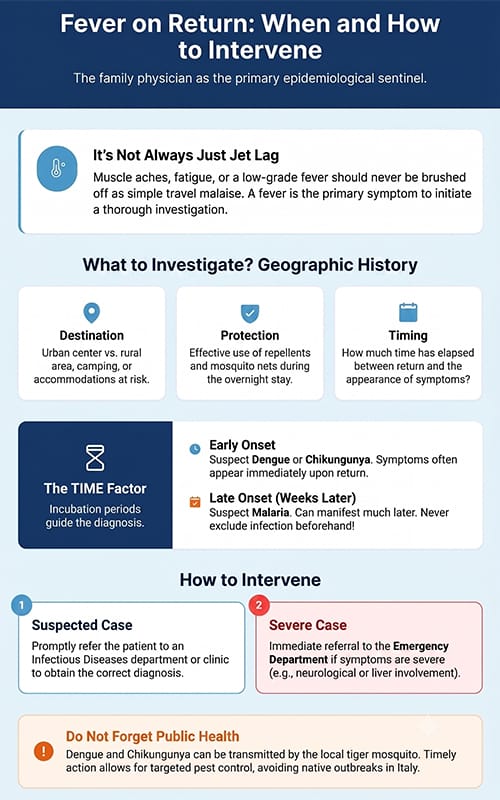
Mastronuzzi emphasized that distinguishing travel-related fatigue from an infectious disease requires a thorough medical history, including detailed information about the itinerary, destinations visited, and activities undertaken.
“It is not enough to know which country the traveler visited. Recent events have shown that staying in a major city is very different from sleeping in rural shelters, camping, or spending time in areas infested with rodents.”
In many destinations, urban accommodation offers better hygiene than rural settings. However, infections can also occur in urban areas.
“It is important to know whether the sleeping environment was protected against mosquito bites.”
Mastronuzzi added that physicians should also ask whether travelers used insect repellents, mosquito nets, or other personal protective measures.
Recognizing Warning Signs
Fever is the most important symptom to assess. “In 1960, Fausto Coppi returned from a trip to Africa with a fever. Because it was winter, when respiratory infections are common, he was mistakenly diagnosed with pneumonia,” said Alberto Tomasi, MD, public health physician, former president of the Italian Society of Travel and Migration Medicine, and co-author of The Doctor and the Travellers (Minerva Medica, 2025). “He actually had malaria, which is treatable if diagnosed promptly. The misdiagnosis cost him his life. Fever is also a common symptom of other mosquito-borne infections, including dengue and chikungunya, which are generally less severe than malaria but can still cause serious illness.”
The interval between returning from travel and the onset of symptoms is another important consideration during clinical evaluation.
“Many imported infections have well-defined incubation periods, and that information can help guide the differential diagnosis,” Mastronuzzi said. “Malaria, for example, can develop weeks after a traveler returns home, whereas arboviral infections such as dengue and chikungunya usually become symptomatic sooner. For this reason, clinicians should not rule out an imported infection simply because some time has passed since the trip.”
Tomasi also emphasized that dengue and chikungunya can be transmitted by the Asian tiger mosquito, which is endemic to Italy.
“If a traveler returns to Italy while infected, a local mosquito could acquire the virus by biting that individual and initiate local transmission. This has already occurred several times,” he said.
Some imported infections are subject to mandatory reporting and may require public health intervention.
“For example, mosquito control measures may need to be implemented around the patient’s home,” Tomasi said. “In these situations, physicians are responsible not only for treating the patient but also for helping prevent community outbreaks.”
Patients with fever whose travel history raises suspicion of an imported infection should be referred promptly to an infectious disease service or emergency department for further evaluation, particularly if they have severe symptoms.
“Other symptoms that may indicate an imported infection include persistent diarrhea, especially if it contains blood, vomiting, and skin rashes,” Mastronuzzi said. “Headaches accompanied by confusion, excessive daytime sleepiness, or impaired attention may indicate central nervous system involvement, whereas jaundice may suggest liver involvement.”
Travelers should also be advised to carefully examine their skin after returning home and seek medical evaluation for any persistent or inflamed skin lesions.
“These lesions may result from infected tick bites,” Tomasi said, “or they may indicate a parasitic infection.”
Follow-Up
Some vaccines administered before travel require additional doses after travelers return home.
“The hepatitis A vaccine, for example, requires a booster dose 6-12 months after the first dose,” Tomasi said. “Many travelers neglect to complete the vaccination series after returning to Italy. Completing the series is important to ensure long-term protection for future travel. In addition, travelers exposed to rabies during their trip who received rabies immunoglobulin abroad must complete the recommended rabies vaccine series after returning home to finish postexposure prophylaxis.”
A follow-up visit after travel is also recommended for individuals at higher risk and for patients with chronic conditions whose treatment was modified during the trip.
“In addition, anyone who received medical care while traveling should follow up with their primary care physician and bring all medical records from the trip,” Mastronuzzi said. “These records may include recommendations for follow-up care or prescriptions that require ongoing management.”
Mastronuzzi reported having no relevant conflicts of interest.
This story was translated from Univadis Italy.


