

 Admin_Adham
 Jump to Key Points
Traditionally, the diagnosis of type 1 diabetes (T1D) has been based on the identification of hyperglycemia once clinical symptoms are already evident. However, current scientific evidence shows that the disease is a continuous biological process that develops silently years before clinical onset.
To unify clinical practice and standardize care pathways, a recent article published in Endocrinología, Diabetes y Nutrición — developed collaboratively by the Spanish Diabetes Society (SED), the Spanish Society of Endocrinology and Nutrition (SEEN), and the Spanish Society of Pediatric Endocrinology (SEEP) — outlines an integrated care process for identifying and monitoring people who have already entered the autoimmune phase of T1D but have not yet developed symptoms.
The framework is designed to support earlier detection and structured follow-up of at-risk individuals before overt disease begins.
Preclinical Stages: A Continuous Biological Process
T1D is an autoimmune disease marked by the progressive destruction of pancreatic beta cells, ultimately resulting in absolute insulin deficiency. Historically, diagnosis has relied on the detection of hyperglycemia with or without symptoms. But growing evidence suggests that T1D is a continuous biological process that may be detectable years before clinical onset. Before symptoms develop, the disease passes through preclinical stages that can be identified through blood tests for specific autoantibodies against beta-cell antigens, including glutamic acid decarboxylase antibodies (GADA), islet antigen-2 autoantibodies (IA-2A), insulin autoantibodies (IAA), and zinc transporter 8 autoantibodies (ZnT8A).
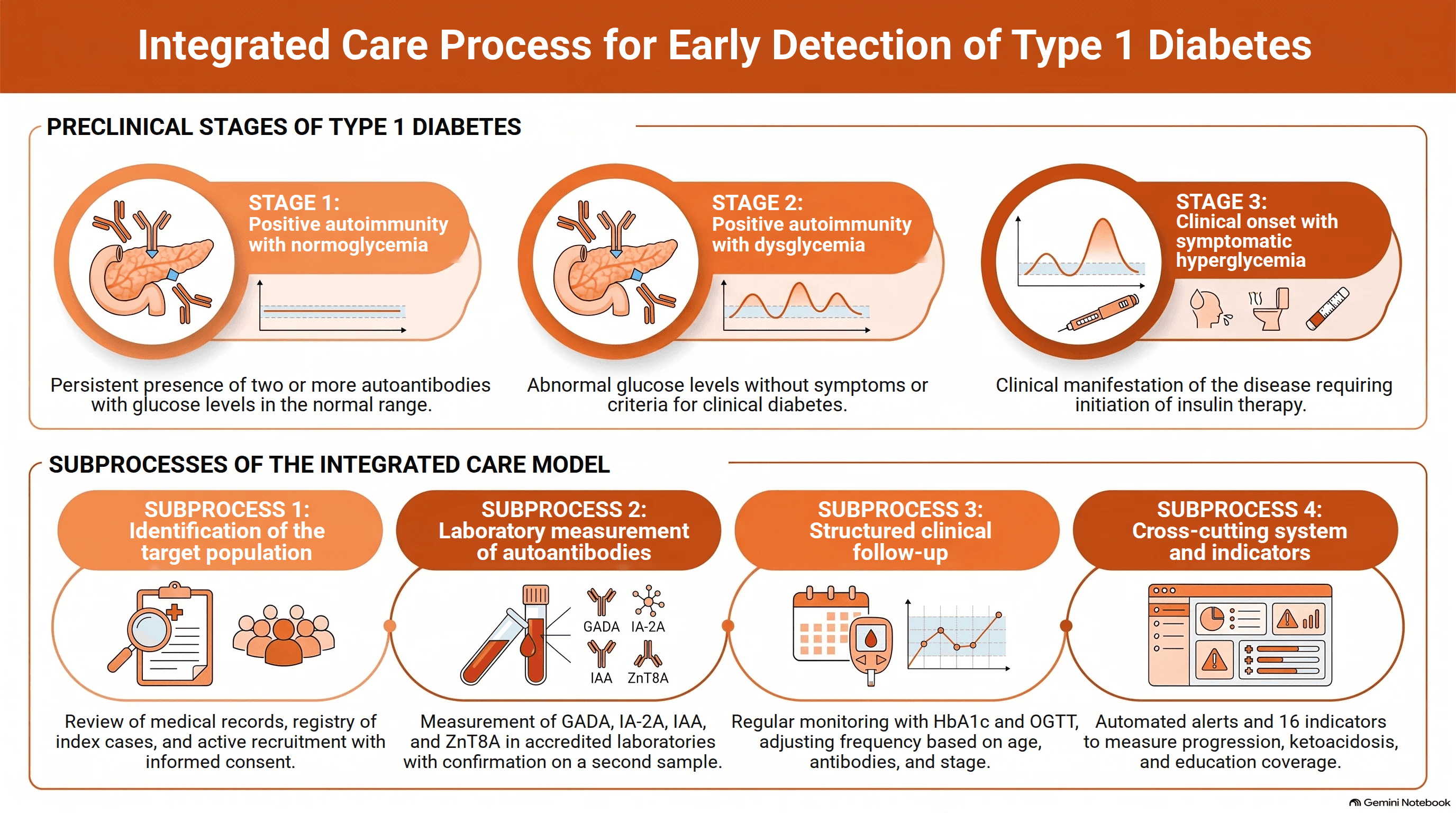
Therefore, the key appears to lie in these autoantibodies. The persistent presence of two or more of these markers defines a presymptomatic phase with a high risk for progression to clinical diabetes. From there, the document adopts the internationally validated three-stage classification endorsed by the International Society for Pediatric and Adolescent Diabetes and the American Diabetes Association:
- Stage 1: Positive autoimmunity with normoglycemia; defined by the persistent presence of two or more autoantibodies against pancreatic beta-cell antigens
- Stage 2: Positive autoimmunity with dysglycemia; glucose levels already abnormal but do not yet meet the criteria for diabetes or cause symptoms
- Stage 3: Corresponds to the clinical onset of T1D; characterized by symptomatic hyperglycemia and the need to initiate insulin therapy
Why Early Detection Matters
The central argument of the consensus is that structured monitoring during the preclinical phases provides significant benefits for both patients and the healthcare system.
First, participation in monitoring programs during the presymptomatic phases drastically reduces the incidence of diabetic ketoacidosis at the time of diagnosis. This acute metabolic complication, which often marks the onset of the disease, is also associated with greater subsequent difficulties in achieving glycemic control goals. In other words, presenting with ketoacidosis is not only a serious medical emergency but also has a lasting impact on long-term metabolic control.
Second, early detection allows for the early initiation of therapeutic education, helping patients and their families understand the autoimmune process, recognize symptoms of disease progression, adopt healthy lifestyle habits, and receive adequate emotional support before insulin dependence sets in.
From a clinical perspective, the short- and medium-term impacts of incorporating therapeutic education during the preclinical stages (stages 1 and 2) on the quality of life of patients and their families are a fundamental consideration. “The identification of a case of T1D in stage 1-2 requires that the patient be enrolled in the diabetes therapeutic education program and, ideally, receive support from a psychologist, although the latter may not always be possible. It is here, without a doubt, that the greatest effort must be made to adapt the integrated care process agreed upon by each health department.
Naturally, the new diagnosis and its emotional impact as well as its effects on quality of life and the patient’s personal and family environment require special assessment and management by nursing and psychology staff in collaboration with endocrinology, adult medicine, or pediatrics, as appropriate,” Juan Francisco Merino-Torres, PhD, coordinator of the Diabetes Area of the SEEN, told Univadis Spain, part of the Medscape Professional Network.
Furthermore, identifying patients at these stages opens the door to their potential inclusion in clinical trials or immunomodulatory strategies aimed at delaying the progression of the disease.
Who to Screen
The text establishes two pathways for entry into the process. The first involves first-degree relatives of people with T1D, the risk for whom is 10-15 times higher than that for the general population; screening is recommended for children and adolescents aged 2-18 years and for adults aged 18-45 years. The second pathway is for individuals with known high genetic risk, identified through high-risk alleles of the human leukocyte antigen system or polygenic risk scores.
The authors acknowledge a significant limitation of this strategy: Approximately 90% of new cases of T1D are diagnosed in people with no family history of the disease. Therefore, they recommend developing pilot population-based screening programs to evaluate their predictive performance, feasibility, and cost-effectiveness within the national health system.
“The integrated care process for T1D screening will, in most cases, originate in the endocrinology clinics themselves, where individuals with T1D, that is, the index case, are primarily followed. Logically, first-degree relatives who wish to be assessed and evaluated will have an impact on the schedules of both adult and pediatric endocrinology services. However, in the medium to long term, the identification of stage 1 and 2 cases of T1D is not expected to have a major impact, especially when considering the benefits of early diagnosis and early intervention strategies. At the primary care level — for both adults and children — it is true that there will be a demand for information, but this is a process that will primarily have an impact at the hospital level, as has been discussed,” emphasized Merino-Torres.
How the Process Is Organized
The model is structured around three core subprocesses and one crosscutting subprocess. The first identifies the target population through a review of medical records, index case registration, and active case finding, always with informed consent and respecting the right not to know. The second subprocess determines the presence of autoantibodies — GADA, IA-2A, IAA, and ZnT8A — in accredited laboratories, with confirmation using a second sample to minimize the occurrence of false positives. The third subprocess establishes clinical follow-up using A1c and an oral glucose tolerance test, adjusting the frequency based on age, the number and type of autoantibodies, and disease stage.
The fourth, crosscutting subprocess is an information system with automatic alerts and 16 indicators that enable the evaluation of screening performance, the rate of progression to stage 3, the incidence of ketoacidosis at onset, and the coverage of the educational program.
Among the key recommendations, the document emphasized adapting implementation to the structure of each healthcare service, designing a preliminary training plan for professionals, and ensuring that follow-up is protocol based, multidisciplinary, and includes structured therapeutic education and psychological support when necessary.
A Coordinated Care Model
The new consensus establishes a scalable and structured framework that connects primary care with hospital care. This model is primarily aimed at first-degree relatives of patients with T1D and individuals with identified high genetic risk. With appropriate laboratory confirmation from accredited laboratories and standardized follow-up, this approach seeks to transform the traditional management of the disease toward preventive and precision medicine.
The authors of the article disclosed no relevant conflicts of interest. Merino-Torres has disclosed no relevant financial relationships.
This story was translated from Univadis Spain, part of the Medscape Professional Network.



