Admin_Adham
A wireless electronic prosthesis implanted under the retina has been shown to restore central vision in people with an advanced form of dry age-related macular degeneration, leading to improvement in vision after a year, a small study of patients in Europe showed.
The device, called PRIMA, is surgically implanted under the retina and is paired with glasses that project near-infrared light to the implant to restore vision to areas of the retina damaged by geographic atrophy — the advanced stage of dry, or nonexudative, age-related macular degeneration.
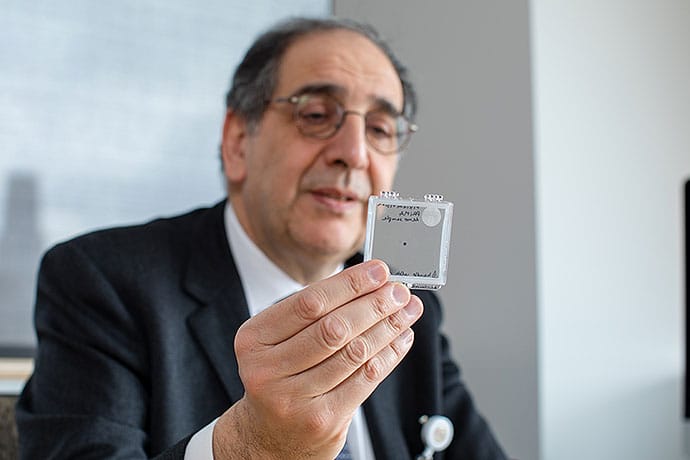
The PRIMAvera study, published in The New England Journal of Medicine, included 38 patients with end-stage disease and very low central vision who received the photovoltaic retinal implant microarray.

The study demonstrated “in the largest ever multicentric trial of significant improvement in visual acuity and reading capabilities in the vast majority of treated patients,” study co-leader José-Alain Sahel, MD, director of the UPMC Vision Institute in Pittsburgh, told Medscape Medical News. The study also showed the ability of well-trained surgeons to perform the surgery safely and efficiently, Sahel said.
“It is the first multicenter study giving evidence of vision restoration in geographic atrophy,” Anat Loewenstein, MD, head of retina at Tel Aviv Medical Center in Tel Aviv, Israel, and president of the European Retina Society, who was not associated with the research, told Medscape Medical News.
Study Results
Of the 38 patients who received the PRIMA implant, 32 were evaluated at 12 months. Twenty-six of them (81%) had at least a 0.2 logMAR improvement, which is equivalent to more than a 10-letter improvement in visual acuity on the standard Early Treatment Diabetic Retinopathy (ETDRS) chart and similar to an improvement from 20/100 to 20/63 on the Snellen chart.

The average improvement in visual acuity at 12 months was 0.49 logMAR, ranging from -0.32 to 1.18 logMAR, with the PRIMA glasses and 0.51 logMAR, ranging from -0.04 to 0.51 logMAR, with the participant’s choice, which means the better visual acuity between the assessment without glasses and the assessment with glasses. These changes correspond to improvements of 24.5 and 25.5 ETDRS letters, respectively.
The study reported 26 serious complications associated with the implantation surgery in 19 patients within 12 months of the operation. Twenty-one such events occurred within 2 months of the surgery, all but one of which resolved 2 months later, according to the researchers. Twenty-two events were considered mild or moderate in severity. The four complications considered severe were full-thickness macular hole, ocular hypertension, retinal detachment, and proliferative retinopathy.
Ocular hypertension was the most common complication, occurring in six patients within 3 weeks of the implantation operation. All cases resolved, the study reported. Five participants had peripheral retinal breaks, all of which were treated and none of which resulted in a rhegmatogenous retinal detachment. Three had a subretinal hemorrhage during the implantation procedure, which resolved spontaneously or after an increase in infusion pressure, Sahel and his colleagues reported.
Despite the complications, Sahel said all patients retained their prior vision and more than 80% improved. “Surgeons experience with the technology will minimize the impact,” he said.
Impact on Inner Retinal Structures
Use of optical coherence tomography imaging and fundus photography demonstrated the implant placement did not alter the inner structure of the retina in the targeted area of atrophy, but the average area of atrophy in the treated eyes increased by 8.5 mm2 within a year compared with an increase of 2.5 mm2 in eyes without the implant. However, Sahel said the increase in atrophy was not observed in most patients, and it had no measurable effect on vision.
Although the prevalence and severity of adverse events were significant, they were not out of the norm for a subretinal injection, Lowenstein said. “Their nature and predictable etiology suggest that the safety profile is acceptable and may be further improved with wide scale usage,” she said.
However, the more than threefold increase in the average area of retinal atrophy in the implanted “raises potential concern regarding long-term preservation of viable retinal tissue,” Lowenstein said. Further follow-up with these patients would be needed to see if expansion of the area of atrophy stabilizes over time, she said.
Lowenstein called the PRIMAvera study “the most comprehensive clinical evaluation to date of a wireless subretinal prosthesis, with a prospective, multicenter design with 17 international sites,” and praised the methodology and “rigorous safety oversight.” She also credited the study for using a standardized surgical protocol and an independent safety monitoring board. “Of course, the absence of a control or sham group is a disadvantage,” she added.
Science Corporation provided funding for the study. Sahel reported having no relevant financial conflicts of interest. Loewenstein reported consulting for Astellas Pharmaceuticals, Allergan/AbbVie, and Beyeonics Surgical.
Richard Mark Kirkner is a medical journalist based in Philadelphia.