

 Admin_Adham
This story is part of Blood, Sweat, and Tears, a special Medscape package exploring the future of diagnostics and health monitoring via body fluids. Read about Blood and Tears and find out how medicine is on the verge of a biomarker data renaissance.
Your patients want to know why their Oura rings say they’re stressed in the middle of the night.
The term “moving target” doesn’t even come close to the challenges you face when optimizing menopause therapy.
And that single-point-in-time cortisol test is carrying a lot of weight in your medical decision-making.
We could say don’t sweat it (sorry), but you’ll be doing just that in time. The holy grail of noninvasive biomarker data – sweat monitoring – is poised to inform all of these challenges, and perhaps even someday improve fertility tracking.

“The field of sweat-based diagnostics is at a really interesting inflection point,” said Dayanne Mozaner Bordin, PhD, a lecturer in analytical chemistry at the University of Technology Sydney. “For many years it was largely exploratory, but we’re now seeing a clear shift toward translational and clinically relevant applications.”
The technology can now do the job — wearable, durable sensors capable of picomolar-detection and capturing continuous data that can be transmitted in real time to smartphone apps. And it won’t look at one or two things. There’s already been work done on cortisol, epinephrine, norepinephrine, inflammatory markers, glucose, lactate, creatinine, urea, melatonin, estradiol, and progesterone.

The Texas-based firm EnLiSense can measure four biomarkers with a single sensor. The California Institute of Technology team led by Wei Gao, PhD, recently reported robust results benchmarking a stress sweat sensor for three simultaneously: cortisol, epinephrine, and norepinephrine.
“This opens the door to continuous, noninvasive monitoring and positions sweat as a strong candidate for personalized and preventive healthcare,” said Bordin, who specializes in translational biofluid work. But, she added, “the science is advancing faster than the clinical frameworks needed to support it …In terms of where we are today, I would frame it as: technologically mature, but clinically emerging.”
Sweat: The Details

With the FDA’s new guidance issued in January this year clarifying the definition of low-risk devices for general wellness, new sweat sensors are already entering the marketplace. EnLiSense has now sold 700 of its CORTI stress and sleep wearable sensor (priced at $225), said CEO and President Sriram Muthukumar, PhD; and the company plans to add estradiol and progesterone to its panel that already includes benchmarked melatonin and cortisol in the second half of this year. Menopause sweat wearables may be the most clinically relevant frontrunners because they bypass FDA criteria for medical devices since menopause is a life stage, not a disease.
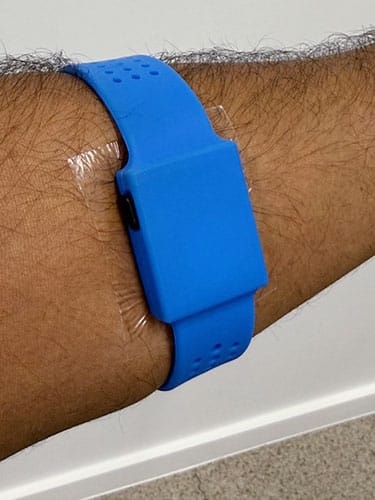
Hydration biomarker sweat sensing was pioneered by Northwestern University researchers, who leveraged cystic fibrosis gold standards for benchmarking.
What initially was known as the Gatorade Sweat Patch (launched 7 years ago and still available today for $12.50) prompted widespread interest from researchers and also from industries focused on worker safety. With that cystic fibrosis benchmark, startup Epicore Biosystems secured an FDA Class 1 medical device listing for their sensor and now sell it as the Discovery Patch to researchers with the assay removed.
The firm also optimized the sensor for Chevron and other companies spanning the energy, construction, and manufacturing spaces. It fully launched commercially at the beginning of this year as an armband sensor-and-app pair called Connected Hydration.

“Think of it like a Fitbit for biochemistry,” said Roozbeh Ghaffari, PhD, associate professor at Northwestern University’s Querrey Simpson Institute for Bioelectronics in Evanston, Illinois, and co-founder and CEO of Epicore, which is based in Cambridge, Massachusetts. “It tells you your sweat loss and your sodium levels in real time — continuously — and your skin temperature and motion. There’s a haptic feedback loop, so the device vibrates when you hit 2% loss of your fluid per your body weight. And so all of that really resonated not just with athletes but with the industrial athletes, as we like to call them.”
Validating hormones and metabolites is much more challenging. Ghaffari said he and Northwestern colleague John Rogers, PhD, (who holds 80 patents and patent applications) are currently working on kidney biomarkers like creatinine and urea.
There is also widespread work on cortisol. Caltech’s Gao says he frequently gets emails from patients who’ve had significantly abnormal cortisol labs.
“They really want to know more about their levels so they can personalize and guide their treatment,” he said, adding that he also gets requests from patients with depression seeking intra-day level monitoring to inform circadian rhythm. Patient inquiries also inspired his team’s work on estradiol.
Clearing Hurdles
Gao said the key five challenges of sweat as a biomarker have been:
- Getting people to sweat reliably — either electrochemically or colorimetrically. This has widely been accomplished.
- Getting the sensor to collect the sample reliably, including making a sensor that lasts long enough to continuously operate in real-world conditions. This has also been accomplished by numerous teams.
- Determining how often to sample to accommodate variability factors like time of day, acute vs chronic stress, and physical exertion. The EnLiSense device takes a sample every 5 minutes.
- Most hormones are present at very low concentrations in sweat. Gao’s sensor needed to be gold dendrite-plated graphene capable of nanomolar and picomolar detection.
- Clinical relevance work is ongoing. For example, Gao’s “Stressomic” sensor is working to differentiate between acute and chronic stress and eustress and distress.
EnLiSense co-founder and University of Texas at Dallas bioengineering Professor Shalini Prasad, PhD, said she has forthcoming results examining dim light melatonin onset and cortisol awakening response.
The work by Gao and by EnLiSense “point to the same broader shift in the field: moving toward continuous, multi-hormone monitoring to capture dynamic physiological processes in real time,” Bordin said. “The promise is significant, but the key challenge remains ensuring that these measurements are accurate, standardized, and clinically validated so they can be translated into meaningful health insights.”

Bordin said one challenge awaiting further exploration is sensor drift over time, and Prasad said it’s important to examine whether sweat stimulation techniques impact data.
Validation and standardization likely have a long road due to the rich complexity offered by continuous sweat biomarker data.
Gao’s Stressomic sensor found “clinically relevant interindividual variability in both physiological regulation and psychological stress perception,” the researchers reported in Science Advances. “Hormonal responses to stress are modulated by diverse factors, including baseline endocrine activity, genetic predisposition, psychological resilience, and prior stress exposure. Rather than masking this variability through averaging, our study embraces it as a key feature of human stress biology.”
Prasad’s research validated that sweat reflects morning cortisol peaks and evening rises in melatonin.
“You can clearly see that age plays a very important role … the cortisol peaks are very pronounced in people above 40,” she said, and in people ages 18-25 there is a “delayed release of melatonin, but it’s still much higher than in people over 40.”
This aligns with saliva-based benchmarks, she said, while noting that “another important aspect of this is that you don’t have to wake people up to take samples, so it could really impact sleep studies.”
What’s Coming
Saliva has contamination challenges, and urine can’t meet the continuous monitoring bar. Sweat is still on track, though.
“In some ways, the challenge has been to miniaturize what’s been happening with cystic fibrosis research,” Ghaffari said.
Bordin and colleagues — whose state-of-the-science roundup just published in the Journal of Pharmaceutical Analysis — contend that: “Importantly, we emphasize that sweat should not be seen as a replacement for blood or urine, but rather as a complementary matrix. When integrated into multi-omics and multi-biofluid approaches, it has the potential to provide additional layers of information that can improve diagnosis, monitoring, and ultimately patient care.”
Gao is the co-founder of Persperity Health. Ghaffari is the co-founder of Epicore Biosystems. Prasad is the co-founder of EnLiSense. Muthukumar is the president and CEO of EnLiSense. Bordin had no relevant financial disclosures. Disclosure information for study authors is available in the original study publications.


