Admin_Adham
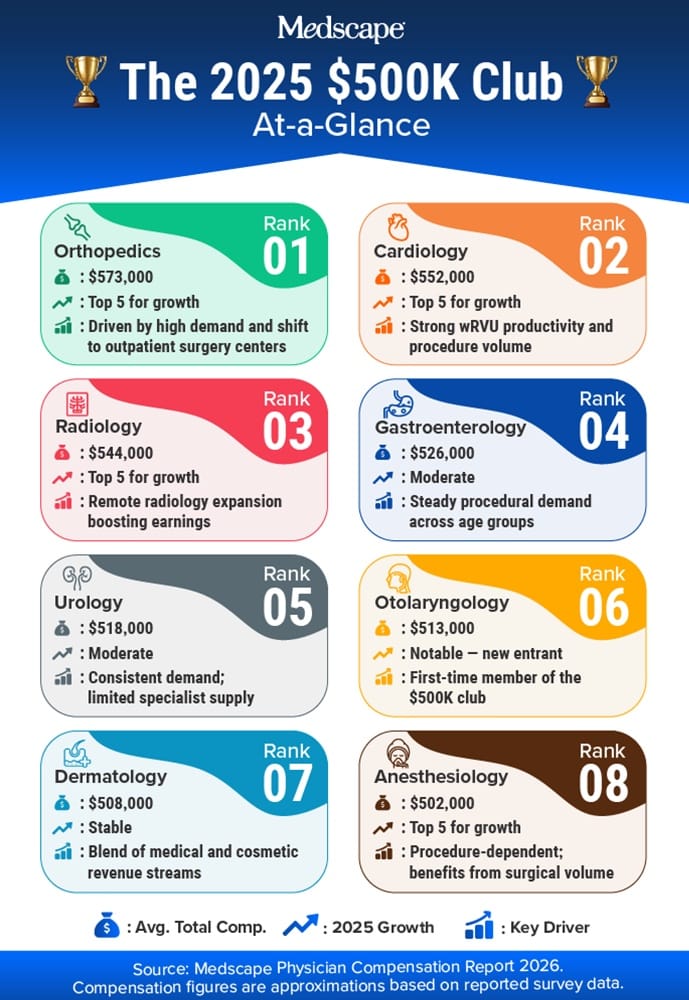
In medicine, compensation has always tracked closely with procedure volume, specialist scarcity, and the sheer complexity of the conditions physicians manage. In 2025, eight specialties reached a milestone few professions ever achieve: an average total annual compensation of $500,000 or more. That figure — drawn from the Medscape Physician Compensation Report 2026 — represents not just a financial benchmark, but a window into where American healthcare is heading.
Total compensation in this context includes base salary, incentive bonuses, and other income such as profit-sharing contributions, as reported by full-time physicians practicing in the United States.
A Year of Measured Gains
Physician pay in the US rose approximately 3% on average in 2025 — modestly outpacing the annualized core inflation rate of 2.7% at year's end. Matthew Wells, PhD, a senior director at AMGA Consulting, characterized 2025 as "a return to normalization," pointing to two primary engines: rising individual physician productivity (measured in work relative value units, or wRVUs) and improved technology-driven efficiency in clinical operations.
For the eight specialties below, that normalization translated into something more significant: sustained earnings well above the national physician average, underpinned by structural demand, limited supply, and in several cases, an expanding scope of practice.
What These Specialties Have in Common
Across the eight specialties, a few themes emerge consistently.
Procedural volume is the most powerful lever. Specialties where physicians perform a high number of billable procedures — surgeries, imaging reads, cardiac interventions — generate more wRVUs, which directly drive both base pay and incentive bonuses.
Orthopedics, cardiology, radiology, and anesthesiology all ranked in the top five for compensation growth in 2025 and remained in the top five for average total pay.
Supply constraints reinforce pricing power. Angie Caldwell, a principal with PYA Accountants & Advisors and a healthcare consultant, notes that the concentration of orthopedics, cardiology, and radiology at the top is unsurprising given the national supply of practitioners relative to demand. With medical training pipelines that can take over a decade to produce a fully credentialed specialist, imbalances between supply and demand tend to persist.
I absolutely am not surprised that orthopedics, cardiology, and radiology are at the top of this list, based on the supply of practitioners nationally and demand for procedures.
Angie Caldwell, PYA Accountants & Advisors
Technology and practice setting also matter. Radiology has seen significant earnings growth, in part due to the expansion of remote radiology work — a model that allows radiologists to read studies from multiple facilities, effectively multiplying their productive capacity. In orthopedics, the migration of hip and knee replacements from inpatient hospital settings to outpatient ambulatory surgery centers (ASCs) has been a notable financial driver, particularly in high-volume markets like Florida.
The New Member: Otolaryngology
Seven of the eight specialties in the $500K club also appeared in last year's report. The notable addition for 2025 is otolaryngology (ENT), which crossed the threshold for the first time. ENT specialists manage a broad procedural scope — from complex head and neck oncology to high-volume outpatient sinus and airway procedures — and the specialty has benefited from both aging population dynamics and technological advances in minimally invasive techniques.
Its entry into the $500K tier reflects broader trends: as surgical procedures shift to lower-cost settings and technology reduces operative times, specialists who own or participate in ASCs can generate substantially more revenue per hour worked.
Compensation and Career Planning
For physicians in training or those evaluating specialty pathways, compensation data like this is one of many relevant inputs. Medscape’s survey also captures sentiment: 53% of physicians overall reported feeling fairly compensated in 2025 — an improvement over the prior year's 48%, the lowest reading in a decade.
But compensation satisfaction is not purely a function of earnings. Staffing levels, administrative burden, documentation requirements, and schedule control all influence how physicians perceive their pay relative to their workload. Notably, pathologists and public health specialists — both outside the $500K tier — reported the highest rates of feeling fairly compensated (69% and 66%, respectively), suggesting that factors beyond raw compensation significantly shape career satisfaction.
For prospective medical students, the calculus is equally complex. Caldwell expects more students to pursue high-earning specialties not only for the compensation but also because of the impact of research and technology on those fields. Training length, lifestyle considerations, geographic flexibility, and alignment with clinical interests all warrant serious weight alongside earning potential.
Looking Ahead
Wells anticipates consistency in compensation increases moving forward, provided productivity trends hold. The structural factors that have elevated these eight specialties — aging patient populations, limited specialist supply, technology-enabled efficiency — show little sign of reversing.
One Florida surgeon in the Medscape survey offered a perspective worth noting: "I think that there are not enough physician specialists being produced and as the population ages, they may be able to negotiate better contracts." Whether that plays out as projected depends on medical school enrollment trends, the evolution of scope-of-practice laws for advanced practice providers, and the ongoing transformation of reimbursement models.
For now, the $500K threshold stands as a meaningful marker — one that eight specialties have earned through the convergence of skill, demand, and structural market dynamics.
Data sourced from the Medscape Physician Compensation Report 2026.
Sources report no financial disclosures.
Jennifer Nelson is the features editor at Medscape Insights. Her work has also appeared on WebMD, Medical Economics, and MedPage Today, as well as in The Washington Post, AARP, US News & World Report, The Oprah Magazine, Women's Health, and other publications.