Admin_Adham
GLP-1 receptor agonists such as semaglutide are changing the way type 2 diabetes and obesity are treated. But these drugs have also shown a surprising ability to improve cardiovascular health — and not just because losing weight benefits the heart.
“These effects were not predicted,” said Michael Nauck, MD, head of clinical research at the Diabetes Division of St. Josef Hospital at Ruhr University Bochum in Bochum, Germany. “There were no animal studies or even basic physiology suggesting they would be helpful for the cardiovascular system.”

In 2008, the FDA ordered a series of cardiovascular outcomes trials after two studies suggested lowering blood sugar could be dangerous for the heart in patients with type 2 diabetes, Nauck said. Results from these studies brought the potential cardiovascular benefits of GLP-1s to light. “The results were really positive,” he said.
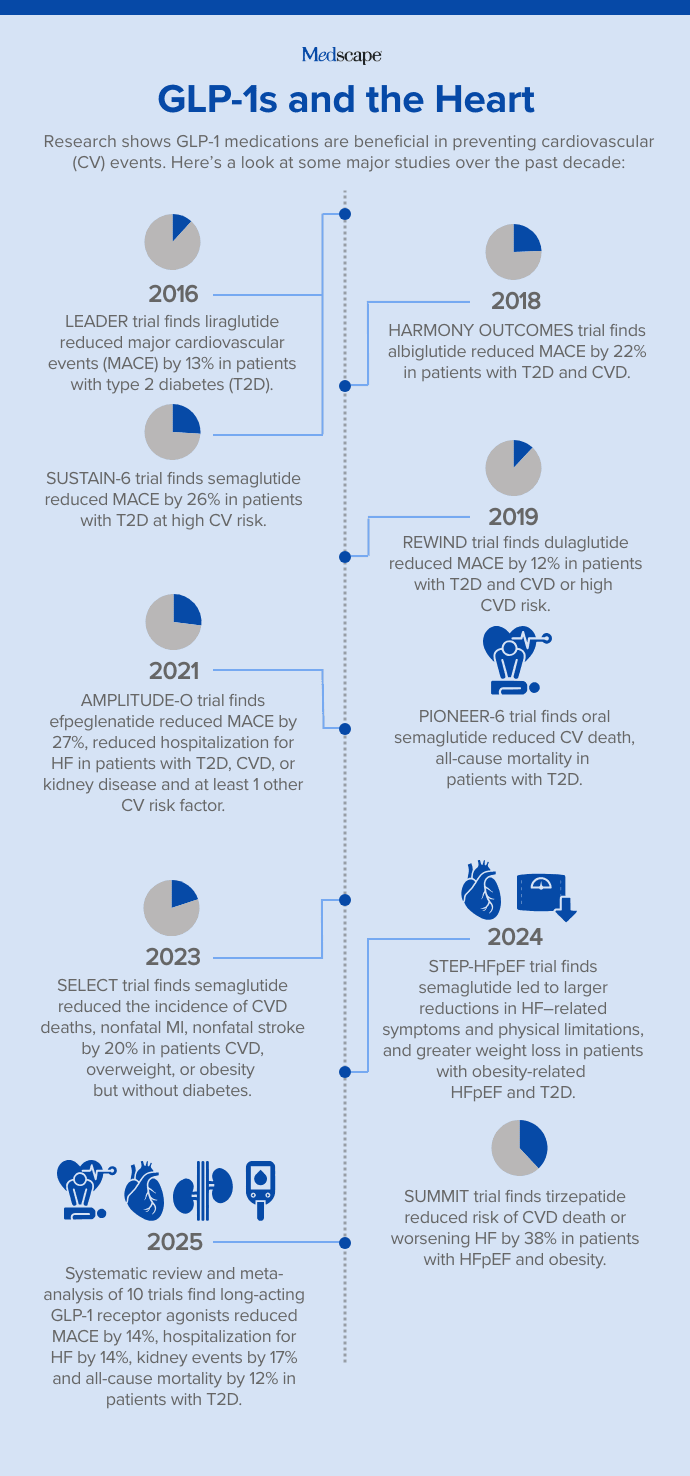
All of the drugs tested were shown to be safe, and several showed significant reductions in composite major adverse cardiovascular event (MACE) endpoints, which usually included cardiovascular death, nonfatal heart attack, and nonfatal ischemic stroke, compared with placebo.
The strongest benefits were seen with efpeglenatide, with a 27% reduction in MACE, and semaglutide, with a 26% reduction. Albiglutide, dulaglutide, and liraglutide had statistically significant but more modest reductions. A pooled meta-analysis of 60,000 patients found a relative reduction in MACE of 14% and all-cause mortality of 12%. Some of the drugs have also been associated with improvements in peripheral artery disease and symptoms of heart failure with preserved ejection fraction.

Daniel Drucker, MD, an endocrinologist at the University of Toronto in Canada, said the “impressive” data from these phase 3 clinical trials has led to widespread acceptance of the cardiovascular benefits of GLP-1s, particularly semaglutide. “All the forms of semaglutide, whether it’s the oral form or the injectable, now have an FDA label that says they may be useful for preventing heart disease,” he said.
More Than Just Risk Factor Modulation?
What remains unclear is how, exactly, GLP-1s deliver those cardiovascular benefits. Olivia Gilbert, MD, a cardiologist at Wake Forest University in Winston-Salem, North Carolina, believes improvements in cardiovascular risk factors have the biggest impact.
“I think it’s the weight loss itself that is providing most of the benefit,” she said, with improved glycemic control and reduced inflammation also providing some benefits.
But there is also evidence that other factors are in play. Drucker points out that even early versions of the drugs, which didn’t lead to much weight loss, still reduced MACE by around 20%. “It doesn’t seem to matter if weight is lost,” he said.
And, he added, the people involved in the trials were already taking blood pressure-lowering drugs, platelet aggregation inhibitors, statins, PCSK9 inhibitors, and more. Adding GLP-1 receptor agonists to all those proven cardiovascular medicines results in a 10%-20% further reduction in rates of heart attacks, strokes, and deaths.
“This is a profound benefit that we’re seeing on top of excellent cardioprotective standard of care, and I think it’s worthwhile remembering that,” he said.
So far, it remains unclear to what extent the benefits are due to improvements in risk factors or if there are other mechanisms involved. A growing body of work suggests GLP-1 drugs act on platelets, immune cells, and vascular cells to protect against atherosclerosis independently of their effects on glycemia, appetite, and weight.
Nauck’s belief, which he admits is not yet widely accepted, is that GLP-1s work directly within the blood vessel wall at the cellular level to prevent the formation of plaques. In a review of animal and human tissue and cellular studies, Nauck identified 13 cellular processes that lead to the formation and rupture of atherosclerotic plaques, all of which GLP-1s can slow down or stop.
“It’s a difficult thing to study, but it’s the most convincing explanation I can come up with,” he said.
Drucker is not yet convinced by this idea, but agrees it is worth investigating further. “There’s little scientific evidence to support it so far, but it’s a very valid hypothesis,” he said.
The Next Steps
Over the past several years, the use of GLP-1 drugs has expanded beyond their original role in diabetes management to treating obesity, and that trajectory looks set to continue as the cardiovascular benefits become clear.
Gilbert was lead author on a set of clinical guidelines from the American College of Cardiology in 2025 that recommend providers consider GLP-1s as a first-line treatment option for weight management in patients with obesity to reduce cardiovascular risk.
“Patients shouldn’t have to ‘try and fail’ lifestyle interventions before they get these drugs, since we know that lifestyle interventions aren’t as effective in achieving cardiovascular outcomes,” she said.
Both Drucker and Nauck expect this trend will continue, with the drugs eventually used to help control cardiovascular risk in people without either diabetes or obesity.
“You could probably take any patient with a diagnosis of atherosclerotic cardiovascular disease, and you will likely find the same effects,” he said. “It doesn’t depend on the presence of diabetes — that was shown in the SELECT trial — and doesn’t necessarily depend on obesity.”
That would require one of the pharmaceutical companies to carry out a clinical trial that would allow drug regulators to further expand the use of these medications. “I’d like to see that done,” said Drucker. “I think there would be a high likelihood of success.”
Nauck reported being a member on advisory boards or consulting with Boehringer Ingelheim, Eli Lilly and Company, Medtronic, Merck Sharp & Dohme, Novo Nordisk, Pfizer, Regor, Sun Pharma, and Structure Therapeutics (Gasherbrum); receiving grant support from Merck Sharp & Dohme; serving on the speakers bureau of Eli Lilly and Company, Merck Sharp & Dohme, Medscape, Medical Learning Institute, and Novo Nordisk; and being on a Data Monitoring and Safety Board for Inventiva. Drucker reported having served as a speaker for Novo Nordisk and Eli Lilly and Company and as a consultant to Alnylam, Amgen, AstraZeneca, Crinetics, Eli Lilly and Company, General Medicines, Kallyope, Pfizer, Protagonist Therapeutics, and Sanofi. Gilbert did not report any relevant financial relationships.
Brian Owens is a freelance journalist based in New Brunswick, Canada.