Admin_Adham
Why would a physician leave their home country to practice medicine elsewhere? For some, the decision is driven by work-life balance or higher compensation; for others, it comes down to training opportunities, safety, or the desire for a fresh start.
A global survey conducted by Medscape Professional Network collected responses from 1271 physicians across dozens of countries. The findings outline the motivations, barriers, and preferred destinations shaping today’s worldwide trend of medical migration. Meanwhile, Italy continues to confront a significant outflow of healthcare professionals who increasingly seek better working conditions beyond its borders.
Profile of the Expatriate Physician
According to the Medscape survey, most physicians who plan to practice outside their home country are men (58%). Younger doctors account for a substantial group (43%), but the majority are older than 45 years (57%).
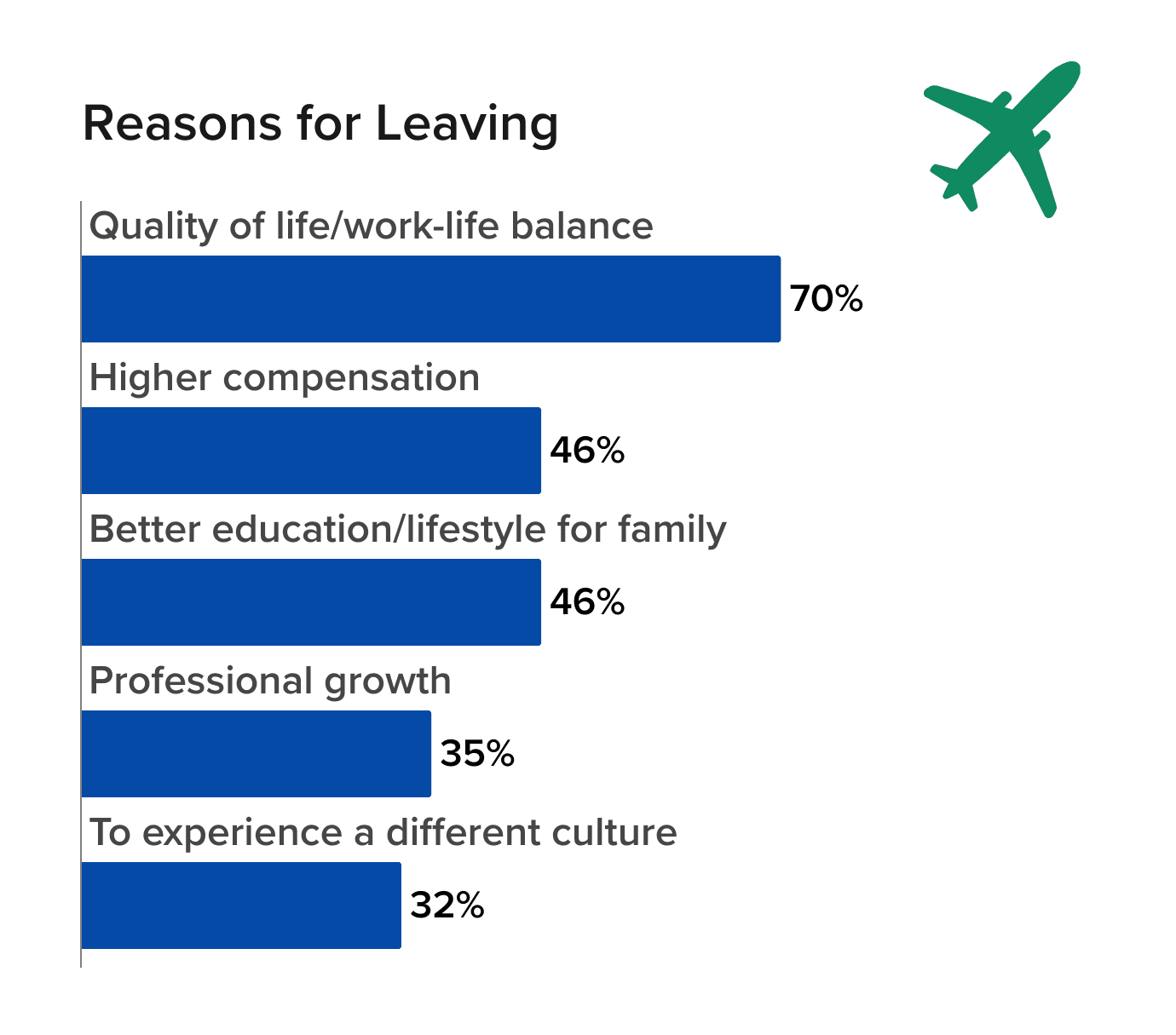
The most common motivation is the pursuit of a better quality of life and improved work-life balance (70%). Financial incentives (46%) and benefits for family (46%) are the next most influential factors, reflecting widespread dissatisfaction with working conditions at home.
Top Destinations
Europe is the most popular destination for relocating physicians, followed by the US and Australia. The data suggest that high-income, established health systems attract the largest share of international medical talent.
Within the EU, doctors tend to migrate to other EU countries, with particularly high flows toward France, Germany, and Switzerland. One striking finding involves physicians from Latin America: nearly two thirds report practicing in Spain compared with 24% among all respondents.
Most Represented Specialties
Family medicine/general practice and internal medicine are the two most represented specialties among both potential and current expatriate doctors. Anesthesiology remains consistently among the top specialties as well, underscoring the global demand for broad-based clinical expertise.
Barriers to Relocating
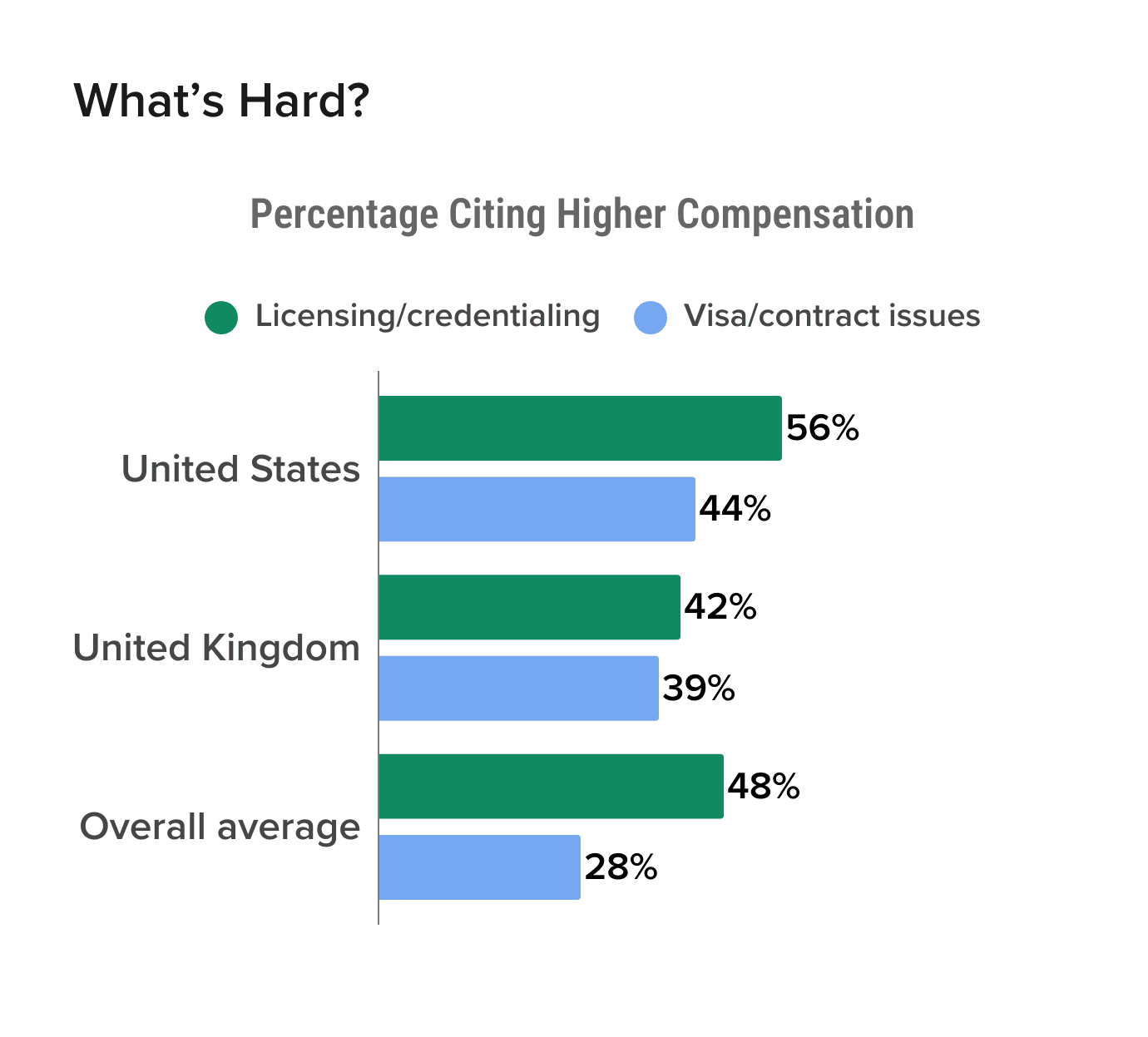
Across all destinations, licensure and professional authorization remain the largest practical barriers. These challenges — together with visa processes, immigration procedures, and contract negotiations — are especially common among doctors moving to the US.
Other reported challenges include differences in health system structure and workflow, as well as cultural and communication barriers.
Income Differences by Destination
Physicians’ reported income varies dramatically depending on their new country. Spain has the highest share of doctors earning under $50,000 annually (28%), reinforcing its role as a lower-income destination. By contrast, the US (38%) and Switzerland (21%) show the highest proportions of physicians earning over $300,000.
Italy’s Situation: A Continuing Exodus
While Medscape’s survey reflects global patterns, Italy stands out as a notable example of a country consistently losing healthcare workers. The numbers are stark, and the trend shows no sign of slowing.
Between 2000 and 2022, nearly 180,000 Italian healthcare professionals chose to work abroad, including 131,000 physicians and 48,000 nurses, according to the Organisation for Economic Co-operation and Development (OECD).
Every year, roughly 1000 Italian doctors request certification to work abroad, according to Filippo Anelli, president of FNOMCeO (Italy’s National Federation of Medical Associations). Other data suggest a higher figure: according to the Association of Foreign-Origin Doctors in Italy, from January 2023 through October 2024, more than 13,550 healthcare professionals formally requested information about relocating abroad — 54% of them physicians.
In the first 5 months of 2024, the Lazio region (home to Rome) saw 1252 healthcare workers leave: 810 physicians, 389 nurses, and 53 technicians.
Where Italian Physicians Are Going
For nurses, the UK is the top destination, followed by Switzerland and Germany. Physicians are more spread out: between 1500 and 1700 move to France each year, and 1000-1050 to Belgium. OECD data also show that Germany, Israel, Switzerland, and the UK each have more than 1000 physicians of Italian origin or trained in Italy.
Another growing trend is the migration of Italian doctors to the Gulf states, where large-scale government investments in healthcare have created a strong pull. In these countries — where foreign workers account for about 90% of the health workforce — monthly salaries can reach €20,000, along with benefits such as housing, children’s education, and tax advantages.
Why Italian Physicians Are Leaving: Beyond Salary
The reasons Italian physicians emigrate are varied and interrelated. While better pay is a major factor, many also seek more organized workplaces, stronger career pathways, and greater recognition of their professional role.
Financially, the data are striking. Between 2015 and 2022, salaries for senior physicians in Italy fell 6.2%, and spending on permanent contracts decreased 2.8%, according to the CENSIS (Center for the Study of Social Investments) Institute, a major Italian social research organization.
Italian physician salaries are among the lowest in Europe. Medical trainees rank fifth from the bottom among 21 EU countries, according to the European Federation of Salaried Doctors. Italy ranks below the midpoint even for fully trained physicians.
After at least 10 years of training, a physician employed by Italy’s National Health Service (Servizio Sanitario Nazionale) earns €2500-€4000 net per month. In comparison, countries such as Germany, France, Austria, and the Netherlands pay between €5000 and over €6000 net monthly.
But the challenges go beyond pay. Working conditions are affected by hiring gaps, limited advancement opportunities (only 12% reach senior positions, and just 2% are women), failure to uphold contract terms, and increased workplace violence — 16,000 assaults in 2023 alone, according to FNOMCeO.
In 2023, the region with the highest number of relocation requests was Lombardy (which includes Milan), with 630 cases (430 physicians, 125 nurses, and other professionals). Veneto followed with 600, and Piedmont with 550.
An Unenviable Record
Between 2008 and 2018, more than 10,000 Italian physicians moved abroad, with the UK (33%) and Switzerland (26%) as top destinations. During the same period, for every 100 European doctors who emigrated from their home countries, 52 were Italian, according to the European Commission.
This has major implications not only for talent loss but also for the country’s public finances. Training a medical specialist costs up to €250,000. Each year, Italy effectively transfers about €350 million in training investment to other countries that hire Italian-trained physicians.
The paradox is that while thousands of Italian doctors seek opportunities abroad, the National Health Service is experiencing severe personnel shortages. In 2025, the gap between retiring specialists and newly trained ones is expected to be sharply negative.
A comparison of global Medscape Professional Network data with the Italian situation highlights that the core drivers of medical migration are universal: the search for a better quality of life, fair compensation, sustainable work conditions, and career opportunities. But Italy appears particularly vulnerable to these pressures, losing year after year a pool of expertise that will be difficult to replace in the near future.
This story was translated from Univadis Italy.