

 Admin_Adham
A heart-healthy diet based on traditional indigenous foods reduced hospitalizations and emergency department (ED) visits among patients with heart failure (HF) in rural Navajo Nation, according to a new study.
HF causes significant morbidity and mortality within the Navajo Nation, and food insecurity is a contributing factor. Cardiovascular disease is the leading cause of death among all American Indians, with particularly high prevalence among people younger than 65 years.
Researchers in the Medically Tailored Traditional Food to Optimize Nutrition in Heart Failure (MUTTON-HF) trial compared a home-delivered culturally and medically tailored meal (CMTM) program to usual care comprising heart-healthy, home-prepared meals incorporating locally sourced foods. The study was published online on July 27 in JAMA Internal Medicine.
The authors said the randomized clinical trial is the first of its kind and could inspire similar efforts in other geographic and cultural contexts.
Reclaiming Indigenous Foods
“We conducted community outreach in Navajo Nation and had listening sessions, focus groups, and surveys to understand what the biggest barriers for community members are to achieving optimal health,” said the study’s first author, Lauren Eberly, MD, MPH, who started an Indian Health Service (IHS) quality improvement initiative 2 years ago that laid the groundwork for the study “What we overwhelmingly found was that access to healthy food or nutrition insecurity was reported as the major barrier to health.”

Eberly, an assistant professor of medicine in the Division of Cardiovascular Medicine at the University of Pennsylvania in Philadelphia and a staff cardiologist for the IHS at Gallup Indian Medical in Gallup, New Mexico, also noted that participants expressed a desire to reclaim traditional ways of life, including indigenous foods.
“Traditional foods are sacred and healing,” said Eberly, who noted the concept of food is medicine is a long-standing Navajo belief.
A Community-Based Approach
Eberly’s team tested the hypothesis that reclaiming traditional foods could improve health among patients with HF. They conducted the study at two IHS ambulatory clinics serving a large area within Navajo Nation that offers limited fresh produce and healthy food options.
Nutrition requirements in the meals were based on Dietary Approaches to Stop Hypertension diet and the American Heart Association’s Heart-Check Food Certification Program.
The meals cost $12 each, not including research and development, delivery, and distribution, which was conducted via a network of pickup sites. The study provided kitchen appliances including microwaves and freezers for participants lacking that equipment.
Patients in the intervention arm received 14 CMTMs per week for 60 days. Breakfast included items such as a blue corn mush plate with blueberries, bison sausage, and butternut squash. For dinner, patients had meals such as mutton rainbow stew with steamed corn, blue corn meal, and wild rice. The meals included no added salt or sugar, and patients could eat whatever they wanted outside of the prescribed diet, Eberly said.
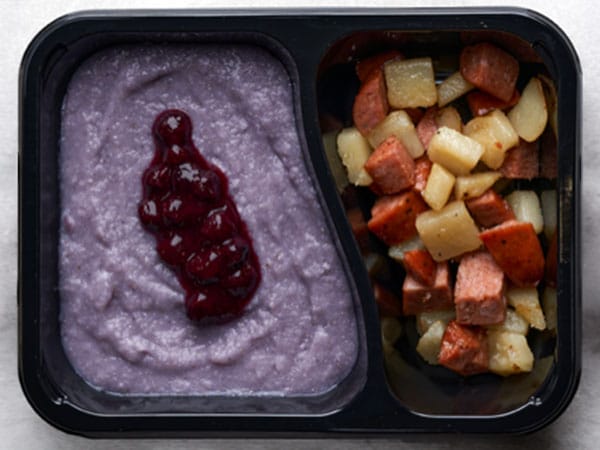
“Additional research on optimal dose and optimal duration is still needed in the Food-is-Medicine field, but prior work in other settings [such as the MEDIMEALS study] has shown that even seven meals weekly may provide benefit,” Eberly said.
Patients in the control arm assigned to usual care received a set of recipes that incorporated traditional local foods and an educational booklet. After 60 days, patients in this group could choose to receive 14 home-delivered tailored meals per week for 30 days.
A Strength-Based Intervention
Among 106 patients in the intervention arm, 43 (40.6%) had a hospitalization or ED visit for any cause compared to 57 patients out of 100 (57%) in the control arm.
That difference was primarily driven by a decrease in the rate of hospitalizations, which was 12.3% in the intervention arm vs 26% in the control arm. Hospitalizations for HF were also lower among the patients on CMTM, at 3.8% vs 13.0% in the control arm.
Researchers found that patients receiving home-delivered traditional meals had improved Kansas City Cardiomyopathy questionnaire scores, reduced weight, reduced blood pressure, reduced financial strain, and improved renal function compared to the control arm.
“MUTTON-HF is a strength-based intervention,” Eberly said. “This work emphasizes the importance of community-engaged design as well as highlighting how leveraging the protective assets of native communities is really critical to advancing Indigenous health.”
Expanding to Other Cultural Contexts
Eberly said to her knowledge this is the first randomized clinical trial evaluating the efficacy of a community-designed, medically tailored meal program that incorporates traditional Indigenous and culturally relevant foods to improve cardiovascular health outcomes.
“The reduction in hospitalization and emergency department visits was substantial and clinically meaningful,” said Jason Wu, PhD, program head for nutrition science at The George Institute for Global Health in Sydney, Australia.

“Acceptability to the intended program recipients is critical to the likely impact of any Food-is-Medicine program,” he said. “This approach also taps into traditional knowledge about sources of local healthy foods and can strengthen people’s connection to culture and land.”
Wu, who had no involvement in the MUTTON-HF trial, echoed Eberly’s belief that some methods could translate to other settings.
“We’ll need more research to evaluate the overall cost versus benefit of such programs and to inform government and others on long-term funding and support for these kinds of programs,” Wu said.
Eberly and her team are working with their farming and ranching partners to evaluate the impact of the study on strengthening local food systems and advancing food sovereignty within Navajo Nation.
They are also finalizing qualitative analyses and forming partnerships to supplement the quantitative work characterizing how the program improved holistic health among participants. They have also launched a cost-saving and cost-effectiveness analysis.
“We anticipate the program to be cost saving given its significant reduction on hospitalizations, and we hope this will add further evidence to support its long-term adoption and expansion,” Eberly said, adding, “We hope these results will motivate payors, public health officials, and health systems to adopt similar programs an integral part of care and covered benefit.”
The MUTTON program is ongoing for participants with HF at the IHS trial sites, and researchers are piloting the program in other high-risk groups, including at senior centers and as part of a prevention program targeting women with cardiovascular disease risk factors.
Eberly reported having no relevant financial relationships. Her statements related to the MUTTON trial represent her views, not those of the IHS. Wu reported receiving funding from the International Fresh Produce Association, Hort Innovation, Costa, Fresh Produce Group, Piñata Farms, Perfection Fresh, and One Harvest to conduct Food-is-Medicine-related research.
Catherine Shaffer is a freelance science and medical writer with a background in molecular biology and pharmaceutical research. Her work has appeared extensively in scientific trade and mainstream publications and on public radio.


