

 Admin_Adham
For patients recovering from spinal damage, joint trauma, or stroke, rehabilitation can stretch across months and often defines whether they return to independent living. The work is painstaking, and for decades it has relied on therapists’ hands, clinical intuition, and passive devices that don’t capture much beyond what the eye can see.
That model is changing. In some of Europe’s clinics and hospitals, wearable robotic exoskeletons are turning physiotherapy into a data-rich, feedback-driven process. Embedded sensors track joint angles, muscle activation, and gait symmetry; motors can assist or complete a movement once a person initiates it. The result is training that is both measurable and adaptable, with the potential to accelerate recovery while easing the physical burden on clinicians.

“We need to move beyond simple mechanics,” said Nicolò Boccardo, PhD, chief mechatronic engineer at the Rehab Technologies Laboratory (IIT) in Genoa, Italy. “The goal is embodiment, where the device is so intuitive that the patient perceives it not as a tool to be operated but as an extension of their own limb.”
Across north-western Europe, teams are testing how that vision plays out in practice — both for patients learning to walk again and for healthcare professionals seeking protection from the heavy strains of their daily work. Early pilots show promise and expose the real-world barriers that still need solving.
From Passive Support to Active Recovery
Exoskeletons are wearable electromechanical frames designed to augment or restore movement. Lower-limb systems support walking by assisting the hip, knee, or ankle; upper-limb devices aid shoulder, arm, and hand function; trunk and back designs stabilize the torso and reduce strain. In neurorehabilitation, exoskeletons are designed to help patients relearn movement after neurologic injuries such as stroke; they guide and support movements as patients regain muscle control. Assistive exoskeletons provide active propulsion, completing a movement initiated by the user — critical when a patient is only able to generate weak voluntary movements.
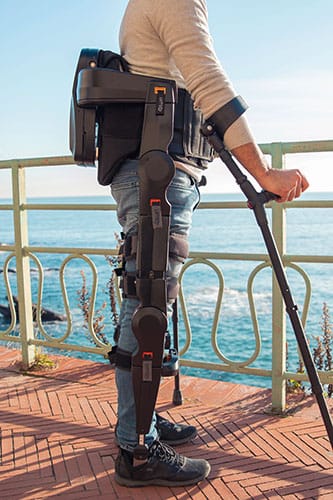
These devices support and guide the body’s natural movements, allowing patients with spinal injuries or severe limb damage to practice standing, stepping, and lifting far earlier than would otherwise be possible, Boccardo explained. “The ability to stand upright or take assisted steps soon after the injury restores a sense of independence and motivates patients to continue pushing through difficult recovery.”
High-repetition practice of correct gait patterns leverages neuroplasticity to retrain the nervous system, while upright mobility supports cardiovascular health, bowel function, muscle tone, and bone density and reduces complications like joint stiffness. “Using bionic exoskeletons can really accelerate recovery in inpatient and outpatient settings,” he said.
Boccardo’s team at IIT has developed the TWIN exoskeleton, a modular lower-limb system for patients with spinal cord injuries. Powered joints are paired with passive compliance to reduce weight and make donning and doffing easier. The device is undergoing clinical validation in six hospitals across Italy.
Inside the Clinic: Learning to ‘Pilot’ the Robot

Hardware alone does not determine outcomes, said Ilaria Baroncini, MD, a physiatrist at the Montecatone Rehabilitation Institute in Imola, Italy, one of the centers trialing IIT’s device.
Therapeutic efficacy hinges on patient acceptance and the way the technology is integrated into care pathways. “The challenge is trust,” Baroncini explained. “The patient must feel that the machine is a partner, not a constraint, to engage in the rehabilitation process fully.”
There is also a learning curve for physiotherapists accustomed to hands-on guidance. “With an exoskeleton, the therapist must learn to become a pilot.” Instead of relying on tactile cues, clinicians must interpret sensor data and mechanical feedback to individualize training. Despite the adjustment, the benefits to providers are substantial: the robot bears much of the patient’s weight, reducing the physical strain on the therapist and back injuries that are common with manual gait training.
Protecting Clinicians: Exoskeletons for Ergonomics
The same technology is being explored to protect healthcare workers from musculoskeletal injuries caused by heavy patient lifting and standing for prolonged periods during procedures.

“Healthcare represents one of the fastest-growing opportunities for exoskeleton innovation,” said Shiney Franz, PhD, a nurse scientist at HAWK University of Applied Sciences and Arts in Hildesheim, Germany. Nursing carries a high risk for musculoskeletal disorders from lifting, transferring, and sustained awkward postures — often at rates exceeding heavy industry.
Franz leads the MSD-CARE project, co-funded by the EU’s Interreg North-West Europe program, to adapt industrial exoskeletons for clinical use. In simulated hospital settings, nurses and caregivers from Germany, Ireland, and Netherlands performed routine tasks with and without the devices. The feedback was nuanced. Staff valued the physical support during strenuous tasks but identified design barriers that would limit adoption on the ward.
Fit and comfort topped the list. With most healthcare workers being women, standard chest straps were uncomfortable. Hygiene was nonnegotiable: Materials must withstand frequent disinfection without degrading. Appearance mattered, particularly in pediatrics and among patients with cognitive impairment — devices that look intimidating could jeopardize rapport. Quick donning and doffing were essential, and exoskeletons could not obstruct communication or delay response in emergencies.
“The market opportunity is real,” Franz said. “But only for devices that respect the user’s reality. Success depends on designing around the needs of healthcare workers themselves rather than simply repurposing factory equipment.”
Boccardo, Franz, and Baroncini reported no relevant financial relationships.
Manuela Callari is a freelance science journalist specializing in human and planetary health. Her work has been published in The Medical Republic, Rare Disease Advisor, New Scientist, The Guardian, MIT Technology Review, and others.


