

 Admin_Adham
 Jump to Key Points
A surprising thing might happen to the immune system if you live long enough: rather than steadily declining, it may adapt to help you survive.
A new analysis in Cell Reports adds fresh support to this hypothesis, which emerged in 2019 when researchers at Osaka University, Suita, Japan, first showed that “supercentenarians” — those who live to 110 years and beyond — harbor an unusually high number of a rare immune cell.
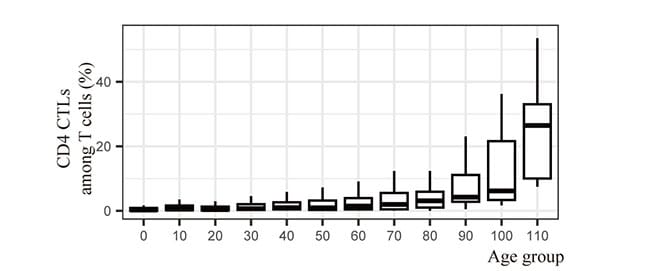
After analyzing blood samples from 10 supercentenarians, 10 centenarians, and eight people in their seventies to nineties — and combining that data with large public single-cell datasets covering ages 0-110 or older — the researchers have now found that these cells increase “markedly” around age 100.

The hybrid immune cells — CD4 cytotoxic T lymphocytes (CD4 CTLs) — have capabilities of both “helper” CD4 T cells (which recognize threats and activate other immune cells) and cytotoxic effector molecules (used by “killer” T cells to eliminate threats). They typically account for less than 5% of a person’s total T cells, but can multiply to fight viruses (HIV, COVID) and have been shown to kill age-accelerating senescent cells and lung, bladder, and skin cancer cells.
- CD4 CTLs ↑ markedly around age 100; 17.6% in supercentenarians vs 4% younger donors.
- CD4 CTLs are hybrid helper/cytotoxic T cells; <5% of total T cells typically.
- Expanded clones suggest focused response to persistent antigens; largest clone = 33% overall.
- No known antigen matches; 32/36 expanded matches linked to cancer samples.
- Immune aging may include adaptation, not only decline; potential blood biomarkers for healthy aging.
“One broader implication is that immune aging may not simply be a process of decline,” said lead author Kosuke Hashimoto, PhD, an associate professor at Osaka’s Institute for Protein Research. “In some very old individuals, the immune system may continue to adapt to persistent antigens.”
The study adds to growing research highlighting changes in the immune cell populations of centenarians, said Paola Sebastiani, PhD, a professor of medicine at Tufts University School of Medicine, Boston, who was not involved in the new research. Sebastiani co-led a 2023 study that showed centenarians may have super-charged immune resilience.

“They get sick, they rebound, and that’s the signature in their immune cells,” she said.
Hashimoto’s new analysis found CD4 CTLs comprised 17.6% of supercentenarians’ T cells compared with 9.6% in centenarians, and 4% in younger donors. A healthy participant in their nineties had the highest proportion of CD4 CTLs overall. Some supercentenarians had much higher levels than others.
“If we could analyze a much larger number of people, we would probably see a broad range within each age group,” Hashimoto said. “Even with that individual variation, I would still expect the overall distribution, and particularly the median, to shift upward around the ages of 100 and 110.”
The Search for a Secret Target
Genes likely play a role in driving CD4 CTL expansion, Hashimoto said. MHC class II molecules — which present antigens to CD4 T cells — are gene-encoded and vary widely from one person to the next.
“There is also an element of chance,” Hashimoto said. T cell receptor sequences that help identify antigens are generated through a “largely random” recombination process.
In his analysis, a small number of sequences cloned themselves to become very large populations. The largest clone represented 33% of the CD4 CTLs across all donors. In one donor, a centenarian, the largest clone made up about 54% (126 out of 234) of CD4 CTL cells. “This suggests that their responses may be focused on a relatively limited set of persistent targets,” Hashimoto said.
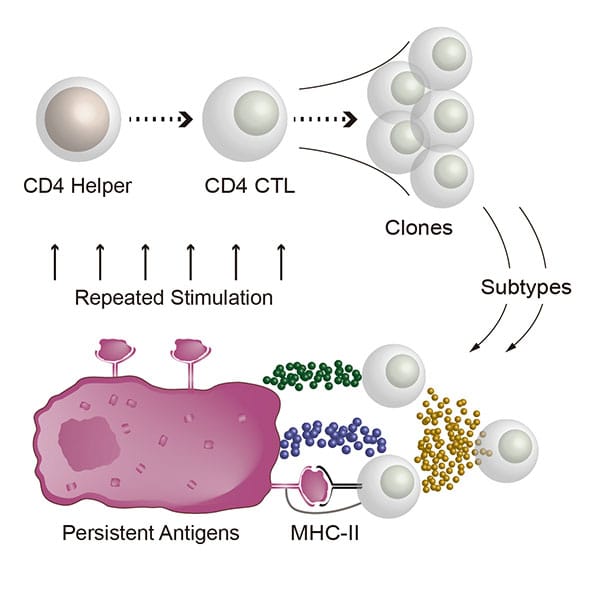
What those antigen targets are remains a mystery.

“If these clones were against senescent markers, that would be pretty cool,” said Katrin Andreasson, MD, a professor of neurology and neurological sciences at Stanford University School of Medicine, Stanford, California, who was not involved in the new study.
Andreasson’s 2026 research considers how immune cells called tissue-resident macrophages clear age-accelerating senescent neutrophils. In separate experiments, her lab has been struggling to identify the targets of expanded T-cell clones.
“This is the biggest problem in the field,” she said. “We have all these T-cell sequences, but we don’t know what they’re against.”
A Shield Against Cancer Growth
Hashimoto investigated the genetic sequences of the most prolific clones and found a link to cancer resistance.
Specifically, he cross-checked the clones’ CDR3 sequences (especially crucial in determining which antigen to target) against a database of sequences linked to known antigens, and a larger database of sequences from almost 20,000 healthy and diseased samples. No matches to known antigens, but 617 entries matched samples from the larger database. Of those, 36 had expanded enough to indicate a biological threat, and 32 of the 36 matched samples were from patients with cancer — including 17 non-small cell lung cancer, nine breast cancer, and six liver cancer.
That doesn’t mean longevity depends on cancer suppression alone, Hashimoto said, but “maintaining the ability of the immune system to adapt to challenges even at very advanced ages may be one factor.”
Clinical applications could be down the road. “If we can identify blood-based markers that allow us to monitor [a healthy immune state in very old age], we may eventually be able to consider ways to support beneficial immune responses during aging,” Hashimoto said.
Long-term studies of centenarians’ offspring could reveal clearer answers, Sebastiani said. She leads data analysis for the New England Centenarian Study, based at Chobanian and Avedisian School of Medicine, Boston University, which has been following centenarians and their families since 1995. Some participants survived breast cancer in the 1950s before modern treatments, she said, and one lived to be 114 despite having surgery for colon cancer at age 70.
“It could be that there is this resilience to cancer,” Sebastiani said. “It would be fantastic if the hypothesis of the authors is real, that there is a signature in the immune cell that prescribes this phenomenon.”
The experts cited in this article reported having no relevant disclosures.



