Admin_Adham
For classical hematologist Srila Gopal, MD, overseeing the care of about 250 adults with sickle cell disease (SCD) and thalassemia isn’t just a matter of diagnosis and treatment.
In just a single week in September 2025, the University of California San Diego (UCSD) physician handled a range of other tasks:
- She ran interference for a deeply ill young woman who lives 2.5 hours away and would not agree to stick around for a hospital stay.
- She monitored a groundbreaking infusion program whose focus on same-day visits has been linked to fewer emergency department stays.
- She counseled a young patient with SCD on gene therapy and reproductive preservation.
- She attended an out-of-town meeting for thalassemia specialists where topics included the lack of guidance about treating adult patients.
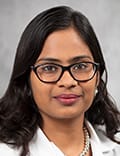
That wasn’t all. Gopal also found time to treat other patients, dig into a pair of ongoing studies, teach young trainees, and meet with a social worker who’s helping patients to stay afloat. Throughout the week, Gopal kept in mind the unique challenges of treating young patients with SCD, as they try to make it in the world on their own with the burden of a chronic disease.
“When they reach out for help, we never turn them down. That may be our only opportunity to help them,” said Gopal, who serves as medical director of Adult Sickle Cell Program and associate clinical professor in the Division of Hematology & Oncology at UCSD.
High-Stakes Care for a High-Risk Patient
Gopal’s path to hematology began in India, where she was inspired by the intersection of sophisticated laboratory science and direct impact on patient health. After medical school in India, she completed residency at the University of Connecticut and a fellowship at Tufts Medical Center in Boston, with a stint in laboratory research at Beth Israel Deaconess (also in Boston), studying thrombosis mechanisms. Then she landed at UCSD.
“I really find it fascinating to work through a problem and play detective to figure out what is the next thing I should really be looking for,” she said.
Here’s a look at highlights from Gopal’s week:
Gopal put her problem-solving skills to work immediately as the week began. On Monday, an 18-year-old patient with immune thrombocytopenia arrived with a platelet count < 5000/mL — dangerously low. She had been experiencing severe bleeding for over a week. She had traveled 2.5 hours for the appointment and didn’t have anywhere to get the urgent care she needed near her home.
The patient refused hospitalization in San Diego. “She told me as much. She said, ‘If you’re gonna ask me to go, I’m just gonna go home,’” Gopal recalled. “And I said, ‘No, no, don’t do that. Let’s try and find another plan for you.’”
The solution required extensive coordination. Gopal and her team started high-dose steroids immediately, made multiple phone calls to get urgent insurance authorization for intravenous immunoglobulin, and brought the patient back the next day for outpatient infusion. Quickly, her platelet levels began recovering.
“It took us a lot of time in the back end, in the middle of clinic, to arrange for all that,” Gopal said. But thanks to quick and coordinated action, the patient was able to recover.
An Infusion Clinic With Same-Day Service
Gopal’s clinic faced another challenge on that Monday: Everyone seemed to be seeking infusion therapy for SCD pain relief, possibly because the weather had shifted as fall set in. Even in ever-sunny San Diego, “we get a ton of infusion requests any time there’s a change, like a little bit cooler or a little bit warmer,” she said.
Whether it’s a slow or busy day, the infusion clinic takes a unique approach to care: It allows patients to request same-day outpatient pain management. As Gopal explained, patients contact the clinic by phone or MyChart and meet a clinician via video visit for triage.
If appropriate, they come in the same day for pain medication, hydration, and labs. “It’s been really successful in keeping patients out of the hospital and helping them manage their pain more efficiently.”
Gopal and colleagues reported on the infusion clinic’s experience in a February 2025 Blood Advances report. They found that the mean number of emergency department discharges per patient with SCD per year decreased from 1.4 to 1.0 (P = .031) after the telemedicine system was instituted in 2019.
Navigating the Crucial SCD Transition Period
Also on Monday, Gopal saw two young men with SCD as both were making the high-risk transition from pediatric to adult care. Patients with SCD are at high risk for dying during this period because they fall out of the medical system, she said.
One patient was doing quite well on hydroxyurea, while the other had improved significantly after starting red blood cell exchange. This patient was interested in gene therapy to avoid monthly blood exchanges.
The conversation addressed FDA-approved gene therapy options, quality of life implications, and potential fertility loss from the required high-dose chemotherapy. Gopal discussed referring the patient to reproductive medicine for sperm banking. “It’s a big decision for somebody that age to make,” she said. “He hadn’t made up his mind yet on whether or not to do it.”
‘We Never Turn Them Down’
On Tuesday, a patient with chronic myeloid leukemia failed to appear for an appointment. “I’ve been taking care of him for a few years now. He’s dealing with some substance abuse issues, unfortunately, and surfaces every once in a while. When he comes up for air, we try and get him in at that point.”
It’s not unusual for Gopal to get ghosted by patients. “I take care of a population of patients who tend to fall off the grid,” she said.
How can clinicians help patients like these? “You just got to keep calling them. And when they reach out for help, we never turn them down,” she said. “If they’re late to an appointment, we never say we won’t see them. We try to get them in because that may be our only opportunity to help them, you know. We just persist and tell them that we’re there to help whenever they show up.”
Patients with SCD are especially challenging when it comes to getting them into the clinic, Gopal said. Some are busy with their young lives, while others wonder why they should bother: “Unless you have something new for me, why am I coming there and wasting my time?” There also may be other challenges regarding transportation costs or no time off work. The clinic tries to be flexible with telehealth options, she said.
Kidney Disease, Social Impacts, and Patient Challenges
On Thursday, Gopal worked on research projects. One looks at SCD and chronic kidney disease (CKD). About half of patients with SCD develop some kidney impairment by age 50. Analyses of California data, she said, have revealed troubling patterns: Some patients with CKD in stage III or IV didn’t see kidney specialists — or sometimes even hematologists — for years.
“The main question we’re trying to answer is how long it takes for somebody with chronic kidney disease to progress to end-stage kidney disease where they need dialysis,” Gopal said. “Is there something that you can do to slow down that progression?”
Another Gopal’s project examines social vulnerability index and mortality risk. So far, her team has found that many patients who die from SCD are from neighborhoods with very high social vulnerability, based on census tract data.
Earlier in the week, on Wednesday, Gopal and team members held their weekly meeting with community health worker from the Sickle Cell Disease Foundation of California. The worker provides social support that medical settings can’t address directly, such as arranging transportation, addressing food insecurity, helping with housing applications, and connecting patients with county rehabilitation services for educational support.
“Since they are not able to physically be in clinic due to organizational policies, we created a weekly meeting format. During these meetings, we discuss any new referrals and get updates regarding shared clients and any challenges that they’re facing.”
Cross-State Trip to Talk Thalassemia
Gopal traveled to Oakland, California, for the Thalassemia Western Consortium meeting, where she joined colleagues from across the western US to discuss gene therapy implementation. Two FDA-approved therapies for beta thalassemia exist, she said, but uptake has been slower than hoped.
“These therapies work great. They seem to be safe, but we’re still not where we wanted to be in terms of how many people we’re treating,” she said, citing logistic issues, expensive costs that make insurance authorization difficult, and manufacturing delays.
Also at the conference, Gopal and colleagues discussed launching a research project into pregnancy outcomes in thalassemia. And they tackled a hot topic in thalassemia: How should older patients be treated as lifespans get longer for those with the disease?
“There’s a lot of burden in adults now, and we don’t really know what the best way to manage them is, especially the ones with nontransfusion-dependent thalassemia. They don’t need routine blood transfusions. But it seems as they get older and into adulthood, they start to have more complications that would necessitate a more rigorous transfusion therapy program.”
Gopal had no relevant disclosures.