

 Admin_Adham
 Jump to Key Points
Medicine is a life of learning. Take My Advice is a Medscape series where physicians share their best lessons, the wins and losses, and how to use everything you know to become a better caregiver every day.
I can tell you exactly where I was driving on the highway when my daughter Hannah called me. She was 4 years old, and she wanted to hear my voice because she hadn’t seen me in 3 days. It wasn’t just the missed family dinners and overall sacrifice. I never encouraged any of my children to go into medicine because the medical world is not the same as when I started my career. It’s not as congenial or as collaborative as it used to be. Administrative demands and loss of control of the practice environment have changed it dramatically.
Yet Hannah had an interest in medicine from a young age. She learned it first-hand. At age 16, she was one of the top distance swimmers in the state. One day, we noticed her lagging behind in a race she’d typically have won by a pool length or more. Something was wrong. I bought her a blood sugar test kit, and her reading came back over 600 mg/dL — astronomically high. The following 3 days that she spent at Cincinnati Children’s Hospital, Cincinnati, were some of the most influential in her life. She went from having a debilitating, life-threatening problem, to being healthy and ready to compete, now as a type 1 diabetic. Ten days later, she was on the podium at her state competition.
I joke that if you need an opinion, Hannah has one, and another one behind it. But the funny thing is, so do I. Her hand-eye coordination is phenomenal. She was always making projects with her hands. After she got into medical school, I knew she would end up as a surgeon. Still, I didn’t push her to consider my field and never expected our careers would overlap.
- Physician careers now face ↑ admin burden; compartmentalize clinical vs business tasks.
- Early career doctors need contract, insurance, retirement, and legal/financial literacy.
- Family understanding of medicine’s commitment helps sustain long-term career demands.
- Specialty fit matters; meaningful work can offset workaholic surgical schedules.
- Post-morbidity loss: recovery requires resilience and returning to work despite shaken confidence.
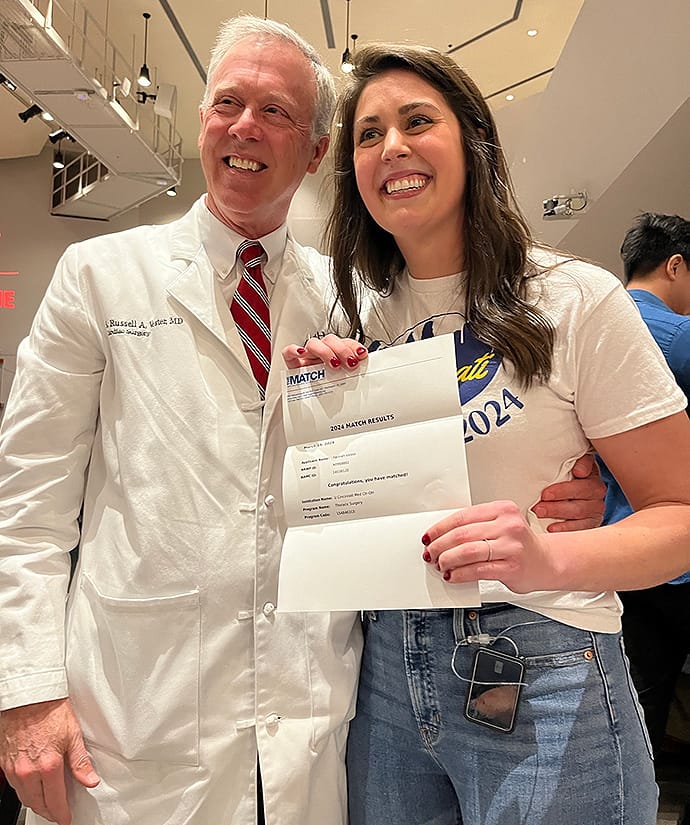
That is, until she matched with our cardiothoracic surgery training program at the University of Cincinnati Medical Center. She was our top pick, and as soon as I found out, I knew I’d be delaying my upcoming retirement until her training was completed. She is beginning year 3 of her 6-year residency. I still have a few years to try and teach her everything I know about cardiac surgery.
But some things about life as a physician can’t be taught in the OR. Here’s what else I’m teaching her:
Learn the Business Side
The role of administrative tasks is one of the biggest challenges in a physician’s career today. As long as a young doctor can compartmentalize the administrative and clinical sides, they will be fine. But if you blend those two, it will drive you crazy.

Many young doctors will have to teach themselves these skills until the medical education systems catch up to the pressing need. Today, when most doctors exit school, they quickly learn what they don’t know about how to navigate their first contract, what a retirement plan looks like, how insurance works, and how to generally protect themselves both legally and financially.
Make Sure You (and Loved Ones) Understand the Commitment
Hannah grew up around me missing events, and the whole family understood the importance and the why — I was missing something only so that another family could have their family healthy and home. But this isn’t a commitment everyone understands even if they witness it. You have to live it. I told my daughter, who is now engaged to a wonderful man, that they should live together for 2 years before committing to marry. I wanted them to be sure they truly understood what their life together would look like. They actually did this, and I think it was a big help for both of them.
Choose What Feeds Your Soul
Some specialties can hold a 9-to-5 schedule. But people in my area, along with neurosurgery and general surgery, tend to be workaholics. If the work is meaningful to you and resonates with your soul, that’s how you know you’re in the right specialty. When that happens, you don’t feel like you’re missing something to be at work. You feel like you’re right where you’re supposed to be.
Get Back on the Horse
The darkest days as doctors can be when you lose a patient or have a challenging outcome. The hardest part is getting back on the horse the next day. Your best efforts resulted in a loss, so now you’re questioning your abilities and working through shaken confidence. It doesn’t matter how old or young you are — it’s always hard. As time goes on you learn how to manage getting back into it the next day, but it is never comfortable.
Make and Hold Your Boundaries
I am forever grateful to 4-year-old Hannah for that wake-up call on the highway. I realized then that I had to create boundaries and stick to them, or the medical field would create them for me. This looks different for everyone. But I knew in that moment — not seeing my young child for 3 days was a boundary I wasn’t willing to give on anymore. Figure out those boundaries and stick to them.
The fact that Hannah chose cardiothoracic surgery as her specialty is one of the great gifts of my career. To teach her and help her get started in the profession is the greatest reward after the work I’ve done for decades. It’s the cherry on top. She has just shy of 4 more years working with me. After that, I told her, “Honey, we’re walking out of here holding hands.”
Samuel Vester, MD, is a cardiothoracic surgeon with UC Health in Cincinnati.
Are you a doctor with wisdom to share about life in medicine? Do you have good advice you want to offer your fellow physicians and a story only you can tell? Medscape Medical News would love to consider you for Take My Advice. Please email your contact information and a short summary to access@webmd.net.
The experts cited in this article had no relevant disclosures.



