

 Admin_Adham
Five years ago, Maya A. Bass, MD, rarely had patients schedule appointments specifically to talk about perimenopause. Today, she said, such visits have become routine.
“That just wasn’t something that I saw as a chief complaint until recent years,” Bass, vice chair of education for the Department of Family Medicine at Cooper University Health Care in Camden, New Jersey, said.
Those conversations in exam rooms reflect a sharp increase in the past decade of women on the cusp of menopause taking hormone therapy, according to new data that suggest clinicians may be responding to evolving evidence about the benefits of the treatment.
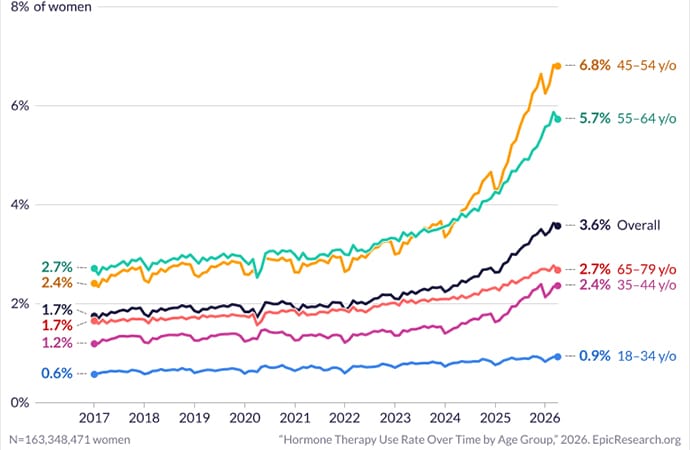
The use of hormone therapy in US outpatient care nearly doubled since 2017, according to a new analysis provided exclusively to Medscape Medical News by Epic Research, using Epic Cosmos, a database that includes more than 307 million patient records from approximately 2000 hospitals and more than 49,000 clinics across the nation. The sharpest increases occurred after 2022 in women in their late forties and early fifties, the study found.
The researchers excluded women with a history of breast cancer, current pregnancy, or evidence of gender-affirming care to better capture hormone therapy prescribed for menopausal and perimenopausal symptoms.
Women’s Health Initiative Fallout Settling
Prescribing of estrogen plateaued after the landmark Women’s Health Initiative study in 2002 linked combined estrogen-progestin therapy to increased risks for cardiovascular disease, stroke, venous thromboembolism, and breast cancer, prompting boxed warnings from the FDA. Studies now suggest those risks were overstated for many women who begin treatment near the onset of menopause.
In November 2025, the FDA removed boxed warnings related to cardiovascular disease, breast cancer, and dementia from products containing estrogen, citing evidence that the benefits may outweigh the risks when therapy is initiated within 10 years of menopause.
The Epic analysis, based on more than 163 million adult women seen in outpatient settings between January 2017 and April 2026, found the use of hormone therapy increased from 1.7% of women in January 2017 to 3.6% by April 2026. Growth was modest before accelerating in 2023.
“Our study is descriptive, so we can tell the trend accelerated around 2023 but can’t tell from these data why,” said Kersten Bartelt, RN, who helped conduct the study.
Bass said she believes the shift reflects changes on both sides of the exam room.
“I think part of this is patients advocating for it,” driven by increasing discussion of menopause on social media, she said.
She welcomes those conversations. “I love the self-advocacy,” Bass said. “Patients are coming in and saying, ‘Hey, I think this is what’s going on. Can we have a discussion about it?’”
At the same time, she said, clinicians have become more comfortable prescribing hormone therapy as evidence has evolved.
“The M enopause Society guidelines have changed in the last decade and are now more in line with recognizing that HT [hormone therapy] is safe in specific ways,” she said. “The benefit does outweigh the risk for a decent chunk of the population.”
Bass added that many of today’s therapies differ from those studied in the original Women’s Health Initiative, with newer transdermal estrogen and micronized progesterone formulations appearing to carry lower risks than older oral therapies.
JoAnn E. Manson, MD, an endocrinologist and principal investigator of the Women’s Health Initiative Clinical Center in Boston, agreed the trend likely reflects years of accumulating evidence rather than a single event.
“I think it was the cumulative effect of a lot of research becoming available and accessible to women,” said Manson, who also is professor of medicine at Harvard Medical School and chief of the Division of Preventive Medicine at Brigham and Women’s Hospital in Boston.
Midlife Women Drove the Increase
The largest increase occurred in women aged 45-54 years, whose use of hormone therapy nearly tripled — from approximately 24 prescriptions per 1000 women in 2017 to 68 prescriptions per 1000 women by April 2026, Bartelt and her colleagues found. Women aged 35-44 years and 55-64 years also experienced roughly twofold increases, while use changed relatively little in women aged 18-34 years and 65-79 years.
Bartelt said the age distribution matched expectations.
“The 45-54 finding didn’t surprise me,” she said. “That age range overlaps the typical menopausal transition, so it’s the group you’d expect to see symptom-directed therapy in.”
Because the Epic Cosmos dataset does not capture menopause directly, investigators used age bands as a proxy for menopausal status.
Manson said the findings are encouraging because they suggest more women are discussing treatment options with their clinicians rather than dismissing hormone therapy altogether.
Shift Toward Single-Hormone and Nonoral Therapies
Orders for progestin-only therapy increased approximately 3.3-fold, from about 0.3% to 1.1% of women during the study period, while prescribing of estrogen-only preparations increased about 2.3-fold, from roughly 1.1% to 2.6%. Use of combined estrogen-progestin products and testosterone-containing therapies remained relatively stable.
Transdermal therapies, including patches and gels, showed the fastest growth, increasing about 3.5-fold from 0.33% to 1.17%. Vaginal hormone therapies nearly tripled, increasing from 0.45% to 1.26%, outpacing growth in oral medications and injectable formulations.
“The shift toward transdermal and vaginal formulations is consistent with options that have become more familiar in recent years,” Bartelt said. “However, our data only show the pattern, they don’t tell us why any individual clinician or patient made the decision that they did.”
Bass said the trend mirrors her own prescribing.
“Based on current research, transdermal estrogen has a lower risk for clots than the oral formulations,” Bass said. That means she can feel safer offering these transdermal options for women who are at borderline risk for the oral estrogens, she said.
Studies also show the minimal systemic absorption with topical vaginal estrogen may have expanded its use, even in some women who are not candidates for systemic hormone therapy.
Individualized Treatment Remains Key
Despite the increase in prescribing, experts say that hormone therapy is not appropriate for every patient.
“The most important factor is whether a woman has an indication for hormone therapy,” she said. Bothersome hot flashes and night sweats remain the primary FDA-approved indication.
Prevention of osteoporosis is another approved use for selected women. Once an indication is established, clinicians should consider a patient’s age; time since menopause; cardiovascular risk; breast cancer risk; and contraindications, such as a history of venous thromboembolism or estrogen-sensitive cancers.
Bass said one challenge for primary care physicians has been adapting to the major shift in the evidence.
“When I trained, we were told giving people hormones could potentially increase their risk for heart attack and stroke,” she said. “To then have to go back and realize actually, if given at the right times and using the right formulations, I’m improving patient outcomes without drastically increasing risk, that shift can be really tough.”
As more women seek care for menopausal symptoms, Bass said, more primary care physicians are recognizing that perimenopause management belongs in routine practice.
“Family physicians especially are hungry for this information,” she said. “They’re now diving deep to make sure that they know how to do it the safest and best way for their patients.”
The researchers, Bass, and Manson had no relevant conflicts of interest.
Lara Salahi is a health journalist based in Boston.


