Admin_Adham
During the COVID pandemic, Jennifer Meddings, MD, noticed that many of her in-person patients presented with cases of Clostridioides difficile infections just a week or so after receiving antibiotics via telehealth for a potential urinary tract infection (UTI). The pattern was troubling, and she wondered how often virtual visits were leading to unnecessary antibiotic use and downstream harm.
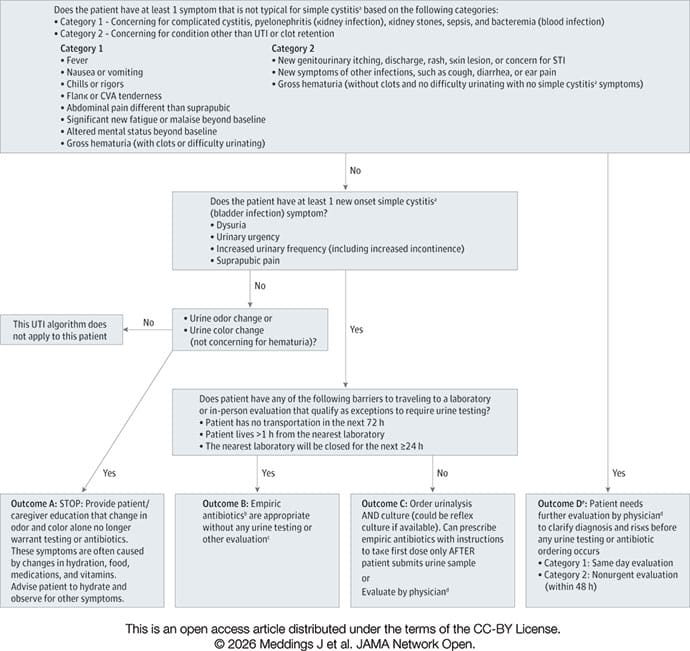
Meddings’ experience prompted the creation of a decision tree to help clinicians virtually determine when patients suspected of having a UTI can be treated with antibiotics without testing or when they need an in-person visit and cultures collected.
The US CDC estimates that 1 in 3 antibiotic courses prescribed in the outpatient setting for a suspected UTI is unnecessary. But the condition is one of the most common indications for antibiotic prescribing.
“You have to wonder how often is that appropriate?” Meddings, professor of internal medicine and pediatrics at the University of Michigan Medical School in Ann Arbor, Michigan, who led the research that is published in JAMA Network Open, said. “For clinicians, our goal was to make a stepwise algorithm that really easily helps them triage those that need to be seen in person versus those that could be treated with or without urine testing.”
Although recent clinical guidelines on UTIs make recommendations on optimal selection of antibiotics for empiric treatment, Meddings said the decision tree specifically addresses clinicians seeing patients over telehealth.
Triaging Steps
For the decision tree, Meddings and her colleagues recruited 13 clinical experts to conduct a scoping review of research on diagnostic testing and stewardship for suspected UTI in telehealth and outpatient settings published over a 15-year period starting in 2009. They rated the appropriateness of treatment initiated without definitive diagnostic results in 136 clinical scenarios.
Takeaways included that clinicians should first rule out complicated cystitis, kidney stones, or bacteremia. Patients with symptoms such as pain over the kidney, fever, or chills should come in for an appointment or go to an emergency department.
Clinicians evaluating a woman with suspected first-time UTI symptoms should see the patient in person to rule out alternative diagnoses, including sexually transmitted infections and genitourinary syndrome of menopause, Meddings said.
If they have a risk factor for developing antibiotic resistance, such as hospitalization within the past month, a urine culture is needed.
If risk factors are not present, the decision tree specifies treatment by sex: Empiric antibiotics may be prescribed to women without any urine testing or evaluation. But all men should have a urinalysis with culture before the first dose of antibiotics is taken, regardless of how often they have had a UTI.
The guideline also specifies that clinicians may consider empiric treatment without testing for all patients who face barriers to submitting urine samples or cannot come in for an evaluation.
Emily Spivak, MD, medical director of antimicrobial stewardship programs at the University of Utah Hospital and the VA Salt Lake City Health Care System, Salt Lake City, said the guide may be helpful, but Spivak questioned how the guide will be translated into practice.
“Can you implement it easily, either in an electronic health record and some kind of phone tree?”
Meddings said her team is developing a pilot project to evaluate the impact of the decision tree on patient outcomes.
The study was funded by the VHA National Center for Patient Safety. Meddings reported receiving research support from the Agency for Healthcare Research and Quality and the VHA National Center for Patient Safety, among others. Spivak reported consulting for PRIME Education LLC and being an unpaid advisor for Solution Diagnostics.
Brenda Sandburg is a freelance journalist for Medscape Medical News. She has written about the biopharmaceutical industry and legal issues for the Pink Sheet and American Lawyer Media.