

 Admin_Adham
A 39-year-old woman was in her second trimester when her hip kept popping out of place, painfully. She’d always had flexible, loose joints, but the pregnancy made this dramatically worse.
Rebekah Jamieson-Keenum of Daytona Beach, Florida, saw a chiropractor three times a week to realign the hip. Her obstetrician offered that she might have a hypermobility disorder but then walked it back. “She said it’s so rare and they would have caught it by now,” Jamieson-Keenum recalled.
The wide range of symptoms with hypermobility disorders can contribute to missed opportunities like hers. Ehlers-Danlos syndrome (EDS) is a group of 13 connective tissue disorders. The most common among these — hypermobile EDS (hEDS) — is characterized by hypermobile joints, subluxations and dislocations, and chronic pain. It also has a high rate of comorbid conditions such as gastrointestinal (GI) issues, migraines, fibromyalgia, postural orthostatic tachycardia syndrome (POTS), and mast cell activation syndrome (MCAS), among others.
Patients with hypermobility spectrum disorder (HSD) often have similar symptoms to hEDS but may not meet the full diagnostic criteria.
These conditions aren’t as rare as once thought. The combined rate of hEDS and HSD was put at 1 in 3000-5000 people. Recent research puts the prevalence closer to 1 in 500-600 people. Some experts believe even that estimate is low.
This rarity, combined with a failure to see the full picture, means a diagnosis can take 10-20 years, surveys show. Patients are typically treated for other conditions or not treated at all.
“My ob literally named it and didn’t proceed with a diagnosis and reassured me that I was fine and everything was normal,” said Jamieson-Keenum, who spent the past 4 months of her pregnancy in a wheelchair to limit the pain. She had many other signs of hEDS, including tachycardia, a low cervix, debilitating heartburn, and acid reflux. After giving birth via cesarean section, her stitches tore open 3 days later (likely caused by her atypical connective tissue), and she still wasn’t diagnosed.
Her medical history might have raised red flags. As a child, she had severe constipation and other GI issues, and she later developed migraines and chronic pain, along with a long list of other ailments.
“Years of feeling like I was in the wrong body and mind, along with incorrect diagnoses and emergency surgeries, led me to believe that pain, gastric issues, and depression were simply the human condition,” said Jamieson-Keenum. It wasn’t until her mid-thirties, by then a mother of three boys, that she was diagnosed with hEDS at Mayo Clinic.
A delay in diagnosis and a lack of understanding of hEDS can allow the disease to progress and can cause unintentional harm. In her case, an earlier diagnosis might have led to physical therapy to stabilize her hips and stronger sutures.
The Ehlers-Danlos Society is trying to rectify the confusion. The group convened a panel of international experts to revise diagnostic, classification, and treatment recommendations of HSD and related EDS. An update of the classification framework for all types of HSD and EDS is expected to be published in early December this year. A diagnostic and management guide is to follow in March 2027.
The criteria issued in 2017 were criticized, said Cortney Gensemer, PhD, a translational scientist at biotech firm ChronicleBio in Menlo Park, California, who specializes in the genetic and molecular mechanisms of hEDS. “They were definitely missing a lot of aspects of what the disease actually looks like,” she said.
Missed Diagnoses
Someone with hEDS tends to have comorbid conditions, so each one may be treated by a different specialist: migraines by a neurologist, irritable bowel syndrome (IBS) by a gastroenterologist, muscle and joint aches by a rheumatologist, POTS by a cardiologist.
The siloed healthcare system often means “no one’s connecting those dots and finding that underlying issue, which is hEDS,” said Gensemer.
Or they dismiss it because they assume it’s rare.
“We see patients who have gone a couple of decades without a diagnosis, and at that point, those symptoms just start snowballing after the first year, the second year, the third,” said Dacre Knight, MD, medical director of the EDS & Hypermobility Disorders Center at the University of Virginia in Charlottesville. “After 10 years, it can be failed surgery, failed treatments, work hours lost, patients end up getting on disability, dropping out of school, all sorts of terrible situations.”
It can also feel like medical gaslighting. Linda Bluestein, MD, treats hypermobility disorders in Littleton, Colorado, and is the creator of the podcast Bendy Bodies. She was in her forties when she was diagnosed with hEDS.
“I was treated terribly by my doctors all my life,” she said. “I told my internist for years that there’s something wrong with me. I get injured so easily; I don’t heal like I should.” A rheumatologist called her crazy, and when she went to see an orthopedic surgeon, who was a colleague, for severe knee pain, he told her there was nothing wrong with her knee. “He actually yelled at me in the doctors’ lounge in front of all of our colleagues,” she said.
To improve diagnosis and treatment, said Bluestein, “every single doctor needs to be able to recognize these patients coming through their clinics, and they need to be able to recognize the implications specific to what’s most important for other specialists.”
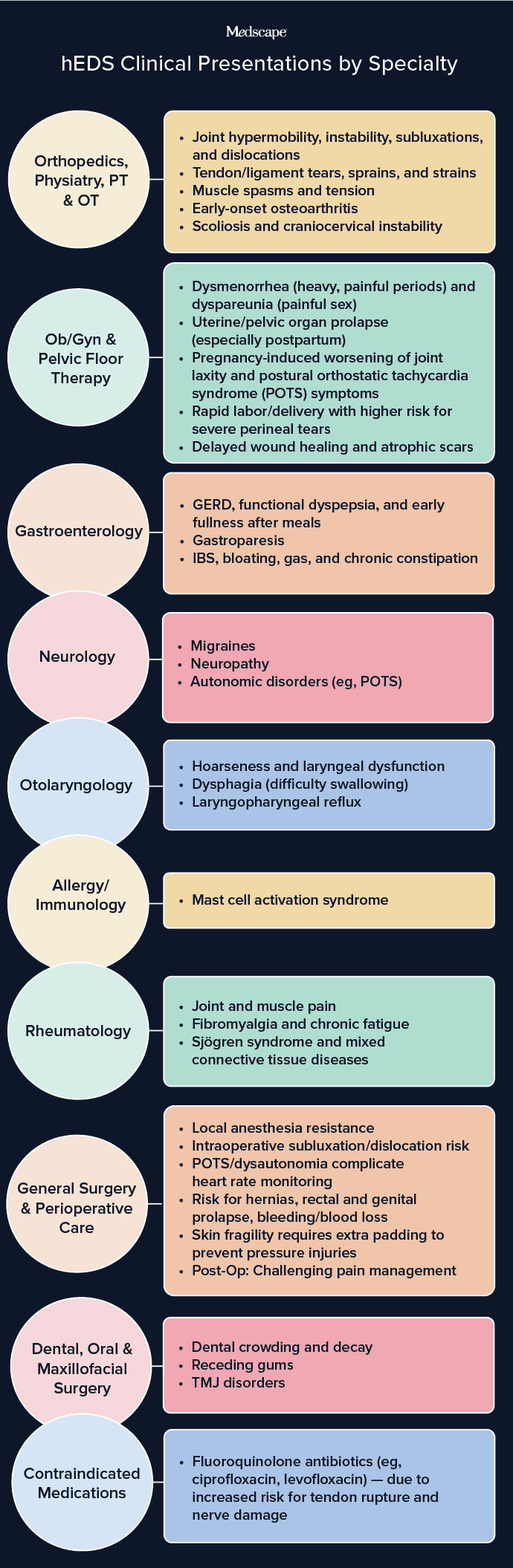
Among the long list of symptoms are those that certain specialists are more likely to recognize. (Which symptoms are you most likely to see in your practice? See the graphic at the end of this article to find out.)
Gastroenterologists In the Dark
Up to 98% of people with hEDS have GI symptoms. They’re typically diagnosed with IBS, heartburn, diarrhea, constipation, or gastroparesis. “Gastroenterological complications in patients with hEDS are potentially the most severe and can be fatal in some cases, usually because of a cascade of malnutrition that gets worse,” said Knight.
In serious cases, they may need a feeding tube or may become susceptible to infections such as small intestinal bacterial overgrowth.
Last year, the American Gastroenterological Association (AGA) published practice updates recommending that clinicians seeing patients with disorders of gut-brain interactions such as IBS should ask about joint hypermobility and strongly consider using a hEDS screening tool.
In some cases, MCAS, which is common in people with hEDS, can also drive GI symptoms. “Doctors are often wanting to do scopes, looking for structural problems, and a lot of times they’re not looking at mast cells,” said Bluestein.
The AGA guidelines recommend testing for MCAS if patients have symptoms that involve two or more other systems (chronic pain, sweating, allergic reactions, tachycardia, abdominal cramping, nausea, diarrhea, or urogynecologic or neurologic complaints). Most people with hEDS would qualify.
Orthopedic Surgeons Play Whack-a-Mole
Having hEDS increases the risk for musculoskeletal injuries, such as subluxations, dislocations, tendon tears, sprains, and spinal issues. These patients tend to be seen frequently by orthopedic specialists and have a high rate of surgeries, particularly for joint stabilization. Yet orthopedic surgeons are often not aware of the potential surgical complications or poor outcomes patients with hEDS may experience, said Bluestein.
Sometimes larger musculoskeletal issues need to be addressed first.
Bluestein calls it the whack-a-mole phenomenon. “If underlying contributors such as joint instability, inflammation, mast cell activation, or muscle dysfunction are not also addressed, new symptoms or new structural problems may emerge elsewhere,” she said. “The result can be a cycle of one procedure leading to another, without achieving the overall improvement the patient was hoping for.”
Another issue is slow wound healing. Atypical connective tissue can slow healing — both internally and on the surface. Recovery may be longer and less successful. In patients with MCAS — estimated at around 25% of those with HSD or hEDS — stitches can be rejected outright, leading to open wounds and elevated infection risk.
“I hear stories of slow wound healing all the time from my hEDS patients,” said Knight. “They say that their surgeon said that they’d never seen this before, across multiple surgical specialties. They’re just perplexed by this.”
Dentists See Poor Responses to Lidocaine
The dentist’s office may be one of the earliest points of care where an hEDS diagnosis is missed. Local anesthetics often don’t work as effectively because of atypical connective tissue. A double dose or more of local anesthetic is sometimes needed, said Knight. “I don’t think dentists know about this, and unfortunately, patients find out the hard way.” That typically means enduring pain during routine procedures and having to ask for more numbing.
Bluestein, who was trained as an anesthesiologist, never encountered training in how to deal with people with connective tissue disorders. “When I was working as an anesthesiologist, if somebody said the local anesthetic didn’t work, I thought, well, you must be crazy,” she said.
Physical Medicine Clinicians Push Too Hard
Any providers performing physical therapy or body movement work — physiatrists, physical therapists, sports medicine and orthopedic doctors, doctors of osteopathy, chiropractors, and massage therapists — need to understand how hEDS affects the musculoskeletal system, said Knight.
The levels of stretching, strengthening, manipulating, or massaging appropriate for the general population can hurt someone with hypermobile joints. “Physical therapy can be damaging if it’s not done correctly,” said Knight. A stretch can hyperextend a joint. Muscles tend to be tighter because they’re working harder to support loose joints. But if they’re loosened too aggressively, it can cause a joint dislocation or trigger muscle spasms elsewhere.
Bluestein learned this firsthand when she saw a chiropractor for her back pain. “He did a very forceful manipulation, and that night I almost went to the ER [emergency room]. I was in such excruciating pain, and it did set me back for a little while,” she said.
Whether strengthening joints or doing rehabilitation after surgery, people with hEDS benefit from a slower, more gradual approach, building muscle support for unstable joints rather than pushing through pain or loading too fast. “You have to do it in a graded fashion very carefully,” said Knight.
Amalie Paar, 21, a student at the University of Virginia, experienced unnecessary pain from an aggressive approach. She had chronic pain most of her childhood and adolescence, and at 14, she was sent to a children’s pain and rehabilitation program that emphasized conditioning the body and mind to work through pain. “I remember asking when I was doing [physical therapy], ‘Is it normal that you’ve had to put my hips back into place every morning?’ and they said yes,” she recalled. Paar had undiagnosed HSD. She now has posttraumatic stress disorder, which she attributes to the pain and humiliation she endured there.
Filling the Knowledge Gap
Experts treating people with hEDS are pushing for better education in medical school and residencies so that clinicians learn to recognize signs. The forthcoming guidelines may help but only if clinicians use them.
“There’s not really a lot of endorsement by other medical societies and organizations, so you can make fabulous criteria, but if physicians aren’t adopting that and using it, it’s not going to help,” said Gensemer.
A 5-point questionnaire has been developed as a basic screening tool that any clinician can use, though it may change with new broader diagnostic criteria. It starts with primary care screening and educating, said Knight. “We hope that one day, through enough education and resources, that primary care can make these diagnoses and get patients started on treatment.”
Knight reported having a consulting role and advisory role with three companies, namely, Vindara Health, ChronicleBio, and EDS Connective. Gensemer and Bluestein reported no disclosures.


