

 Admin_Adham
Emergencies happen anywhere, anytime, and sometimes medical professionals find themselves in situations where they are the only ones who can help. Is There a Doctor in the House? is a Medscape Medical News series telling these stories.

It was a warm day, and we had the windows open, so I heard the screams as soon as they started.
I’d just moved to Decimomannu, a historic town in Sardinia, Italy. I’m a second-year anesthesiology resident and had finished a night shift at the emergency medical service, similar to an urgent care clinic, in San Giovanni Suergiu, about 70 km away. I got home in the early morning.
It was a Saturday, typically the day when I go shopping and run errands. Around 9:00 AM, I was waiting for my partner to finish getting ready to go out when the screams began.
It sounded like an argument. My house is right near the central square of Decimomannu, next to the church, and the village is very quiet, but these kinds of arguments happen once in a while. Out of curiosity, I looked out the window and saw a bizarre scene. A woman was running toward the square. People were chasing after her, including a man in a garbage truck, who drove straight across the square.
At first, I thought someone was being physically attacked, and people were running to intervene. Or, it could be a dogfight, which also happens here, and everyone was trying to separate them. Then I realized someone might be ill. Maybe someone had fainted or was having a heart attack. I ran outside.
A woman was lying on the ground in front of the church door with a small crowd gathered around her. She was clearly in pain, agitated, and screaming. When I reached them, I could see she was wearing summer clothing: shorts and a short-sleeved top. Her skin was covered in red welts. They were all over her legs, arms, and face. A medium-sized short-haired dog was sitting next to her and whimpering.
The woman kept screaming, “Take care of my dog! He was stung! Don’t let him die!”
It hit me: The welts were wasp stings. About 50 m away from my place and the square, there’s a large olive grove. It belongs to a local landowner, but he generously keeps it open to the public, and it’s where everyone walks their dogs. I have two, and it’s a nice place to let them run free. High up in the olive trees, we often see wasps’ nests. She must have been walking her dog in the olive grove and been attacked by wasps.
I asked if anyone knew what had happened, and people confirmed they had seen her surrounded by a swarm of wasps. Someone told me they had already called for an ambulance. My training kicked in, and everything I needed to do just popped into my head.
The woman was alert and able to speak. I took her pulse to see if she was tachycardic, and it was weak. I checked if she was dyspneic or if there was laryngeal stridor. She was slightly short of breath.
I was worried about the angioedema on her face. Her eyes and lips were swelling up even though she hadn’t been stung in those areas. She could be going into anaphylactic shock.
At that point, I decided to leave the woman with the people there and rush home to get some supplies. I have a bag with a blood pressure cuff, a stethoscope, a pulse oximeter, an intravenous (IV) kit, and some basic drugs. And I always keep adrenaline in the fridge. I bring it in a cooler if I’m going to the beach or on a picnic with friends. You never know when someone might have an allergic reaction, and it’s a really simple thing that can save a life.
When I got back, I took the woman’s blood pressure and oxygen saturation. She had slight hypotension and tachycardia. I started an IV and gave her betamethasone and an antihistamine. One of the women there helped by holding the IV bag up high.
I was relieved when the welts on her skin from the stings began to subside. But I knew the woman was still in danger. I stayed next to her with the adrenaline shot ready in case her breathing and hypotension worsened. I knew if she went downhill, I might have to repeat the shot more than once. She could also go into cardiac arrest, which happens with anaphylactic shock, and I would have to start cardiopulmonary resuscitation.
I kept thinking about a 4-year-old whom I had treated at the urgent care a few months earlier. A man came in at 3:00 AM with his child and said in a very calm voice, “My son is having trouble breathing.” The boy was making a stridorous sound, which can be extremely serious. I knew I needed to give him adrenaline, but if that doesn’t work, you have to start thinking about a cricothyroidotomy. For anesthesiologists, it’s the last resort and might happen once in a lifetime.
But I had not yet been trained to do it.
I couldn’t help thinking about that in the moment, what I’d actually experienced — treating that boy — vs what I didn’t yet know how to do. I gave the child sublingual betamethasone and adrenaline in aerosol form, because fortunately I had a pediatric mask. I waited, just praying that he would stabilize. And thankfully, he stabilized.
This woman’s condition seemed less serious. But she was still very agitated and crying. She seemed much more worried about her dog than herself and kept asking if he was okay. I gave her some Xanax, which I had in my emergency bag, to calm her down. Then I called a family friend who is a veterinarian.
The dog was lying quietly in the arms of one of the bystanders. He had been stung but seemed okay. My friend asked if his body was swollen, but I didn’t think so. Most drugs for human use will work for animals, so my friend told me I could give him a dose of cortisone. But I really didn’t think it was necessary.
So, I lied. I told the woman I had given the dog a cortisone shot, and this calmed her down even more than the Xanax.
There were only a few people still with us by then. Meanwhile, people were walking around the square as if nothing was going on, which was weird and made me a little sad. I’m not saying you have to stop and stay there, but at least ask if you can do something, you know?
It seemed like forever, but it must have been about 20 minutes later when the ambulance arrived. It was a type of ambulance with a nurse who was trained to handle emergency situations. She was probably more experienced than I am, and it was a huge relief to have her there and all the equipment in case the woman needed to be intubated.
The ambulance took her to the hospital, where they kept her under observation for a couple of hours, and then she was discharged. A few weeks later, she sent me a message on Facebook to say thank you. Though it’s a small town, I haven’t seen her. It’s likely that I won’t run into her in the olive grove.
I definitely consider myself a fairly clear-headed person. But it’s a lot easier to be clear-headed in the emergency clinic with a team around me and all the equipment I could need. That’s why I keep basic equipment in my bag, even the adrenaline. It’s scary when you realize that the guidelines say one thing, but in a situation like this, where you’re on your own, you just have to act while all the worst-case scenarios are running through your head.
That’s why I took the cricothyroidotomy course a few days ago. Just in case.
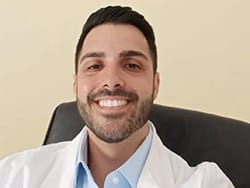
Andrea Carta, MD, is in his second year of specialty training in anesthesia, resuscitation, and intensive pain therapy at the Monserrato Polyclinic of the University of Cagliari, Sardinia. He currently works at the Santissima Trinità Hospital in Cagliari.
Are you a medical professional with a dramatic story outside the clinic? Medscape Medical News would love to consider your story for Is There a Doctor in the House? Please email your contact information and a short summary to access@webmd.net.
Read more in the series:
Nightmare In-Flight Crisis Forces Desperate Treatment Choice
Subway Car Severs a Man’s Leg and a Lone EMT Must Help
