

 Admin_Adham
 Jump to Key Points
The result arrives flagged in the portal: urine oxalate. The patient, 46, with no history of kidney stones, has already found an explanation online. She has a list of foods to cut, from spinach to almonds, and a warning that she may feel worse for a while as stored oxalate “dumps” from her body.
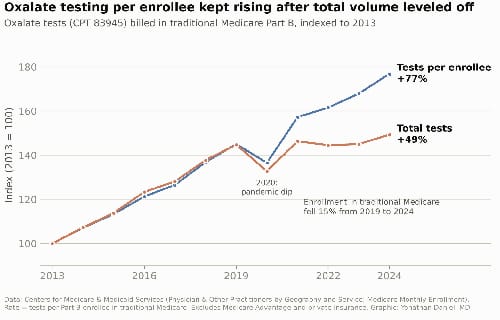
Is this a trend? Medicare claims suggest testing for oxalate is growing. In traditional Medicare, billed tests for oxalate, or oxalic acid, rose from about 46,800 in 2013 to about 69,900 in 2024, a 49% increase, according to data from the Centers for Medicare & Medicaid Services (CMS). Raw volume has been roughly flat since 2019, but the pool of patients behind it shrank: Part B enrollment in traditional Medicare fell about 15% from 2019 to 2024 as beneficiaries moved to Medicare Advantage, CMS enrollment data show. The testing rate rose from about 1.4 tests per 1000 traditional Medicare Part B enrollees in 2013 to two in 2019 and 2.5 in 2024. The figures exclude Medicare Advantage and private insurance.
Check the Test First
Start by asking whether the right oxalate was measured. “People without kidney stones typically do not get urine oxalate results,” said David Goldfarb, MD, professor of medicine and physiology at NYU Grossman School of Medicine and clinical chief of nephrology at NYU Langone Health, both in New York City. Measured urine oxalate comes from a 24-hour collection ordered to work up stones, he said.

More often, he said, a routine urinalysis reports calcium oxalate crystals. That is “a frequent and unremarkable result in a patient with no history of stones,” Goldfarb said. Many people’s urine is supersaturated, especially with heat or exercise, and crystals alone don’t mean disease. “My advice is to fuggedaboudit!”
- Confirm test type: routine UA crystals ≠ 24-h urine oxalate.
- Adult reference ranges vary by lab; 35 mg/d may be normal or high.
- No stones/CKD/bowel disease: evidence for isolated hyperoxaluria is lacking.
- History should screen for vitamin C, supplements, bariatric/IBD, kidney function.
- Management: fluids, normal calcium with meals; avoid routine low-oxalate diet.
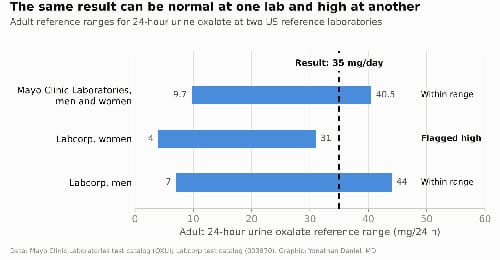
If urine oxalate was measured, check whether it was a spot test or a 24-hour collection. Mayo Clinic Laboratories offers a random urine oxalate only for patients younger than 16 years, with no adult reference range. Adult ranges differ by lab: Mayo uses 9.7-40.5 mg/day for both sexes, while Labcorp uses 4-31 mg/day for women and 7-44 mg/day for men. A woman excreting 35 mg per day is high at one lab and normal at the other. Mayo asks patients to avoid more than 2 g per day of vitamin C before and during collection because the substance can falsely raise results.
Some results come from urine panels sold by functional medicine clinics and labs. Goldfarb called using them to judge oxalate “very nonevidence-based.” One such lab, Mosaic Diagnostics, says on its website that “low oxalate values do not rule out an oxalate issue” and advises cutting oxalate slowly to avoid “an increase in pain as a result of ‘oxalate dumping.’”
Melanie Betz, MS, RD, a renal dietitian and founder and CEO of The Kidney Dietitian, in Chicago, has called oxalate dumping a “false phenomenon.” Mosaic did not respond to a request for comment.
Take a History
No guideline or outcome study addresses high urine oxalate in an adult without stones, kidney disease, or bowel disease. The 2026 American Urological Association (AUA) guideline covers patients with a history of stones. For everyone else, the history has two jobs: find a cause that can be stopped and find the patient who belongs in a higher-risk group.

Start with what the patient is taking. The AUA advises asking stone formers with high urine oxalate about vitamin C, herbal supplements, and plant extracts. Betz adds collagen, green “superfood” powders, turmeric, and cinnamon. The evidence that supplements matter is small but consistent. In a controlled feeding study, 30 g of gelatin, a collagen product, raised urinary oxalate 43% compared with the same amount of whey protein. In a 35-patient series at one academic center, supplements were implicated in 44% of cases of oxalate nephropathy from 2020 to early 2022, up from none in 2018 and 2019; eight of nine patients for whom the causative agent was identified improved once they stopped taking the substance.
Then ask what the patient eats alongside the oxalate. “I would first want to know what their current calcium intake is,” Betz said. Calcium in the same meal binds oxalate in the gut and keeps it from being absorbed, Goldfarb said.
Last, ask the questions that change the workup: a personal or family history of stones, bariatric or bowel surgery, inflammatory bowel disease, and kidney function. Those answers sort patients into the groups below.
When to Look Further
Stone formers. The AUA recommends a metabolic evaluation, including stone analysis and 24-hour urine testing, for adults at increased risk for forming stones and for motivated first-time stone formers. The guideline treats more than 75 mg per day in an adult without bowel disease as grounds to suspect primary hyperoxaluria; no single cutoff is diagnostic, and genetic testing confirms it. Two RNA interference drugs, lumasiran and nedosiran, are approved for primary hyperoxaluria.
Malabsorption. Unabsorbed fat binds calcium in the gut, leaving oxalate free to be absorbed. Among 58 patients without stones who underwent bariatric surgery, 74% had urine oxalate above 45 mg per day in at least one of two collections, but only 52% did in both, a sign of how much results vary from day to day. Goldfarb considers Roux-en-Y gastric bypass the most worrisome. Patients with inflammatory bowel disease are also at risk, he said.
Unexplained kidney injury. Oxalate nephropathy accounted for about 1% of 2265 native kidney biopsies in a Belgian series and is often found late: In one series, 21 of 26 patients required dialysis. High oxalate is unusual in unexplained chronic kidney disease (CKD), Goldfarb said. In patients without stones, the sequence usually runs in reverse: A biopsy shows calcium oxalate crystals, and the 24-hour urine follows to find the cause.
Existing CKD. In the Chronic Renal Insufficiency Cohort, adults with stage 2-4 CKD in the top fifth of urine oxalate (27.8 mg/d or more, a level most labs call normal) had a 45% higher risk for kidney failure than those in the bottom fifth. The link is observational and applies only to people with CKD.
What to Tell Patients
For a confirmed high result, the advice borrows from stone prevention, and much of it runs counter to what patients may find online.
Fluids. Enough to produce at least 2.5 L of urine a day.
Calcium, with the meal. Keep intake normal and eat calcium-rich foods with high-oxalate meals. The 2014 AUA guideline told patients with high urine oxalate to limit oxalate-rich foods; the 2026 version leads with calcium, a recommendation it grades as expert opinion, its lowest tier. Goldfarb said calcium in the same meal “may be more effective in lowering urinary oxalate” than cutting foods.
Betz said she recommends one serving of dairy or a calcium-fortified substitute with each meal. “In my experience, we can get high urine oxalate down about 90% of the time with adequate calcium from food timed with meals and snacks,” she said, especially in patients without enteric hyperoxaluria. Food is generally better than supplements, she added, although the latter can help when urine calcium is not elevated, which she sees most often with enteric hyperoxaluria.
Limit vitamin C supplements, not vitamin C from food. In the Health Professionals Follow-up Study, men taking 1000 mg per day or more in supplements had a 19% higher risk for kidney stones than men who took no vitamin C supplements. Men whose total intake from food and supplements reached that level had a 43% higher risk than those getting less than 90 mg per day. But vitamin C from food showed no association, and women in the companion Nurses’ Health Studies showed none either.
“I tell people that vitamin C has only one purpose: prevents scurvy,” Goldfarb said. For patients who insist on taking it, he accepts 500 mg per day. Betz is stricter: She stops vitamin C supplements for anyone with calcium oxalate stones or high urine oxalate. Neither limit comes from trial data.
Not a blanket low-oxalate diet. Betz advises against the diet for most patients with high urine oxalate. It is “highly restrictive, difficult to follow, and makes it nearly impossible to get in enough fiber, fruits, veggies, and plant proteins,” she said, and “there simply isn’t any data linking lower oxalate diets with the hard outcome of stone recurrence or formation.” She limits only foods that are very rich in oxalate, such as spinach, rhubarb, and beets, and only when urine oxalate stays high despite enough calcium.
The patient in the portal came in with a list of foods to give up. She needs a shorter list first: which test she took, which lab processed it, and what supplements or foods she’s taking. Once those are answered, the advice is often the reverse of what she read: Keep the spinach — and put the vitamin C back on the shelf.
Goldfarb has a proprietary interest in Moonstone Stone Stopper, a high-citrate beverage for stone prevention whose patent is held by NYU, Massachusetts General Hospital, and the University of California, San Francisco. He also reported being a consultant for Alnylam and Novo Nordisk, both of which have an interest in primary hyperoxaluria. He reported being the second author of the 2014 AUA guideline and did not take part in the 2026 update because of the Moonstone interest.
Yonathan Daniel, MD, is a third-year internal medicine resident at NYU Grossman School of Medicine and a graduate of Brown University in Providence, Rhode Island. He enjoys medical journalism and has previously contributed to the ABC News Medical Unit.



